Not long ago I was interviewed on a "news-talk" radio show. The host was a particularly venomous anti-Christian, with a long history of ridiculing Christianity on his show. Evidently he particularly likes to ridicule creationism.
His introductory comment was, "You're one of those idiots who believes the earth is only six-thousand years old. Tell me one thing. How did Noah get all those millions of dinosaurs onboard Noah's Ark?"
I asked if he knew how many dinosaurs there were. He didn't, but he knew there were too many to get on the Ark. When I explained that only about 600 species of dinosaurs had ever been named, that many species had been named from only a piece of one bone, that many of the species were probably of the same "kind," that many dinosaurs were small, that God wouldn't have brought the largest specimens to Noah, and that, in my opinion, there were probably only around 100 dinosaurs onboard the Ark, with an average size of a cow, he changed his tune. But he still knew the story was ridiculous.
Then he included all the animals—fish, whales, clams, etc.—along with the land animals. I explained that the Bible clearly teaches that it was only those "in whose nostrils was the breath of life, of all that was in the dry land" (Genesis 7:22) that were present on the Ark, and that, although marine animals died by the trillions in the Flood, at least representatives of each kind" would have survived. I further speculated that insects might not have been on board, since they don't breathe air. They absorb oxygen through abdominal membranes. They could have survived, particularly in their egg and larvae states, on floating plant debris. Actually, they would be needed worldwide as the Flood ended, to help seeds and sprigs re-germinate and flourish once again.
Restricted to only land animals and birds, this host still insisted they couldn't fit on the Ark. I asked how many there were? He didn't know, "but they couldn't fit!" I asked if he knew the size of the Ark. He didn't, "but it wasn't big enough!"
Now, this was an amazing admission. According to him, an unknown number of animals couldn't fit onto a boat of unknown size!
Let us honestly ask the same question: How many animals were there and how big was the Ark? Could they fit?
The total number of land-dwelling mammals birds, reptiles, and amphibian species is less than 20,000 or so. The number of "kinds," the Biblical designation, is probably much smaller. For instance, of the 9,000 bird species, approximately 400 are hummingbirds, with only minor differences in color, size, and habitat. Very likely, they all come from only one or a few kinds, thereby dropping the total number.
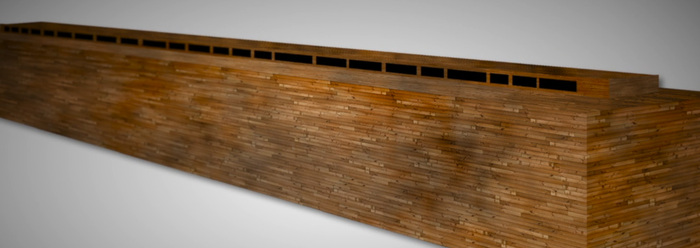
The Ark itself was huge! With gross dimensions of about 450 feet by 75 feet by 45 feet, its volume was easily able to house two (or in some cases seven) of each land species, let alone kinds. The trip may have been difficult for Noah and his family, but it was possible, with God's help.
And so it is with us. With God's help, even the tough questions have answers. We only need to study and believe.
* Dr. John Morris is the President of ICR.
Cite this article: Morris, J. 1992. How Could All the Animals Get On Board Noah's Ark? Acts & Facts. 21 (3).