“I beheld the earth, and, lo, it was without form, and void; and the heavens, and they had no light.” (Jeremiah 4:23)
The language in this verse is clearly patterned after Genesis 1:2, the description of the primordial earth: “And the earth was without form, and void; and darkness was upon the face of the deep.” That it is a metaphor, however, and not an actual reference to that primordial earth is evident from its context. The previous verse speaks of “my people” (that is, the people of Judah) and the following verse of “the mountains” (there were no mountains as yet at the time of Genesis 1:2).
Furthermore, the broader context makes it plain that the prophet is speaking of a coming judgment on the land of Judah because of the rebellion of its people against their God (verse 16 specifically mentions Judah, and verse 31 mentions Zion). The land is to be so devastated that the prophet compared its future appearance to the unformed and barren earth at its very beginning.
This ultimate fulfillment will be at Armageddon. The same Hebrew words (tohu for “without form,” and bohu for “void”) occur again in this context in an awesome scene of judgment described by Isaiah: “For the indignation of the LORD is upon all nations” (34:2), gathered together in the former land of Edom to fight against Jerusalem when Christ returns, “and he shall stretch out upon it the line of confusion [i.e., tohu], and the stones of emptiness [i.e., bohu]” (34:11). Instead of the regular surveyor’s line and markers ordering the property boundaries, God’s judgment will bring such disorder and barrenness to the land that it almost will seem to revert back to its primeval state at the beginning of time. “Nevertheless we . . . look for new heavens and a new earth” (2 Peter 3:13), and that earth will be beautiful and bountiful with “no night there” (Revelation 22:5). HMM

Without Form and Void
More Creation Was 24/6 and Recent
A Journey to the Truth of Creation
I recently had lunch with the chief academic officer of a local Christian university. As we connected over our meal, I could see his excitement about...
Old-Earth Creationism
Many evangelical leaders today, unfortunately, have capitulated to the evolutionary time-scale of modern unbelieving geologists and astronomers. They feel...

Is Belief in the Young Earth Necessary to Be a Christian?
At our seminars and in our books, we at the Institute for Creation Research take a strong stand on the young earth. We certainly don't do this to...
More Creation Q&A

Where Did Faces Come From?
Animals don’t laugh, smirk, roll their eyes, or give subtle squints like humans do. Hundreds of different tiny facial expressions can convey our...

Does Biblical Creation Help Us Glorify God?
How well do you glorify God? Robbing God of glory is serious, as illustrated in this brief account in the book of Acts: “So, on a set day Herod,...

Do We See Complex Design in Mosquito Eggs?
Mosquitoes hatch from tiny eggs and spend a few days filter-feeding on things like bacteria, pollen, and algae. They molt three times as they grow,...
The Latest
Life Can Rebound “Ridiculously Fast”
In the beginning, God created plants and animals to multiply and fill the earth (Genesis 1:11–13, 20–25). So, when areas are devastated,...
Under the Alerce Trees: A Hidden Fungal Ecosystem
Some of the oldest living trees on Earth are in the temperate rainforests of the Chilean Coast Range. Second only to the bristlecone pine in age, these...
God’s Architecture: The Hidden Biology in a Paris Icon
In 1889, Paris hosted the Exposition Universelle, a world’s fair celebrating the hundredth anniversary of the French Revolution. To mark the occasion,...
Chemical Clues Raise Questions About Early Animals
What if a simple sea sponge could spark a debate about the origin of animal life? A recent study suggests that some of Earth’s earliest animals...
Alive with Christ
“Now if we be dead with Christ, we believe that we shall also live with him: knowing that Christ being raised from the dead dieth no more; death...
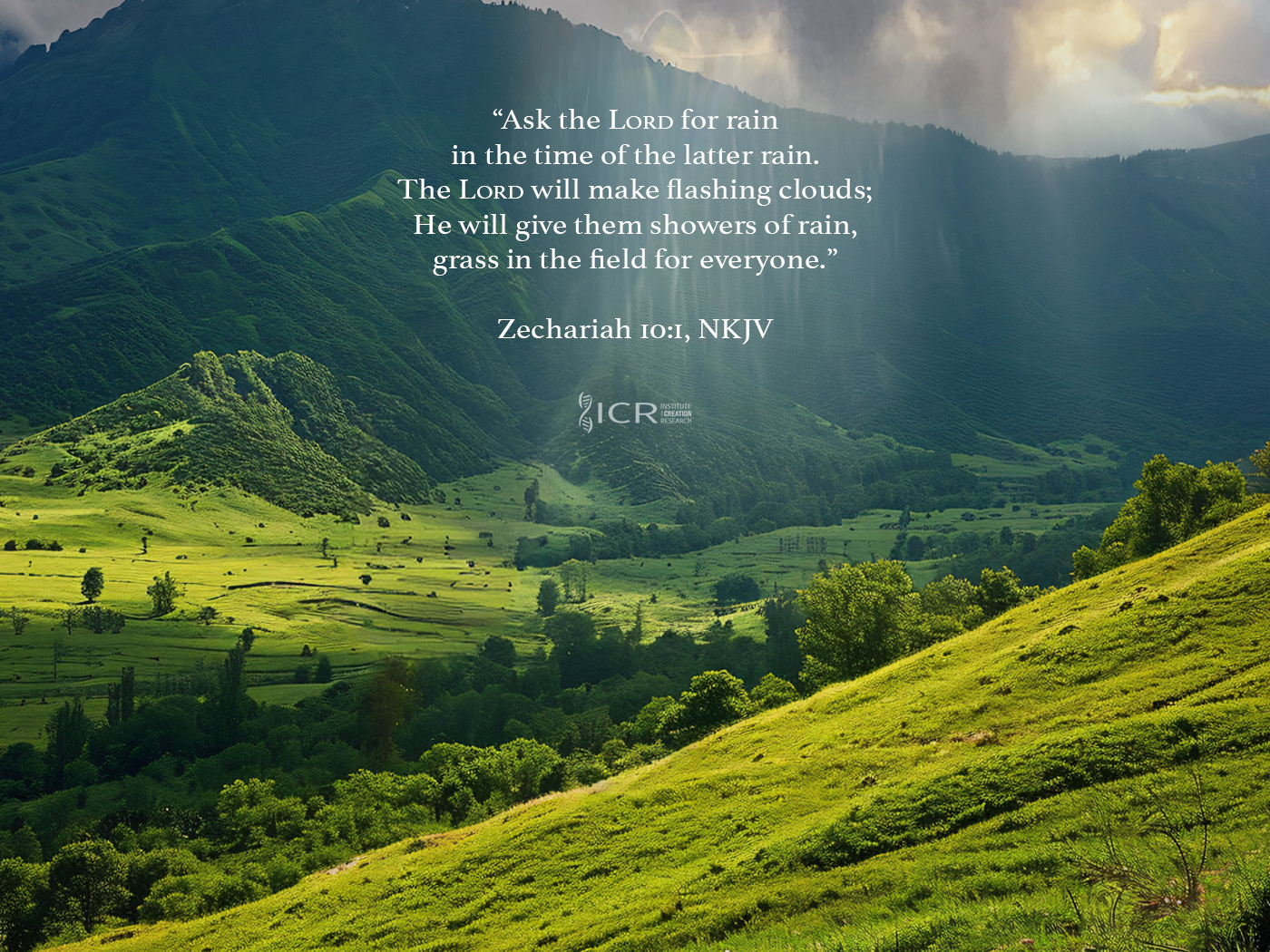
April 2026 Wallpaper
"Ask the Lord for rain in the time of the latter rain. The Lord will make flashing clouds; He will give them showers of rain, Grass in the field...
Does Earth Have a Twin?
A possible Earth-like planet 146 light-years away has recently been discovered by citizen scientists.1 The evolutionary community is cautiously...

CREATION PODCAST
Christian PhDs: 5 New Discoveries That Have Atheists SCRAMBLING
From the depths of outer space to the microscopic strands of our DNA, recent scientific discoveries are telling a story secular scientists are scrambling...
Giant Virus, Big Claims: Does Ushikuvirus Explain Complex Life?
A newly discovered giant virus called ushikuvirus has been described by conventional scientists as a possible clue to how complex cells evolved. But...
Conventional Science Still Struggling to Exhume the Great Unconformity
The book of Genesis tells us about a global flood that occurred about 4,500 years ago, an event that began with the bursting of the fountains of the...
Shop Related Products