The rapture of seeing Saturn's rings in a telescope for the first time has been enough to inspire many young people to become astronomers. Galileo called them a "most extraordinary marvel." In today's age of planetary reconnaissance, we now have close-up data and pictures beyond his imagination. Sadly, there seems to be more interest today in rescuing the rings' "billions of years" timescale than in understanding them.
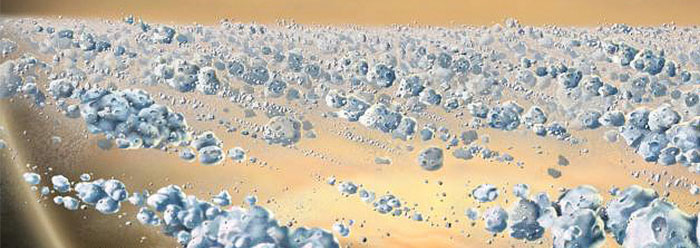
All the gas giants (Jupiter, Saturn, Uranus, and Neptune) have rings made up of separately-orbiting objects. Saturn's rings, the most spectacular, are divided into regions that are labeled outwardly with the letters D, C, B, A, F, G, and E. Some rings (Saturn's E, Jupiter's rings) are composed primarily of smoke-sized particles.1 The brightest rings contain snowball to house-sized objects. Saturn's rings mostly consist of water ice, with some contamination from carbonaceous and silicate "dirt."
The 1981 Voyager flybys astonished scientists with images of hundreds of individual ringlets and gaps. Resonances (periodic alignments) were known to create some of the ringlets and sharp edges, but there was far more dynamism and structure than expected, leading specialists at the time to conclude that the rings were young rather than primordial (i.e., formed along with Saturn). Upper limits were put at ~100 million years, only 2.2 percent of the assumed age of the solar system (4.5 billion years).2
In addition, scientists soon realized that numerous destructive forces were at work: plasma drag from Saturn's atmosphere, sunlight pressure, collisional spreading, meteorite impacts, and sputtering (collisions at the atomic level). The smaller the particles, the more quickly they would be destroyed. To support a continued belief in Saturn’s ancient age, scientists had to propose ad hoc "rescuing devices" like the breakup of a wandering moon 100 million years ago--a highly unlikely happenstance.3
Four years of Cassini observations of Saturn's rings from multiple angles and distances, using a dozen instruments, have led to new discoveries. Radio receivers have heard "tones" coming from the rings as a result of meteor impacts. Self-gravity among the particles appears to cause ongoing cycles of clumping and dispersion; this implies the particle surfaces are "fluffy" rather than hard. Adjacent ringlets vary substantially in amounts of contaminants or "dirt" in them. The Encke and Keeler Gaps both contain small moonlets that perturb the edges of the rings as they pass by.
What do these observations imply? Everything still looks young. One leading ring scientist, however, recently proposed that the B-ring might be as old as Saturn after all. Continuous cycles of clumping and dispersion, he said, might make them recycle themselves endlessly.3 But this fails to address the many other disruptive forces eroding the rings, and also does not explain their brightness. At best, the theory increases their potential age into the billion-year range--still far short of 4.5 billion.
The ages of other rings cannot be rescued so easily. A recent paper on the F-ring indicated that collisions among embedded moonlets and disturbances by passing shepherd moons create structures that vary on timescales of days or hours. "It is difficult to understand how the observed ~1 km-wide ring component seen in some of the highest resolution images can survive in such a chaotic environment," the report's authors said.4 Yet it does. And the F-ring is bright--another indication of youth.
As with so many phenomena in the solar system, Saturn's rings look young. Estimates of old age survive only in the minds of scientists who are committed to a belief that requires vast periods of time. When the evidence threatens to drown these assumptions, they toss out the ring buoy of ad hoc speculation. Good theories should float on their own.
References
- The little moon Enceladus, with its south-pole geysers, creates the E-ring; see my article "Enceladus: A Cold, Youthful Moon" in the November 2006 edition of Acts & Facts.
- For instance, see Joseph A. Burns, "Planetary Rings," The New Solar System, 4th ed. (Cambridge, MA: Sky Publishing, 1999), p. 240: "If all this is accepted at face value, then planetary rings must indeed be young: typical estimates are a few hundreds of millions of years…. If catastrophic events have become less likely over time, how can the rings have had a recent origin? Perhaps our models are wrong or incomplete--explanations equally unpalatable to those of us who contrive them!"
- Saturn's Rings May be Old Timers. Jet Propulsion Laboratory press release, posted online December 12, 2007.
- Murray, C. et al. 2008. The determination of the structure of Saturn's F ring by nearby moonlets. Nature. 453: 739-744.
* David Coppedge works in the Cassini Program at the Jet Propulsion Laboratory. The views expressed are his own.
Cite this article: Coppedge, D. 2008. Rescuing Ring Ages. Acts & Facts. 37 (10): 15.