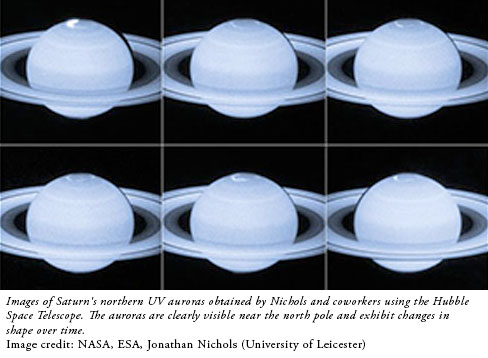
Over a million people have viewed the NASA video "Walking On Air," which features stunning arctic and Antarctic auroras photographed from the International Space Station.1 They look like glowing green metallic clouds swirling high above broad stretches of Earth's poles. New evidence confirms that, like Earth, Saturn's magnetic field helps create its own auroras. This space spectacle attracts a more fundamental question about where its magnetic field came from in the first place.
Though Saturn is incredibly distant, the Hubble telescope was able to record its auroras in unprecedented detail. It is now clear that Saturn's auroras, best seen in ultraviolet (UV) wavelengths, form when solar outbursts collapse its "magnetotail," the portion of its magnetic field and attending electrified gas that flows in the planet's wake.
A Leicester University News Release noted that the collaborating scientists will publish their photographic results in Geophysical Research Letters. It stated that Saturn's collection of newly captured dramatic light displays "smoking gun" evidence that confirms a magnetic field at the source.2
 Magnetic fields can be created by running electrical current through copper coils, but it fades as soon as the battery runs down. Certain types of metals can store a magnetic field for a time, as in a bar magnet. But even these long-lasting magnetic fields decay over time. What about Saturn?
The magnetic field of Saturn decreases slowly enough to persist for several thousand years. But if the planet were billions of years old, as secularists allege, then its magnetic field should have decayed to nothing long ago. Secular scientists have had a really tough time explaining all planetary magnetic fields, including Saturn's. They continually adjust various magnetic dynamo theories, but none yet proposed have succeeded in theoretically upholding the magnetic field strength over the billions of years since the planets supposedly formed.
Physicist Russell Humphreys recently described this long track record of dynamo model failures in the Proceedings of the Seventh International Conference on Creationism.3 He wrote, "In particular, the section above, ‘The heart of dynamo theory isn't beating,' offers quantitative reasons why the most viable form of dynamo theory appears to be dead."3
Dynamo theories that attempt to explain planetary magnetic fields posit metal-rich molten material swirling round and round deep inside a planet. Like the copper coils of a generator, this could induce an electrical current that would produce its magnetic field. "Turbulent dynamo theory" looks like the best candidate among them. However, Dr. Humphreys found that getting its formula to output a millions-of-years-long magnetic field requires inputting totally unrealistic values for one or more required factors.4
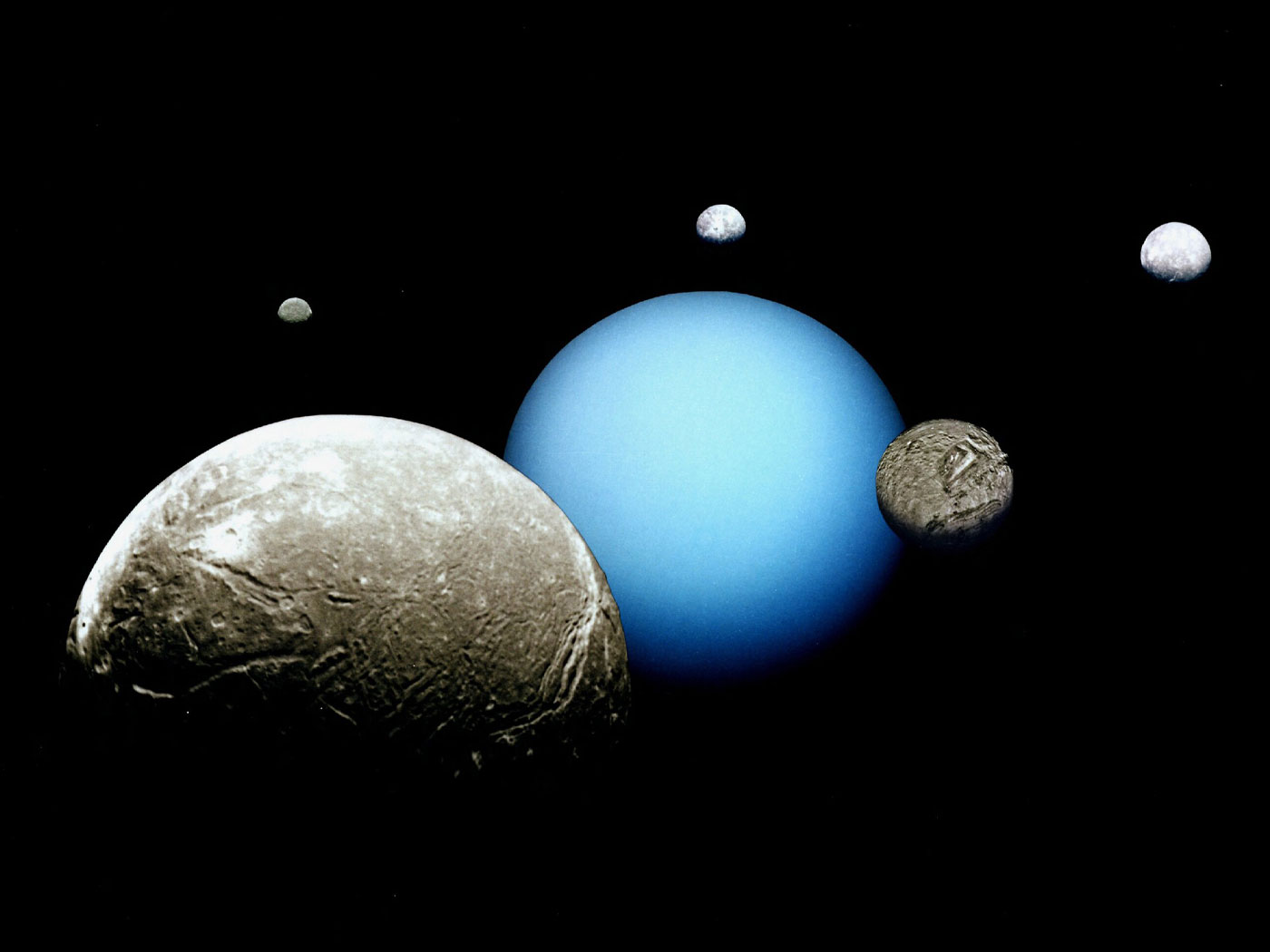
In 1984 Humphreys proposed an alternative magnetic model involving God aligning water molecules during the creation week. It accurately predicted the recently measured magnetic field strengths of Uranus, and Neptune, as well as the decay rate of Mercury's magnetic field.5
The same model accurately describes Saturn's present magnetic field strength. Saturn's magnetotail, emanating from a thousands-of-years old magnetic field, best explains its unique and spectacular auroras. In short, Saturn's newly confirmed magnetic field looks like a recent creation.
References
- Walking On Air. Nasa.gov Video. Published April 20, 2012 on youtube.com, accessed May 19, 2014.
- "Smoking gun" evidence for theory that Saturn's collapsing magnetic tail causes auroras. University of Leicester News Release, via AlphaGalileo. Posted on alphagalileo.org May 19, 2014, accessed May 20, 2014.
- Humphreys, D.R. 2013. Planetary Magnetic Dynamo Theories: A Century of Failure. Proceedings of the Seventh International Conference on Creationism. Pittsburgh, PA: Creation Science Fellowship.
- These factors include the mean-square velocity of eddies, the average toroidal field, and the mean lifetime of eddies in the core.
- Humphreys, D.R. 1984. The Creation of Planetary Magnetic Fields. Creation Research Society Quarterly. 21 (3).
* Mr. Thomas is Science Writer at the Institute for Creation Research.
Article posted on June 4, 2014.