


Introduction
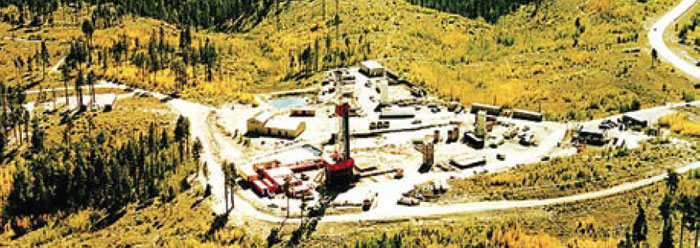
In the final report of ICR’s Radioisotopes and the Age of the Earth (RATE) project, Dr. Russell Humphreys reported that helium diffusion from zircons in borehole GT-2 at Fenton Hill, New Mexico, gave an age for the earth of 6,000 ± 2,000 years.1 This young age agrees with a literal reading of Scripture, but is at variance with the billions of years conventionally held. Gary Loechelt has been a frequent critic of Humphreys’ procedures for calculating the young age by helium diffusion.2 Humphreys has responded to Loechelt and other critics, demonstrating that their concerns were invalid and successfully defending his findings.
However, due to Loechelt’s persistent criticisms, Humphreys recently took a deeper look at one of the key papers on which his helium diffusion research was based, and he found some rather odd assumptions about local heating near the borehole.3 He concluded that some of the assumptions about the heating history of the borehole were made to avoid problems the authors of the paper (Harrison et al4) would otherwise have had with the diffusion of argon from the sample.
Humphreys decided to develop a second, independent method for estimating the age of the earth based on the diffusion of argon from feldspar in the same Fenton Hill borehole. The result was a slightly younger age for the earth than his earlier helium diffusion method.
A Brief Review of Diffusion
When radioactive isotopes decay in rock, various gases are produced as a byproduct. For example, uranium-238 in the rock decays to lead by alpha decay, producing alpha particles that combine with electrons to form helium. Potassium-40 decays directly to argon-40 by inverse beta decay and electron capture. The gases produced by radioactive decay are then free to move through the minerals in which they are imbedded and escape into the atmosphere.
However, the rate at which the gases can escape is highly dependent on the temperature of the minerals. For example, the rate of helium diffusion at the hot temperatures 15,000 feet below the surface is about 160 times faster than the rate at the cooler temperatures at 4,000 feet. Consequently, rock deep in the crust of the earth will be more depleted in helium than rock near the surface.
Humphreys was able to calculate the diffusivity, a measure of the rate of escape of helium from the zircons in the granite at Fenton Hill. Figure 1 displays observed and theoretical diffusivities for helium as a function of temperature. Note that temperature in degrees Celsius is hotter on the left side of the figure, so the diffusivity increases upward to the left. The diffusivity is plotted on a logarithmic scale and increases by a factor of 10 for each tick on the vertical axis.
There are five white data points shown on the red and green curves in the lower right portion of the figure. These are actual concentrations of helium measured from the Fenton Hill core used to compute diffusivity. The diffusivity for the red curve (the uniformitarian model) was computed by dividing the difference between the theoretical amount of helium produced over the conventional age of the rock and the measured amount remaining by the conventional 1.5-billion-year age of the rock.
The diffusivity for the green curve (the creation model) was computed by dividing the difference in helium concentration by 6,000 years. Note there is a factor of about 100,000 in diffusivity between the two curves. In other words, the rate at which helium diffuses from the rock must be many times slower for the uniformitarian model in order to explain the concentration of helium observed in the rock today.
 The RATE project obtained samples of granite from the Fenton Hill borehole and submitted them to one of the most widely respected helium laboratories for determination of helium diffusion rate as a function of temperature. Humphreys hypothesized before the laboratory work was completed that the results would fit the creation model rather than the uniformitarian model and support a young earth.5 Figure 1 clearly shows that his hypothesis was confirmed. The blue data from the laboratory experiments matched the green curve so well that Humphreys has said several times in his public lectures, “Never in my entire scientific career have I ever seen a numerical prediction verified so accurately.” Using the laboratory-measured diffusion rates, he was able to compute an estimated age of the earth and its uncertainties. The value was 6,000 ± 2,000 years.
The New Argon Results
The deep Precambrian granite “basement” rock from the Fenton Hill GT-2 borehole contained not only zircons from which helium diffusion rates could be determined, but also a potassium-bearing microcline feldspar containing argon-40 that could be used to estimate age. Harrison et al conducted argon-argon dating and diffusivity measurements on five feldspar samples.4 They were forced to assume recent heating of the rock in the borehole from a nearby volcano to explain the abundant release of argon evident in the samples.
 They rejected several of the samples from their full analysis because the diffusion rates resulted in a young earth. However, they reported the laboratory results on all five samples. Figure 2 shows their “Age Spectrum” for one of their rejected samples (sample 5) collected from the hottest temperature at a depth of 15,000 feet below the surface. It shows the conventional estimate for age as a function of the percent of argon released by heating experiments in the laboratory.
The peak of 1160 Ma in Figure 2 shows that over “one billion years’ worth” of potassium-40 to argon-40 decay occurred in situ. RATE hypothesized that this decay occurred during several episodes of accelerated nuclear decay in the past, the more recent during the year of the Genesis Flood.
RATE also hypothesized an accelerated cooling mechanism that would have gotten rid of much of the resulting radiogenic heat. Harrison et al had more confidence in the estimate of losses of argon in sample 5. Humphreys also believed that the age of sample 5, with a small adjustment in the percentage of argon loss, was more accurate and better-founded than the others.
Humphreys used the argon data from Figure 2 to compute the age of sample 5 to be 5,100+3,800 -2,100 years, where 5,100 years was his best estimate with the lowest age of 3,000 years and the oldest age of 8,900 years. Humphreys’ lower estimate of 3,000 years was the same as the estimate made by Harrison et al.4
Conclusions
Humphreys concluded that the observed high argon retentions shown in Figure 2 conflict severely with the uniformitarian-assumed long ages. These data say that the feldspar in the Fenton Hill borehole generated over a billion years’ worth of argon-40 and then retained it during a period of time that began only thousands of years ago.The argon data thus support accelerated nuclear decay, RATE’s young helium age, and the biblical youth of the world. Consequently, we can say that both argon and helium diffusion rates agree that the earth is only thousands of years old.
References
- Humphreys, D. R. 2005. Young Helium Diffusion Age of Zircons Supports Accelerated Nuclear Decay. In Radioisotopes and the Age of the Earth: Results of a Young-Earth Creationist Research Initiative. Vardiman, L., A. A. Snelling and E. F. Chaffin, eds. El Cajon, CA: Institute for Creation Research, and Chino Valley, AZ: Creation Research Society, 25-100.
- Loechelt, G. H. 2010. Critics of helium evidence for a young world now seem silent? Journal of Creation. 24 (3): 34-38.
- Humphreys, D. R. 2011. Argon diffusion data support RATE’s 6,000-year helium age of the earth. Journal of Creation. 25 (2): 74-77.
- Harrison, T. M., P. Morgan and D. D. Blackwell. 1986. Constraints on the age of heating at the Fenton Hill site, Valles Caldera, New Mexico. Journal of Geophysical Research. 91 (B2): 1899-1908.
- Humphreys, D. R. 2000. Accelerated Nuclear Decay: A Viable Hypothesis? In Radioisotopes and the Age of the Earth: A Young-Earth Creationist Research Initiative. Vardiman, L., A. A. Snelling and E. F. Chaffin, eds. El Cajon, CA: Institute for Creation Research, and Chino Valley, AZ: Creation Research Society, 333-379.
* Dr. Vardiman is Senior Research Scientist, Astro/Geophysics at the Institute for Creation Research.
Cite this article: Vardiman, L. 2011. Both Argon and Helium Diffusion Rates Indicate a Young Earth. Acts & Facts. 40 (8): 12-13.