The National Creation Science Foundation (NCSF), ICR's new funding initiative to promote quality research, has awarded its first grant to eminent geologist Dr. Steve Austin. NCSF has signed a major contract with Dr. Austin for his continued management of the Flood-Activated Sedimentation and Tectonics (FAST) project.
If Genesis 1-9 can be taken as a literal, historical account of the early years of the universe and mankind, then Noah’s Flood was a catastrophic global event that entirely reshaped earth’s landscape. The modern creation science movement was launched with the 1961 publication of Drs. Henry Morris and John Whitcomb's The Genesis Flood, which correlated scriptural description with scientific evidence to demonstrate that the Flood is, indeed, the best explanation for our world’s physical formations and geologic history.
The FAST project was undertaken to further investigate the implications, processes, and results of the Flood, from intricately analyzing the Genesis account for its narrative descriptions, to examining its sedimentary and tectonic processes. These studies form the three research initiatives of the FAST program:
- Flood Narrative, exploring the connection between the text of Genesis 6-9 and earth's geologic history;
- Flood Sedimentation and Stratigraphy, examining the characteristics of earth's sedimentary rocks and rock layers, and testing theories for the rapid underwater deposition of sand and mud;
- Flood Tectonics, studying the features and formation of mountains to formulate theories regarding how the colossal physical forces of the Flood resulted in such massive geologic structures.
Old Testament scholars are applying their expertise in ancient Hebrew to the Genesis Flood account, unpacking the grammar, vocabulary, and other language features to uncover clues that geologists can apply to their understanding of Flood events. Scientists have also been examining sedimentation in the southwestern United States to gain a better understanding of how the Flood could have produced the widespread and distinctive rock layers that are found there. And geologists have found evidence of superfaults, involving huge movements and collisions of continental plates that would have resulted in catastrophic rock displacement and a profound reshaping of the earth's surface features.
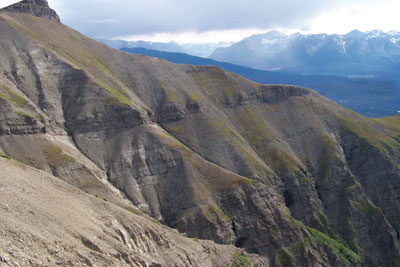
In August, Dr. Austin traveled to Alaska for the FAST program to conduct field work in a remote wilderness area of Wrangell St. Elias National Park. He reported at the time:
I am on the boundary fault where the Pacific Plate collided with the North American Plate in the Upper Cretaceous time. The head-on plate collision occurred as the MacColl Ridge Formation (Upper Cretaceous) was being deposited. I am here to study the sedimentary strata and tectonics of that plate collision. The MacColl Ridge Formation is the product of the collision.
Dr. Austin was particularly interested in a part of the formation he referred to as Conglomerate Bed #7. He concluded:
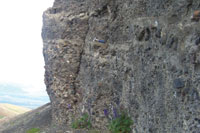
It is obviously a debris flow (undersea mudflow) with extreme power and pulsating delivery of clastics. The largest boulder is about 1 meter by 0.3 meter. Bladelike clasts show imbrication that indicates transport ten miles northward from the collision zone. The rounding of clasts indicates an abrasive flow. Bed #7 is about 100 feet thick. Flow velocity may have exceeded 30 mph.
There is virtually nothing in 7,000 feet of strata that argues for slow deposition. These strata bear witness of catastrophic flood sedimentation. It is "soup and slurry" sedimentation like I have never seen before.
For the next scheduled FAST activity, Dr. Austin will gather his principal investigators in Mesquite, Nevada, in November to discuss their current research and make plans for future projects. NCSF looks forward to furthering this important scientific work.
Cite this article: National Creation Science Foundation Awards First Grant. Acts & Facts. 37 (10): 9.