A Strange and Mysterious Hypercarnivore Discovered | The Institute for Creation Research

A Strange and Mysterious Hypercarnivore Discovered
In 1988 a fossil jaw was discovered by paleontologists in San Diego County, California. Decades later the scientists determined it belonged to a relatively unknown carnivore species of the machaeroidines (saber-toothed, placental mammals). The creature was named Diegoaelurus vanvalkenburghae and was about the size of a bobcat with teeth like slicing blades. So far, only 14 specimens belonging to the machaeroidines have been found.1

Evolutionists maintain this strange creature roamed what is now southern California “42 million years ago” during the Eocene epoch.2 However, creation scientists see this carnivore as having been buried during the later stages of the Flood in the Santiago Formation which is composed of siltstone, mudstone and sandstone—all sedimentary rocks laid down by water. Indeed, evolutionists state, “The exact timing and reason for this extinction also remain mysterious.”2 But this is not a mystery if one subscribes to the Genesis Flood model.
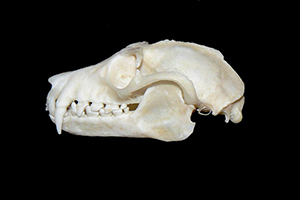
Teeth of Indian Flying Fox  
Image credit: Copyright © Pavel Zuber. Used in accordance with federal copyright (fair use doctrine) law. Usage by ICR does not imply endorsement of copyright holder.

God originally created all animals as vegetarians, including cats such as the saber-toothed D. vanvalkenburghae. Today, many sharp-toothed bears are vegetarian and they use their formidable dentition to tear into tough vegetable material. This is also true with the fruit bat (or megabat, including the flying fox) of Oceania and Africa. Animals needed and need specially designed teeth to break down cones, leaves, bark, twigs, shoots, buds, and seed pods.

D. vanvalkenburghae, the mysterious saber-toothed carnivore, is a member of the cat kind created by God and the Word, Jesus Christ, just thousands of years ago–in the beginning...

References
1. Zach, S. et al. 2022. Diegoaelurus, a new machaeroidine (Oxyaenidae) from the Santiago Formation (late Uintan) of Southern California. Peerj
2. Lanese, N. 2022. Mysterious 'hypercarnivore' with blade-like teeth roamed California 42 million years ago. LiveScience. Posted on livescience.com 15 March 2022, accessed on 24 March 2022. 

Stage Image: Artist's rendition of newly discovered hypercarnivore
Stage Image Credit: Copyright © San Diego Natural History Museum. Used in accordance with federal copyright (fair use doctrine) law. Usage by ICR does not imply endorsement of copyright holder.

*Dr. Sherwin is Research Scientist at the Institute for Creation Research. He earned an M.A. in zoology from the University of Northern Colorado and received an Honorary Doctorate of Science from Pensacola Christian College.
The Latest
NEWS
Fast-Changing Cactus Flowers Still Point to Design
Cactus flowers have a striking range in size—they can be smaller than a grain of rice or longer than a school ruler. Such variation points to...

NEWS
Wings of Beauty: Designed Detail in Butterflies
A butterfly wing may look like painted glass, but beneath its beauty is a living control system. A recent study on South American butterflies and a...

NEWS
Jupiter's Moons Io and Ganymede: Still Problematic for ''Billions...
Two of Jupiter’s four Galilean moons, Io and Ganymede, were recently featured in science news stories—stories that remind us that these...

NEWS
Can Ice Build Life?
Can a freezer make life? A recent paper in Chemical Science suggests that freezing and thawing may have helped early “protocells” grow,...

NEWS
Conventional Scientists Still Struggle to Explain Saturn’s...
Saturn is famous for its beautiful rings, which are composed mostly of water ice particles. A team of scientists recently proposed that the rings were...

NEWS
Centipede-Like Fossil Walked on Land, Not the Ocean Bottom
A new species of what appears to be a fossil centipede was found in sediments that conventional scientists believe were deposited offshore.1...

NEWS
Rewriting the Origin of Spiders and Horseshoe Crabs . . . Again
According to the fossil record, arthropods—in all their complexity—have always been arthropods.1,2 They belong to the phylum...

NEWS
June Wallpaper
"But seek first the kingdom of God and His righteousness, and all these things shall be added to you."  (Matthew 6:33, NKJV) ICR's...

NEWS
Rapid Change, Fixed Design: Rethinking Genetic ''Accelerators''
What if so-called rapid evolution is not a process of building something new, but it simply reveals what was already there? A recent peer-reviewed study...

NEWS
Designed to Adapt: Examining Plankton After Chicxulub
What if new species could appear in just a few thousand years? A recent study reports that many new plankton species showed up quickly after the supposed...