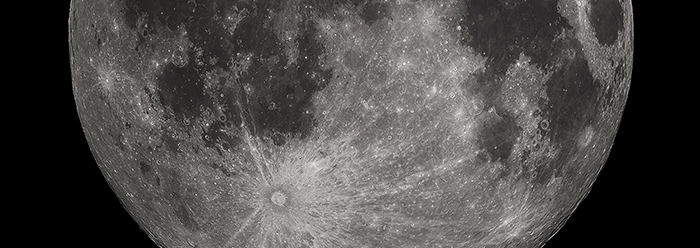
Titan is moving away from Saturn for basically the same reason that the moon is receding away from the Earth. The moon’s gravitational influence causes ocean tides on both sides of the Earth—the side nearest the moon and the side farthest from the moon. However, because of friction between the solid Earth and the ocean, these tides are dragged along with the rotating Earth. This friction causes the Earth’s rotation to slow down, decreasing a quantity called the Earth’s angular momentum. Because of a rule in physics called conservation of angular momentum, if the earth is losing angular momentum then the angular momentum of the moon must increase. This increase is manifested as a gradual increase in the distance between the moon and the Earth. This process is called lunar recession. Although Saturn is a gas giant rather than a solid Earth covered by a liquid ocean, a similar process is causing the size of Titan’s orbit to increase over time.
As an aside, lunar recession has long been a favorite young-Earth argument. Today, the moon is receding from the Earth at 3.8 centimeters per year, but this rate would have been faster in the past. Assuming that tidal friction has always dissipated energy at today’s rate, the moon would have been touching the Earth just 1.5 billion years ago.3 In fact, tidal forces would have torn the moon apart even before that. Naturally, this is a problem for those who claim that the Earth and moon are about 4.6 billion years old.
However, evolutionists can plausibly argue that energy dissipation rates might have been lower in the past, and no one has ever performed a truly rigorous calculation going back billions of years that takes this variation into account.4 Evolutionists have attempted to use geological and paleontological data to “nail down” past lunar recession rates, but they have obtained mixed results depending on which data set or sets they used in their calculations. In one study, three out of four simulations still had the moon catastrophically close to the Earth at some time within the last 3 billion years!5 So this is still very much a potential problem for old-Earthers, although the argument is admittedly not airtight.6
Titan’s higher recession rate confirms a successful prediction by Caltech astrophysicist Jim Fuller (one of the paper’s authors). He predicted that a process called resonance locking could cause Titan to recede from Saturn faster than previously expected.1 However, it may also pose a potential problem for the secular story. Titan is moving away from Saturn so rapidly that it should have been much closer to Titan in the distant past. However, secular stories claim that Titan should have formed close to its current location. Fuller was quoted as saying,
Most prior work had predicted that moons like Titan, or Jupiter’s moon Callisto, were formed at an orbital distance similar to where we see then now [emphasis mine]…. This implies that the Saturnian moon system, and potentially its rings, have formed and evolved more dynamically than previously believed.1
This is a nice way of saying that this result throws a monkey wrench into what secular scientists thought they knew about moon formation! Furthermore, Titan looks young, as do Saturn’s rings!7,8
That observations are revealing more and more discrepancies with the secular old-universe story is hardly surprising. Our universe is created and young, just as one would infer from Scripture.
References
1. Starr, M. Titan is Drifting Away from Saturn 100 Times Faster Than Scientists Expected. Science Alert. Posted on sciencealert.com June 9, 2020, accessed June 11, 2020.
2. Lainey, V. et al. 2020. Resonance locking in giant planets indicated by the rapid orbital expansion of Titan. Nature Astronomy.
3. Green, J. A. M., M. Huber, D. Waltham, J. Buzan, and M. Wells. 2017. Explicitly modelled deep-time tidal dissipation and its implication for Lunar history. Earth and Planetary Science Letters. 461: 46-53.
4. Reference 3 attempts to take this variation into account, but only going back 250 million years into the alleged prehistoric past, a very small fraction of the moon’s alleged 4.5 billion-year history.
5. Williams, G. E. 2000. Geological Constraints on the Precambrian History of the Earth’s Rotation and the Moon’s Orbit. Reviews of Geophysics. 38 (1): 37-59, especially Figure 15.
6. Hebert, J. Lunar Recession in the News. Creation Science Update. Posted on ICR.org June 25, 2020, accessed June 26, 2020.
7. Thomas, B. Young-Looking Methane Lakes on Saturn’s Moon. Creation Science Update. Posted on ICR.org July 16, 2012, accessed June 12, 2020.
8. Hebert, J. 2018. Secular Scientists Dumbfounded by Saturn’s Young Rings. Creation Science Update. Posted on ICR.org January 8, 2018, accessed June 12, 2020.
*Dr. Jake Hebert is Research Associate at the Institute for Creation Research and earned his Ph.D. in physics from the University of Texas at Dallas.