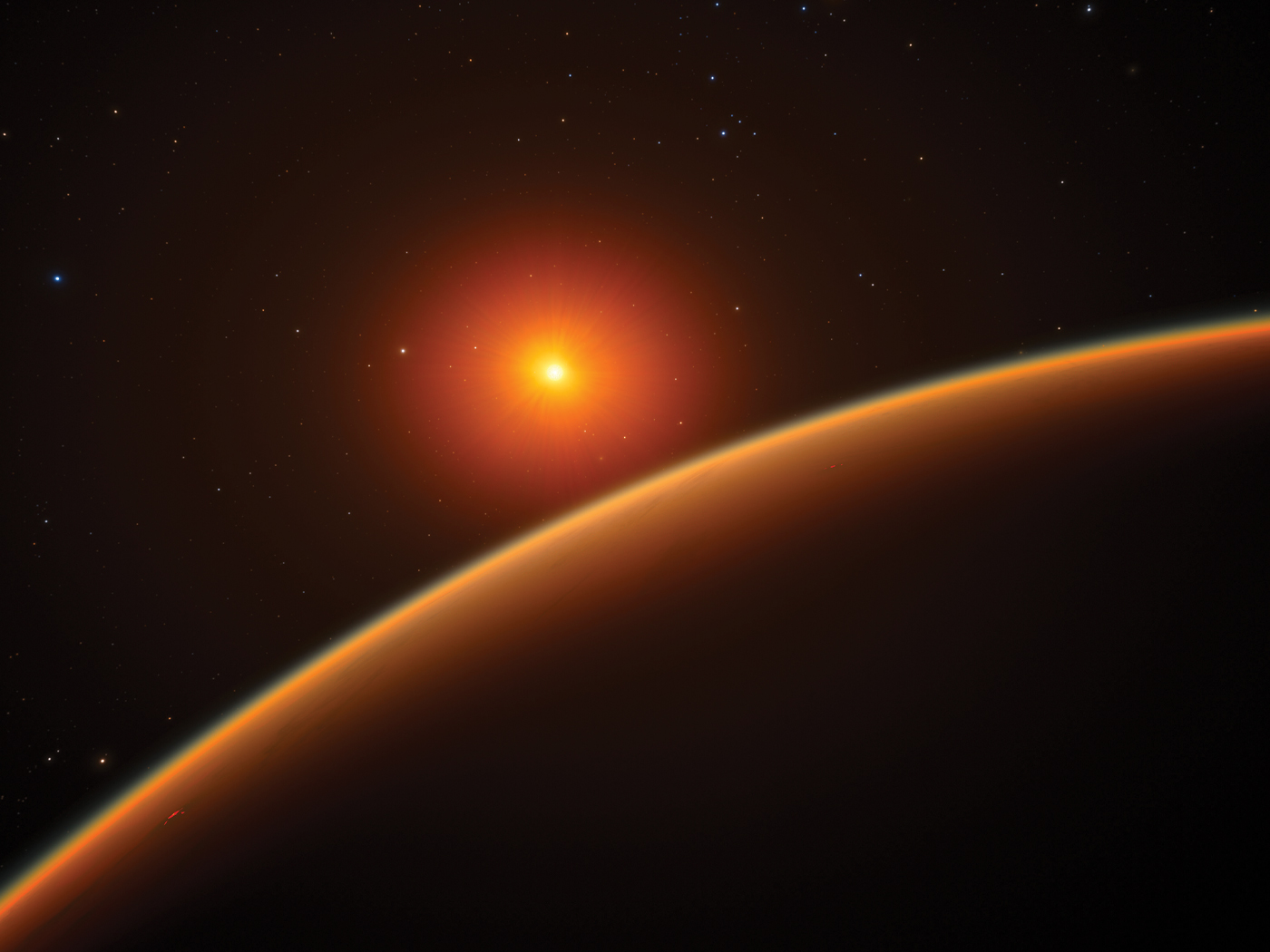
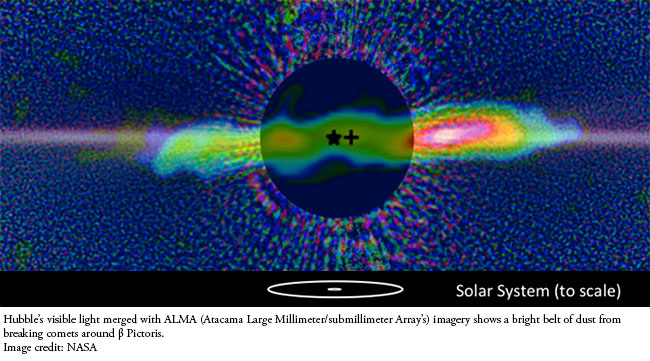
Astronomers recently detected evidence of possible comets orbiting a faraway star system named β Pictoris.1 They compared what they saw to what our solar system may have looked like billions of years ago when the earth and moon were supposedly forming out of a chaotic debris cloud. But details from their report easily refute this imagined "planetary-system formation," and instead illustrate how God recently and uniquely created space objects.
Publishing in Nature, French and Israeli scientists analyzed eight years of data collected by the HARPS instrument on the European Southern Observatory's telescope in La Silla, Chile.1 The instrument measured tiny variations in the star's spectrum, which these astronomers believe to be caused by 493 comets orbiting β Pictoris as they passed between the star and the telescope's lens. The star system lies over 63 light years from our solar system. It can be seen inside a small, southern constellation called "Pictor," taken from a Latin phrase meaning "painter's easel."
Secular astronomers interpret star and comet origins strictly in terms of natural processes like gas particle motions, star explosions, and galactic, planetary, or smaller body collisions. They imagine an explosive Big Bang that supposedly flung out hydrogen, helium, and even space itself as the ultimate origin of all these different space structures.
If that huge chaotic explosion really describes how the universe began, then shouldn't stars and planets—which do not form spontaneously—all look very similar?3 β Pictoris (β Pic) does not fit this expectation, according to NASA's Aki Roberge who summarized this research for Nature's News & Views, saying, "The β Pic planetary system is special."2 Of course, each star would appear special if 1 Corinthians 15:41 is correct, saying, "for one star differs from another star in glory."
Another detail that stands in the way of standard secular expectations is the β Pic star system's "disk of gas and dust originating from the destruction of comets and asteroids."2 So we see astronomical bodies breaking apart, but nobody has ever seen one coalescing—not a galaxy, star, planet, or comet. That means that, like our solar system's comets, β Pic's comets are so young they have not yet fallen apart.
The very existence of comets in our solar system strongly argues for its recent creation, since comets only last on the order of thousands of years, not millions.4 Now, the β Pic comets also make their system look young. But what else should Bible readers expect, since it says God made the sky's luminaries on Day Four of the creation week, only thousands of years ago?
The Nature study authors measured evaporation rates from the comets, called exocomets because they exist far outside our solar system, and found evidence of two distinct populations. Unexpectedly, the population D exocomets produce more gas—mostly vapor—even though they are located farther away from β Pic's vaporizing radiation.
The astronomers wrote, "These results show that exocomets of population D present more active surfaces than exocomets of population S; this could be explained either by the nuclei being larger in size or by the nuclei being disrupted, thus exposing fresh layers of ice buried in their core."1 In other words, perhaps the exocomets formed from a recent breakup of a larger mass.
"Fresh" and "active" describe objects and processes that still have plenty of potential energy and interacting material—fresh and active objects look young. If the β Pic system is really billions of years old, why has it not yet converted its still-energetic and active comets into a scattered rabble of dead dust?
If confirmed, the exocomets orbiting β Pic would be further evidence of the star's youth, just as comets orbiting the sun show that our solar system is young.
References
- Kiefer, F. et al. 2014. Two families of exocomets in the β Pictoris system. Nature. 514 (7523): 462-464.
- Roberge, A. Astronomy: Hurling comets around a planetary nursery. Nature. 514 (7523): 440-441.
- Lisle, J. 2012. Blue Stars Confirm Recent Creation. Acts & Facts. 41 (9): 16.
- Lisle, J. 2014. The Solar System: Asteroids and Comets. Acts & Facts. 43 (5): 12-15.
* Mr. Thomas is Science Writer at the Institute for Creation Research.
Article posted on November 7, 2014.