Did Adam Really Live 930 Years? | The Institute for Creation Research

Did Adam Really Live 930 Years?

Genesis 5:5 says Adam lived for 930 years. Judging by today’s standards, this sounds impossible. Many contemporary readers of Genesis balk at such numbers and some end up rejecting the whole Bible. But a few researchers have found reasons to believe it.

Plant geneticist Dr. John Sanford and his colleagues plotted the ages of the biblical patriarchs listed in Genesis. The result shows a systematic drop-off in lifespans after 950-year-old Noah, “in a way that could never happen by chance,” according to an online post showing their results.1
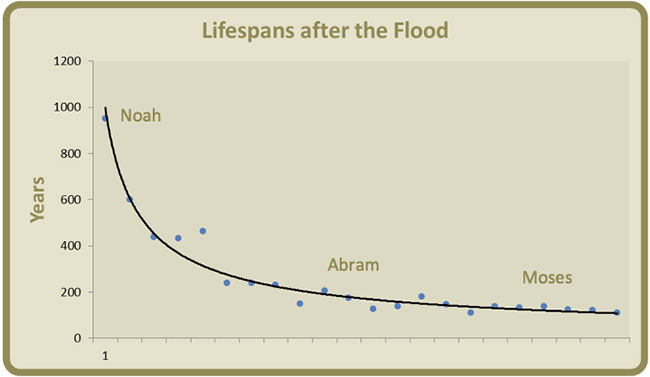
The Genesis lifespans decline according to a well-defined decay curve that began immediately after the Flood.

The researchers’ post points out how the biological decay curve found in these biblical texts matches biological decay curves known from the science of mutation accumulation.1,2 As mutations add up after every generation, they constantly erode genetic information.

Did early mutations damage genes that once enabled human bodies to live for hundreds of years?

The authors of the post wrote, “The lifespan data indicates [sic] that the extreme longevity of the early Patriarchs was real, and that the rapid decline of longevity after the Flood was real.”

And if the patriarch’s lifespans were real, then the verses that record and refer to them accurately describe real history.

References

  1. Sanford, J., J. Pamplin, and C. Rupe. Genetic Entropy Recorded in the Bible? Encouragement for Believers – Science Update. Posted on logosra.org June 1, 2014, accessed June 26, 2014.
  2. Also see Sanford, J. 2008. Genetic Entropy. Waterloo, NY: FMS Publications, 155.

* Mr. Thomas is Science Writer at the Institute for Creation Research.

Article posted on July 14, 2014.

The Latest
NEWS
Jupiter's Moons Io and Ganymede: Still Problematic for ''Billions...
Two of Jupiter’s four Galilean moons, Io and Ganymede, were recently featured in science news stories—stories that remind us that these...

NEWS
Can Ice Build Life?
Can a freezer make life? A recent paper in Chemical Science suggests that freezing and thawing may have helped early “protocells” grow,...

NEWS
Conventional Scientists Still Struggle to Explain Saturn’s...
Saturn is famous for its beautiful rings, which are composed mostly of water ice particles. A team of scientists recently proposed that the rings were...

NEWS
Centipede-Like Fossil Walked on Land, Not the Ocean Bottom
A new species of what appears to be a fossil centipede was found in sediments that conventional scientists believe were deposited offshore.1...

NEWS
Rewriting the Origin of Spiders and Horseshoe Crabs . . . Again
According to the fossil record, arthropods—in all their complexity—have always been arthropods.1,2 They belong to the phylum...

NEWS
June Wallpaper
"But seek first the kingdom of God and His righteousness, and all these things shall be added to you."  (Matthew 6:33, NKJV) ICR's...

NEWS
Rapid Change, Fixed Design: Rethinking Genetic ''Accelerators''
What if so-called rapid evolution is not a process of building something new, but it simply reveals what was already there? A recent peer-reviewed study...

NEWS
Designed to Adapt: Examining Plankton After Chicxulub
What if new species could appear in just a few thousand years? A recent study reports that many new plankton species showed up quickly after the supposed...

NEWS
A Call To Remembrance
I have considered the days of old, the years of ancient times. I call to remembrance my song in the night: I commune with mine own heart: and my spirit...

NEWS
2,200-Year-Old Roman Ship Reveals True Nature of ''Pitch''
What was the pitch that covered the Ark? Many have wondered what this could have been. Was it oil or some type of tree resin? A newly discovered Roman...