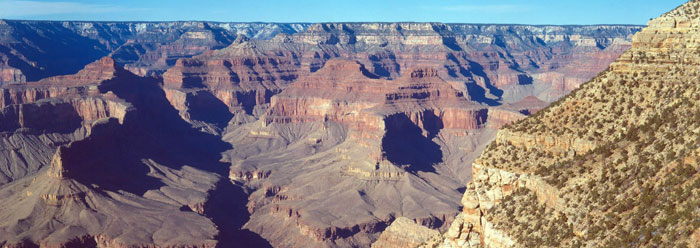
Rocks exposed in the walls of Grand Canyon testify of the advance of marine waters upon North America during the Flood. How rapid was the advance? What was it like? We may never fully know the answers but there are few places on earth that are better suited for study. It is of profound importance to Christians to defend the historicity of the Flood; after all, our Lord predicated His Second Coming on it (Matthew 24:38-39). Could it be that the sequence of layers in Grand Canyon known as the Tonto Group exist for the purpose of being a "memorial" (Joshua 4) or a "witness" (Joshua 24) to the world that God has judged in the past and will again?
Secular geologists agree that the Tonto Group of strata, including the Tapeats Sandstone, the Bright Angel Shale, and the Muav Limestone, is perhaps the best example of a marine transgression on North America. However, it was a very unusual advance. It was unusual in at least three ways.
First, it is nearly unimaginable to postulate an ocean on top of a continent for geophysical reasons. No continents are underwater today for the simple reason that continental crust is composed of lighter minerals than oceanic crust. This buoyancy causes continents to sit high in the mantle compared to the denser ocean basins. Geologists must be able to imagine a world very unlike today's, in which either entire continental masses become depressed or else global sea level somehow rose. Neither isostasy nor glacial melt waters are of sufficient scale to explain it.
A second way this marine transgression is unusual is the flatness of the marine advance. Standard interpretation envisions the Tapeats Sandstone as representing a kind of beach or near-shore deposit, the Bright Angel Shale as shallow-water, and the Muav Limestone as a "deeper" water carbonate bank. It is hard to imagine wading into an ocean for hundreds of miles and still be only waist-deep in water, yet this is the picture most secular geologists work with. Thirty-foot boulders in the base of the Tapeats Sandstone do not fit easily into such a picture.
The third way this is unusual is that the Tonto Group has not been dated by any absolute means. That is, there are no igneous rock bodies within the Tonto Group by which scientists can assign with certainty an "age," even though most will assert it to be 500 plus million years old. How can they have such confidence? Marine fossils of the Tonto Group define "bio-zones" that are found in similar rocks in other parts of the world where dateable igneous rocks are inter-bedded with Tonto-like sedimentary rocks. The bio-zones are thought to represent nearly-synchronous worldwide evolutionary "events," and a single radioisotope date from anywhere in the world is considered sufficient to date the entire horizon. There is only one kind of timeline that stratigraphers universally recognize that can trump evolutionary bio-zones, and that is a volcanic ash bed (tuff).
Newsflash! There is now evidence for more than one volcanic ash bed in the Tonto Group of Grand Canyon. An ICR FAST research project is pursuing these ash beds as a means to understand the advance of the oceans on top of the continent, without appeal to evolutionary bio-zones. Please pray for this project, which may open a new means for understanding the Tonto Group and the Genesis Flood.
*William A. Hoesch, M.S. geology, is Research Assistant in Geology.
Cite this article: Hoesch, W. 2007. Calibrating the Flood? Acts & Facts. 36 (7).