Radiometric dating fascinates nearly everyone. Uranium-lead, potassium-argon, and rubidium-strontium are names associated with radiometric dating. 1,2
Jesus Christ talked about things that most of his listeners did not comprehend. He used parables. Hear now the parable of two scientists who analyze the fruit layer in the crust of the earth.
THE HARVEST
A man raises apples and bananas. During the rush of harvest, he throws both the apples and the bananas in the same truck. This year, the man’s apple crop was excellent, but his banana crop was poor. His total harvest in his truck consisted of 90% apples and 10% bananas.
The man on the adjoining farm raises bananas and coconuts. Both of his crops yielded about the same. His truck was loaded with 50% bananas well-mixed with 50% coconuts.
Both men are in a hurry to market their harvest. They drive too fast on the same winding road. They are approaching one another, but they do not know it until they round the same bend. They swerve and side-swipe one another. As they bump, a portion of each man’s harvest is knocked out of his open truck and falls along the roadside. The spillage from each man’s truck becomes unevenly mixed with the spillage from the other man’s truck. Left behind on the dusty road are piles of unevenly mixed fruit as a reminder of the violence that recently occurred there.
Later that day, two scientists chance on the site of the accident. They are Catastrophist Charlie and Uniformitarianist Egbert. They wonder how piles of unevenly mixed fruit happen to be lying there on the side of the road. Each scientist has a theory. Each scientist examines the piles of mixed fruit to see if his theory fits the evidence.
As evidence, Charlie counts 100 individual fruits from the pile near the tree far off the road, 100 individual fruits from the pile near the bush closer to the road, and 100 individual fruits from the pile on the road. He records his data on charts.
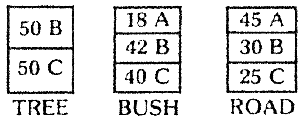 |
Here A stands for apples, B for bananas, and C for coconuts.
In practice when Charlie counts atoms in a sample of crushed rock, he will count millions upon millions of atoms, because atoms are so tiny. Any whole rock sample actually used is already averaged in this way. In our apple, banana, and coconut parable, we will pretend that the numbers of individual fruits are average numbers.
THE CREATIONIST'S THEORY — MIXING
Charlie thinks the unevenly mixed fruit is the result of a recent disaster in which two separate loads of fruit were unevenly mixed.3,4 Charlie explains that the pile of fruit by the tree came entirely from the truck carrying 50% bananas and 50% coconuts. That is why the pile by the tree consists of 50 bananas and 50 coconuts. The tree was so much closer to this truck than it was to the other truck at the time of the accident, that no fruit from the other truck went all the way to the tree.
Charlie explains that the pile of fruit by the bush is a mixture of 20% fruit from the apple and banana truck mixed with 80% fruit from the banana and coconut truck.
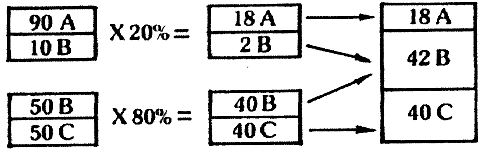 |
The bush was evidently closer to the banana and coconut truck than it was to the apple and banana truck at the time of the accident.
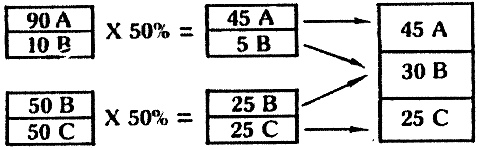
Charlie explains that the pile of fruit in the middle of the road is a 50-50 mixture from both trucks. This location must have been about as close to one truck as it was to the other truck at the time of the accident.
 |
Charlie feels confident that his analysis has proved his theory of an uneven mixing of two original fruit loads to account for the fruit samples. He is able to derive the original composition of each load. He can tell what percentages of the two original loads were mixed to form each pile.
THE UNIFORMITARIANIST THEORY — RADIOACTIVE DECAY
Egbert assumes that these piles of fruit have been there as part of the crust of the earth for millions of years. He says apples slowly change to bananas by radioactive decay. He says the change occurs so slowly that only 1% of original apples change into bananas in 1 million years. Egbert believes this rate of decay has been the same throughout millions of years. Egbert believes that all of the bananas in a stack of bananas might not have been bananas originally. Some of them might have been apples that radioactively decayed into bananas.
Egbert believes that when the fruit layer formed ages ago in the earth's fruity crust, there was one original banana for each original coconut. If a site had a lot of original coconuts, then it would have a lot of original bananas too. If a site had few original coconuts, then it would have few original bananas. Whether many or few, coconuts are always found mixed 1-to-1 with original bananas, he believes.
Egbert believes that there is now more than 1 banana for each coconut, because some original apples have decayed into extra bananas. The number coconuts has remained the same. An old fruit layer will have more extra bananas than a fruit layer that formed more recently. Egbert will determine the age of the fruit layer by finding out how long it took for the extra bananas to be produced by radioactive decay.
Egbert believes that the pile of fruit next to the tree is part of the original fruit crust of the earth. There are no apples to decay into extra bananas. That is why that pile consists only of bananas and coconuts in the 1-to-1 original ratio. He cannot use this pile to date the fruit layer, but at least it fits into his theory.
Egbert believes the pile of fruit next to the bush is 10 million years old. He notes that at the rate of 1% per million years, in 10 million years 10% of original apples would decay into extra bananas. He says that the pile had 20 apples originally. Two of those original 20 apples (that's 10% of the original 20) have decayed into bananas in 10 million years. The rest of the fruit consisted of original bananas and coconuts mixed 1-to-1 as he says they should be. Now there are 2 more bananas than coconuts, because of the radioactive decay of apples into bananas, and that's 10 million years worth of decay.
 |
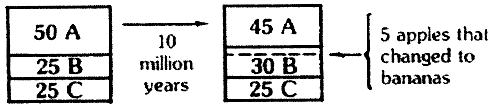
Egbert believes the pile on the road is 10 million years old too. He believes that it had 50 apples originally, and that the rest of the fruits were bananas and coconuts mixed in the required 1-to-1 ratio. In 10 million years 5 of the original 50 apples (that's 10% of the 50) have decayed into extra bananas. This 10 million years of decay from the original accounts for the observed ratio of 45 apples, 30 bananas, and 25 coconuts.
 |
Egbert now feels confident that his theory is correct. He has used his theory to date the fruity crust of the earth, and his method consistently gives the same age, 10 million years. If he uses his method to date more fruit samples, those too give the same age consistently, 10 million years.
Charlie's recent-mixing theory and Egbert's long-ages-of-slow-change theory both explain the same data equally well. Yet, they cannot both be true. They are such different explanations. How is it that such different explanations can fit the same data? Whose explanation is really correct?
Charlie and Egbert stroll down the dirt road discussing their theories. They try to think of some way to decide which explanation is the correct explanation. When they are just about to give up, they come across some more mixed fruit scattered all over the dirt road. Each scientist tries out his theory on two piles of this mixed fruit. Apparently there are a lot of collisions on this road.
They count 100 fruits from one spot on the fruit-strewn road, and 100 fruits from another spot. They display their data on a graph.
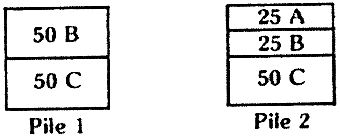 |
Charlie thinks this too was formed by a recent mixing of two original fruit loads.
You can check for yourself that the two samples are the result of mixing of the following two original loads of fruit. Load I is 50% bananas and 50% coconuts, the same as before. Load II is 50% apples and 50% coconuts. The first sample is all from Load I. The second sample is a 50-50 mixture of loads I and II. Charlie is once again able to use his recent mixing theory. He determined what were the compositions of the original loads and in what ratios they mixed.
Egbert tries to explain the fruit composition by his long-ages-of-slow-change theory. As before, the first sample with no apples must give the number of original bananas, since in that sample there were no apples to form bananas.
Egbert uses his knowledge of the original condition of this fruit layer to analyze the second sample. For each of the 50 coconuts, there was one original banana. That means the number of bananas originally present was 50. Wait a minute! There are only 25 bananas altogether in the second pile now. That is supposed to be the number of bananas present originally PLUS the number of apples that decayed into bananas over the long ages. The second pile does not even contain the original amount of bananas, let alone the extra bananas that were supposed to form from apples over the ages.
Egbert conceded that his method will not fit these fruit samples. He admits that Charlie's analysis must be correct here.
The two scientists come across many other fruit samples. Charlie fits all the samples by his theory of recent mixing. Egbert's method sometimes works and sometimes fails.
Charlie thinks that his explanation of a recent mixing is correct, because it works on all samples, and Egbert's explanation does not.
Egbert thinks his explanation of slow change over long ages can still be true if he modifies it. When his dating method yields dates consistent with his theory, he says his samples really are that old. When his dating method yields impossible results, or ages that do not fit his theory, he says the sample resulted from mixing that spoiled the age determination.
All of this actually does relate to real life. In place of apples changing to bananas, scientists use radioactive isotopes like rubidium 87 that decays into strontium 87 so slowly that it would take nearly a billion years for 1% to decay. In place of coconuts, scientists use a non-radioactive isotope like strontium 86.
Uniformitarians attempting to date a rock will analyze samples from various parts of the rock, as Egbert in the parable analyzed the piles of mixed fruit. When the method yields a date that fits their theory, they accept the date as correct. When the method yields impossible results, or a date that does not fit their theory, they say the sample must have been at least partially mixed.
Actually, all of the rock samples could be explained by mixing that occurred in a recent catastrophe. The catastrophe that caused essentially world-wide uneven mixing is described in the Bible as the great Flood.
The very rock samples that uniformitarians display to prove the earth was formed by natural processes billions of years ago, are actually evidence of the destructive turbulent mixing in the recent catastrophe, the Flood.
REFERENCES
1. Moorbath, Stephen, The Oldest Rocks and the Growth of Continents, Scientific American, v. 236, 1977. pp. 92.
2. Arndts, Russell and Overn, William, Pseudo-concordance in U-Pb Dating, Bible-Science Newsletter, Vol. 19, No. 2, Feb., 1981, pp. I ff.
3. Arndts, Russell and Overn, William, Isochrons, Bible-Science Newsletter, Vol. 19, No. 4, April, 1981, pp. I ff.
4. Arndts, Russell and Overn, William, Proof of the Validity of the Mixing Model, Bible-Science Newsletter, Vol. 19, No. 8, Aug., 1981, pp. 1 ff