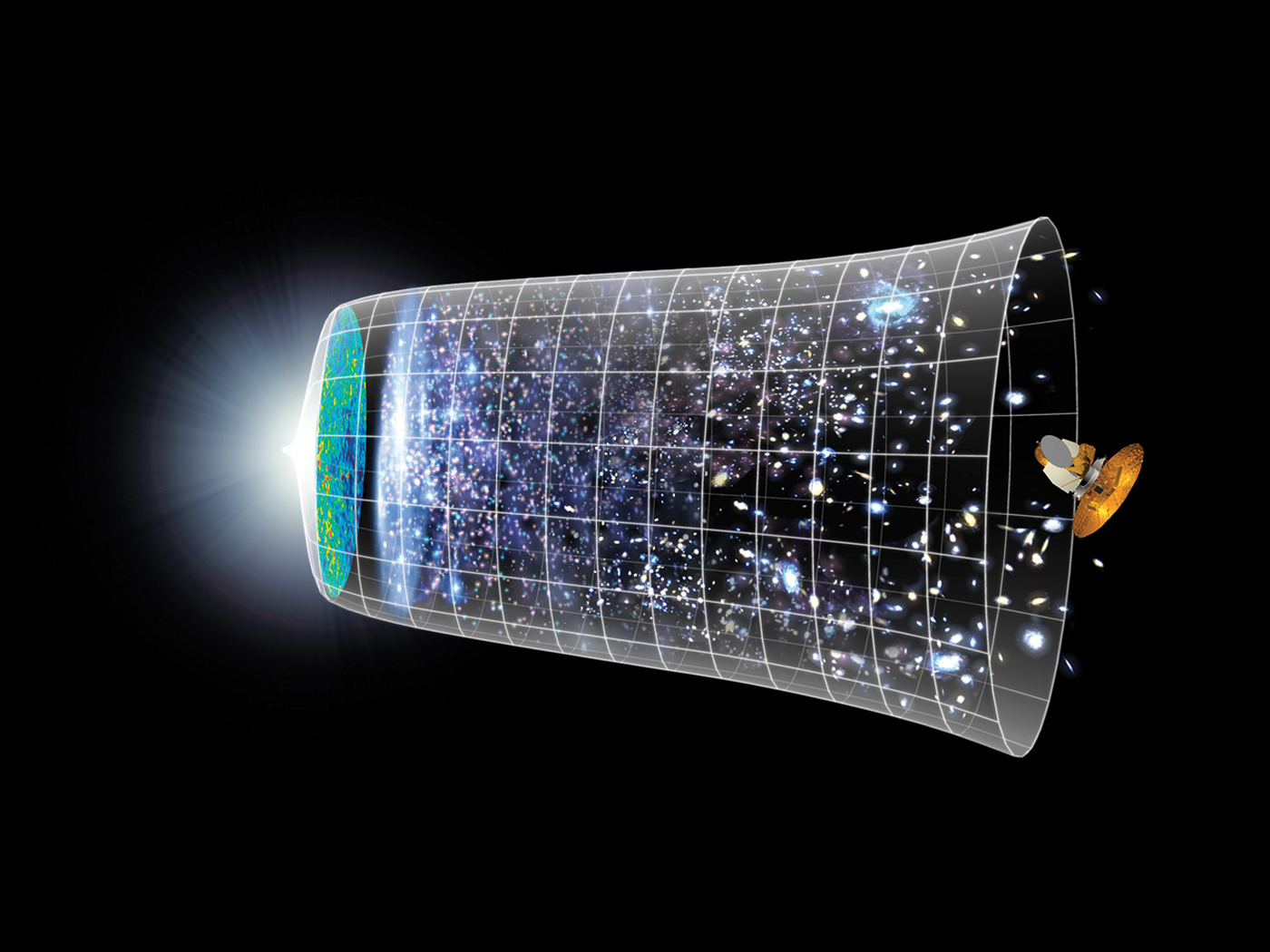
There are three main arguments for the Big Bang model: 1) the apparent expansion of the universe, 2) the ability of the model to account for the relative cosmic abundances of hydrogen and helium, and 3) the existence of the cosmic microwave background (CMB), which Big Bang theorists interpret as an “afterglow” from a time about 400,000 years after the supposed Big Bang. Not a single one of these is an unqualified success, and apparent successes often lead to problems for the model!
Astronomers have inferred that other galaxies are receding away from our own, and they believe this is an indication that space itself is expanding. Big Bang theorists assume that this inferred expansion can be “rewound” backward in time to the supposed birth of our universe. Some creation scientists question whether astronomers are interpreting the redshift data correctly.2 Others think the universe could indeed be expanding, and that for some reason God imposed an expansion on His created universe. But in any case, an expanding universe is seen as one of the three main arguments for the Big Bang. Yet when Big Bang astronomers attempt to calculate the expansion rate using two different methods, they obtain contradictory results!3
Likewise, the ability of the Big Bang to account for the abundances of hydrogen and helium is not nearly as impressive as it first seems. The Big Bang model has an adjustable parameter,4 like a tuning knob on a radio, that theoreticians can adjust to ensure that the Big Bang produces the amounts of hydrogen and helium necessary to match observations.5,6 However, once the value for this parameter is chosen, the Big Bang model indicates how many atoms should exist in the universe. This is only fifteen to twenty percent of the matter that most astronomers think exists, so the remaining eighty percent or so has to be something else. Because Big Bang theorists have ruled out other known forms of matter, they are forced to hypothesize the existence of exotic, never-before-detected forms of non-baryonic matter. Needless to say, the search for this exotic dark matter is going very poorly.7
Moreover, Big Bang theorists acknowledge that, by their own reckoning, they do not know the composition of 95% of the mass/energy of the universe.1 Or to put it another way, they don’t know what the universe is composed of. This one simple fact demonstrates the absurdity of their claim that they know how the universe came to be. It is akin to claiming you understand the recipe for a cake, even though you don’t know what kind of cake the recipe produces!
The cosmic microwave background radiation (CMB) is arguably the strongest argument for the Big Bang, but there are features about the CMB that do not match Big Bang expectations, nor the expectations of “inflation theory” that has become a major part of the model. Said one Cambridge astrophysicist,
[T]he theory of inflation predicts that today’s universe should appear uniform at the largest scales in all directions….That uniformity should also characterize the distribution of fluctuations at the largest scales within the CMB. But these anomalies, which Planck confirmed, such as the cold spot, suggest that this isn’t the case….[T]his is very strange….And I think that if there really is anything to this, you have to question how that fits in with inflation….It’s really puzzling.8
A 2004 open letter published in New Scientist had this to say about the Big Bang:
Big bang theory relies on a growing number of hypothetical entities—things that we have never observed. Inflation, dark matter and dark energy are the most prominent. Without them, there would be fatal contradictions between the observations made by astronomers and the predictions of the big bang theory. In no other field of physics would this continual recourse to new hypothetical objects be accepted as a way of bridging the gap between theory and observation. It would, at the least, raise serious questions about the validity of the underlying theory.9
Creation scientists heartily agree. The scientific problems with the Big Bang model are so great that it should have been abandoned by theorists long ago. What is truly perplexing is why so many Christians insist that the Big Bang was God’s means of creating the universe, when it clearly contradicts the Genesis account in so many ways.10
References
1. Hooper, D. Is the Big Bang in Crisis? Astronomy. Posted on astronomy.com May 14, 2020, accessed May 15, 2020.
2. Hartnett, J. 2011. Does observational evidence indicate the universe is expanding?—part 2: the case against expansion. Journal of Creation. 25 (3): 115-120.
3. Hebert, J. Big Bang Hubble Contradiction Confirmed. Creation Science Update. Posted on ICR.org May 16, 2019, accessed May 18, 2020.
4. This adjustable parameter is called the baryon-to-photon ratio. It is a number that indicates the number of ‘heavy’ particles (like protons and neutrons) in the universe, compared to the number of quanta or “packets” of light.
5. Bergström, L. and A. Goobar. 2008. Cosmology and Particle Astrophysics, 2nd ed. Chichester, UK: Praxis Publishing, 167-176.
6. Hoyle, F., G. Burbidge, and J. V. Narlikar. 2000. A Different Approach to Cosmology: From a Static Universe through the Big Bang towards Reality. Cambridge, UK: Cambridge University Press, 97.
7. Hebert, J. 2019. Dark Matter Search Keeps Coming Up Empty. Creation Science Update. Posted on ICR.org April 9, 2020, accessed May 18, 2020.
8. Discoveries from Planck may mean rethinking how the universe began. Phys.org. Posted on phys.org July 26, 2013, accessed May 18, 2020.
9. Lerner, E. Bucking the Big Bang. New Scientist. Posted on newscientist.com May 22, 2004, accessed May 15, 2020. Also, see Open Letter on Cosmology.
10. Morris, J. D. 1997. Is the Big Bang Biblical? Acts & Facts. 26 (5).
*Dr. Jake Hebert is Research Associate at the Institute for Creation Research and earned his Ph.D. in physics from the University of Texas at Dallas.