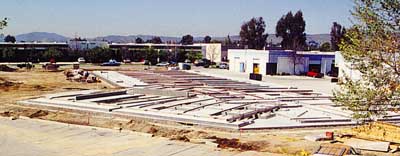
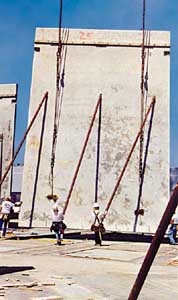
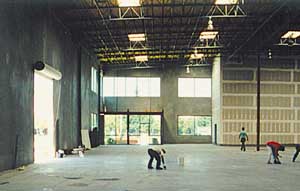
"We'll show the evolutionists that complex structures don't grow by chance," said the operator of the giant crane, as his machine lifted the large concrete slab and hoisted it into position as part of the wall of the new ICR building.
He was wrong, of course. All the scientific authorities of the region agreed that the building had grown up from the ground by time, chance, and natural processes. Because of other commitments, they were only able to observe its growth once a week, on Sundays, when no one else was around, but as scientists they were confident they knew exactly what was happening.
It happened like this, they explained. Once there was this vacant area of land, with nothing on it but grass and weeds and great numbers of little animals. Then the animals probably began to disturb the soil, rearranging it into more suitable conditions for the purpose of building.
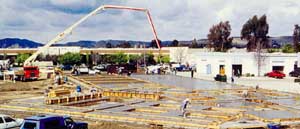
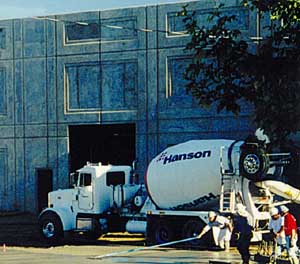
Soon there began to appear on the prepared land a smooth rocklike covering overlain by networks of steel in orderly patterns shaped by forces never actually observed by the scientists. These somehow developed into large slabs of concrete covering the area, possibly aided by several strange beasts that neighbors had observed disgorging their contents on to the soil and steel.
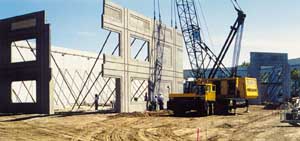
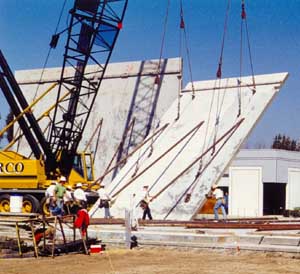
Then, one day, these flat-lying slabs of concrete somehow must have elevated themselves into an upright posture, for there they were, on Sunday, standing upright, eventually encompassing the hitherto unbounded area, forming what seemed to be an embryonic building.
As time went on, this primitive structure managed to develop various internal appendages and external adornments until finally, it became a full-grown building, ready for some as-yet-unknown function in the great time/space continuum of the evolving cosmos. That's how it was, just so, just like that.
There was some disagreement, however, among the scientists of the region as to just what mechanisms had caused this remarkable development, although all agreed that only natural processes were involved. The majority of these scientists were reasonably sure that it all took place very gradually, involving myriads of individually imperceptible biochemical chance alterations in the components of the structure—that is, the soil, the cement, the steel, and possibly other materials that had migrated into the area. Most of these changes were of no help, but others were probably beneficial, so that gradually they all grew step by step, into the beautifully finished structure.
This all seemed quite reasonable to most of the scientists, even though a few of them (no doubt influenced by their religious backgrounds) argued that growth of a complex structure from simpler elements was impossible without some kind of intelligent planning and organized implementation. They had heard of a law called entropy which said that complex structures left to themselves would eventually disintegrate into simpler components—not the other way around.
No so, said the establishment scientists. The building site was an "open system," open to the tremendous radiant energy bathing the site every day from the sun, and they were confident that this energy was more than enough to do the work required to assemble and construct the building. And that seemed to satisfy all these establishment scientists.
But there was another group of scientists who argued that the building could never grow by adding up a long series of imperceptible changes. It would have taken far too long to get it done that way. Furthermore they could see no evidence of the many transitional states that must have been necessary if this had really happened. Once there had been nothing but soil and weeds; then there was a field of concrete, with no evidence of any intermediate mutant stages of soilcrete that might have produced such a change. Later there was a network of steel rods, but again no transitional stage of steelcrete had apparently survived. And certainly there were no remaining slabs that were at 30°, 45°, or 60° angles, though the transition from horizontal to vertical must surely have gone through these stages.
Therefore this group of scientists believed that the growth had been in big, rapid spurts, rather than gradual. After all, the soil had remained undisturbed for many years, but then rather quickly there had appeared a concrete covering, which also lasted a while without change, a situation which they called "stasis." Then, one day a "punctuation" upset the "equilibrium" and suddenly there were these steel rods everywhere. Just how these sudden transmutations could occur was not really clear, but the scientists knew that one revered scientist had received a Nobel Prize for showing mathematically how it was possible that a "dissipative structure" could somehow generate order out of chaos. Perhaps a tornado had caused a rapid change from soil to concrete and a later hurricane had quickly made horizontal slabs vertical. Such rapid changes would, of course, leave no remnant intermediate stages to look at, but that could not prove that they had not been there and done that. At least this seemed more feasible than the idea of zillions of imperceptible changes (most of them either useless or harmful) generating a beautiful, functioning building.
There was still another group of scientists, however, who felt that while natural processes (solar energy, wind, etc.) were adequate to do all the work involved, there was still too much evidence of organized irreducible complexity in the building for it to have come about by chance. Unwilling to fall back on the antiquated notion of an intelligent personal designer, however, they felt that the vibrant universe was itself a quasi-intelligent entity which could somehow organize some of its components into such relatively simple structures as an ICR building. These scientists even regarded Earth as a great mother—Mother Nature, or Gaia, the earth goddess, or some such name—working all her natural processes together in some mysterious way to generate a building.
In any case, whether by gradual mutations, punctuated equilibrium, or cosmic consciousness, all were agreed that natural processes had built the building. More research was needed as to the precise mechanisms involved, but there could be no question that it was all done by unaided nature. That definitely was the way it was, all the scientists agreed, and most people went along.
All agreed, that is, except those "religious" scientists and their associates who had been involved in the actual planning, had raised the funds, and then commissioned an architect and contractor to design and build the building. And all of these testified that the planning, fund-raising, design, and construction had been preceded by much thought and much prayer, and that, ultimately, all credit must go to their Creator God and Savior, who had answered their prayers.
And that was really the way it really was!
 |
 |
 |
 |
 |
 |
 |
 |
* Dr. Morris is Founder and President Emeritus of ICR.