There are many Christians today who insist that they believe the Bible, but seem unable to believe its very first chapter. The Biblical record says that God created the universe and everything in it in six days, then rested on the seventh day (note Exodus 20:8-11). But the modern worldview is that the universe has been evolving for about 15 billion years, and that the earth and its inhabitants have been evolving almost five billion years, and this creates a problem.
They must decide, therefore, whether they should interpret the scientific data in terms of God's revelation, or try to interpret the Genesis record of creation to fit the evolutionary ages. Most Christian intellectuals take the latter approach and then attack those whom they call "young-earth creationists." An example of this is found in the writings of Bradley and Olsen:
The Hebrew word yom and its plural form yamim are used over 1900 times in the Old Testament. . . . Outside of the Genesis 1 case in question, the two-hundred plus occurrences of yom preceded by ordinals all refer to a normal twenty-four hour day. Furthermore, the seven-hundred plus appearances of yamim always refer to a regular day. Thus, it is argued that the Exodus 20:11 reference to the six yamim of creation must also refer to six regular days.1
Bradley and Olsen think that such exegesis doesn't apply to the creation week. Here is their reasoning.
These arguments have a common fallacy, however. There is no other place in the Old Testament where the intent is to describe events that involve multiple and/or sequential indefinite periods of time.
There is, of course, no hint in either Genesis 1 or Exodus 20:8-11 that the writer's intent was to "describe events that involve . . . indefinite periods of time." The accounts are written as simple statements of fact, using straightforward language that everywhere else in the Bible denotes literal days. Another writer, Dr. Pun, agrees.
It is apparent that the most straightforward understanding of the Genesis record . . . is that God created heaven and earth in six solar days, that man was created on the sixth day, that death and chaos entered the world after the Fall of Adam and Eve. . . .2
But Dr. Pun apparently does not believe that God understood what He was saying, since He said it
. . . without regard to all the hermeneutical considerations suggested by science.
That is, he thinks that "science" should govern our Biblical hermeneutics. Dr. Pun goes on to say that:
. . . the recent Creationist position . . . has denied and belittled the vast amount of scientific evidence amassed to support the theory of natural selection and the antiquity of the earth.
All three of these men are leading evangelical scientists (Pun at Wheaton College, Bradley at Texas A & M, Olsen from Colorado School of Mines) and all say they believe in Biblical inerrancy and the historicity of Genesis. Their "day-age theory," however, seems to us to be quite illogical. If Genesis doesn't mean what it says, then why accept its historicity at all?
Liberal theologians don't accept it, as a matter of fact. One leading Hebrew scholar is James Barr, Professor of Hebrew Bible at Vanderbilt University and former Regius Professor of Hebrew at Oxford University in England. Although he does not believe in the historicity of Genesis 1, Dr. Barr does agree that the writer's intent was to narrate the actual history of primeval creation. Others also agree with him.
Probably, so far as I know, there is no professor of Hebrew or Old Testament at any world-class university who does not believe that the writer(s) of Genesis 1-11 intended to convey to their readers the ideas that (a) creation took place in a series of six days which were the same as the days of 24 hours we now experience; . . . Or, to put it negatively, the apologetic arguments which suppose the "days" of creation to be long eras of time, the figures of years not to be chronological, and the flood to be a merely local Mesopotamian flood, are not taken seriously by any such professors, as far as I know.3
While men such as Bradley, Olsen, and Pun may have worthy motives in trying to retain creationism in the face of the supposed evidence for macro evolution and an ancient earth, it seems obvious that Barr's position is more realistic. If God did not mean what He said in the very first chapter of His book, then why should we take the rest of it seriously?
It seems to us that we should take Scripture as the literal Word of God, intended to be understood by its readers in every generation and every nation—especially this chapter, which is the foundation of all the rest. If God had meant to convey the idea of long ages, He could easily have used a number of other Hebrew words and phrases to convey that idea. All the ancients were already familiar with the concept of long ages of evolutionary change in their various nature religions.
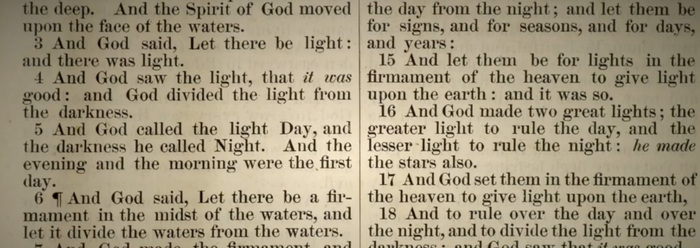
The idea of six-literal-day creation, however, was a radical departure from what the early Hebrews could have heard from their pagan neighbors; so God was very specific in using such words to preclude any such misunderstanding. For example, He defined the word "day" the very first time He used it. "God called the light Day, and the darkness He called Night. And the evening and the morning were the first day" (Genesis 1:5). The word "day" in Genesis does not mean a geological period!
Furthermore, the order of events in Genesis flagrantly contradicts the order assigned by evolutionary astronomers and geologists in well over a dozen ways.4
Although there are many, many references to creation throughout the Bible, there is no hint anywhere of long ages before man's creation. The fact that men and women and various human activities were present from the very foundation of the world is indicated in the New Testament by Peter (Acts 3:21), by Paul (Romans 1:20), by John (I John 3:8), by the father of John the Baptist (Luke 1:69,70), and especially by the Creator, the Lord Jesus Christ Himself (Luke 11:50; Mark 10:6; 13:19).
Perhaps most important of all is the fact that acceptance of the geological ages (with their billions of fossil remains in the sedimentary rocks) makes God out to be the Creator of evil and suffering, directly allowing a billion years of cruel struggle for existence before He created Adam and Eve.
Nature makes everything in vain. After all, what is evolution? A mindless process built on evil; that's what it is. . . . So natural selection seems smart to those who see only the surviving products, but as a design process it is idiotic. And the raw brutality of the process is offensive.5
It seems clear to us that those who truly believe the Bible ought to repudiate this hoary day/age theory once and for all. However, this means repudiating the evolutionary age system, and to many Christian intellectuals, this costs too much. So most of them go on promoting this system of great ages (despite the lack of any genuine scientific proof of any ages before the beginning of recorded history). For example, the president of a leading evangelical college has noted that:
For at least six decades, Wheaton's faculty . . . have held that the "days" of Genesis are most likely to have been extended periods of time. Further, they have also noted that the Bible does not comment on the exact origin of species as described today.6
Most Christian colleges and seminaries today, as well as most Christian student organizations, Christian family ministries, and even some Christian apologetics and creation-oriented organizations would agree with that position. We could become more popular here at ICR, and we would have bigger meetings, more book sales, and more open doors if we would go and do likewise.
But, this we cannot do and still remain faithful to the Word of God. We hope you understand. We believe God does.
References
1 Walter L. Bradley and Roger Olsen, "The Trustworthiness of Scripture in Areas Relating to Natural Science," in Hermeneutics, Inerrancy and the Bible, ed. Earl D. Radmacher and Robert D. Preuss (Grand Rapids: Zondervan Publishing House, 1984), p. 299.
2 Pattle P.T. Pun, "A Theory of Progressive Creationism," Journal of the American Scientific Affiliation (vol. 39, March 1987), p. 14.
3 James Barr, letter to David Watson, 1984.
4 The contradictions have been pointed out in many books. See, for example, the brief tabulation in The Young Earth by John D. Morris (Green Forest, Ark: Master Books, 1994), p. 33.
5 Arthur Falk, "Reflections on Huxley's Evolution and Ethics," The Humanist (vol. 55, November/December 1955), pp. 23-24.
6 Richard Chase, "Teaching Science," Wheaton Alumni (April/May 1990), p. 4
* Dr. Morris is Founder and President Emeritus of ICR.