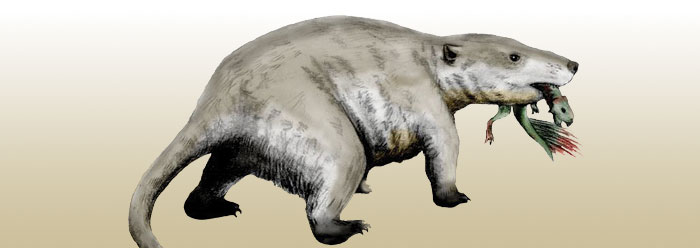
A 2005 Nature journal article1 announced a fossil discovery that “contradicts conventional evolutionary theory that early mammals couldn’t possibly attack and eat a dinosaur because they were timid, chipmunk-sized creatures that scurried in the looming shadow of the giant reptiles.”2 Chinese paleontologists identified the jumbled bones and teeth of a juvenile Psittacosaurus located in the stomach region of a larger mammal. This fur-bearing dinosaur eater may have looked much more familiar than evolutionists would wish.
Named Repenomamus robustus, the Nature study authors wrote that its body length was “comparable to that of a large Tasmanian devil,” and other features of this fossil mammal also look devilish.1 Secular scientists dated the Chinese sediments containing these fossils at 130 million years old, and they believe that Tasmanian devils are a more recent invention of evolution.3 Would scientists who hold such beliefs ever concede that the fossil actually was a Tasmanian devil even if details showed it?
The Tasmanian devil and Repenomamus skeletons look more similar than those of a wolf and Chihuahua, yet the wolf and Chihuahua are both dogs.4 Modern human skulls and skeletons can look quite different from their fossil counterparts, but all are within the created humankind. Objective scientists would consider the possibility that fossils may be varieties of still-living creatures. In fact, the list of “living fossils”—modern-looking creatures found in dinosaur rocks—is quite long and includes tuataras, crocodiles, ducks, loons, parrots, salamanders, turtles, all manner of fish like the famous coelacanth, clams, dragonflies and many other insects, spiders, Wollemi pine, ginkgo, palm trees, cycads, and ferns.
Could Repenomamus representatives still walk the planet? A Geotimes news article covering the find stated that Repenomamus “most resembled a Tasmanian devil.”5 But the comparison can go beyond visual recognition to more objective measures. Devils are marsupials, and marsupials have unique skeletal features. For example, the tear duct holes in their skulls are located on the edges of the eye sockets. Images of the Repenomamus skull clearly show tear duct holes in the same location. Marsupials—not placentals—have a pair of bones that extend from their pelvis toward their head. These epipubic bones support marsupial pouches in some species. Intriguingly, Figure 2 from the Nature article pictures a Repenomamus fossil partly encased in sedimentary rock with an epipubic bone clearly labeled.1
As for the differences, Repenomamus had a higher ratio of sharp, pointed teeth to flatter grinders and slightly longer legs than modern devils. But these kinds of minor differences are well-known as variations within living kinds. Other diagnostic features of Tasmanian devils shared by Repenomamus are the inward angle of the lower jaws and a hip that outwardly angles the devil’s hind legs. Overall, this Chinese fossil mammal, buried with dinosaur bones in its belly, looks extraordinarily similar to the modern Tasmanian devil. Clearly, the burden of proof lies squarely on evolutionists to give anatomical or some other measurable, scientific reasons why Repenomamus was not simply deemed a fossil Tasmanian devil.
If evolution occurred, we would expect ancient mammal-like fossils to be found from creatures transitioning between kinds, not creatures that look virtually the same as living kinds with fully formed physical traits. But if biblical creation presents true history, we would expect modern animals and plants to have lived and died among extinct kinds. If the fossil called Repenomamus is just a Tasmanian devil, it clearly confirms creation.
References
- Hu, Y. et al. 2005. Large Mesozoic mammals fed on young dinosaurs. Nature. 433 (7022): 149-152.
- Verrengia, J. Dinosaur Fossil Found in Mammal’s Stomach. LiveScience. Posted on livescience.com January 12, 2005, accessed December 28, 2012.
- “Estimated cladogenic dates suggest that extant [marsupial] subfamilies shared a common ancestor around 24 Mya.” Krajewski, C., S. Wroe, and M. Westerman. 2000. Molecular evidence for the pattern and timing of cladogenesis in dasyurid marsupials. Zoological Journal of the Linnaean Society. 130 (3): 375-404.
- Thomas, B. 2012. On the Origin of Dogs. Acts & Facts. 41 (1): 16.
- Sever, M. Dinosaur-eating mammal. Geotimes. Posted on geotimes.org March 5, 2005, accessed January 2, 2012.
* Mr. Thomas is Science Writer at the Institute for Creation Research.
Cite this article: Thomas, B. 2013. The Details Are in the "Devil." Acts & Facts. 42 (3): 18.