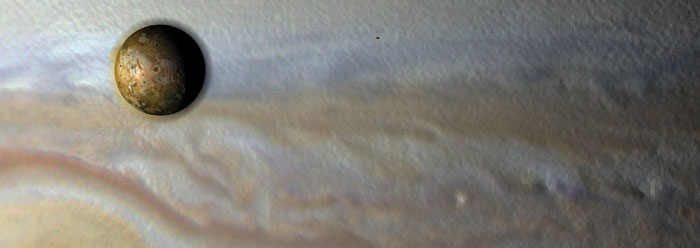
The most volcanically active body in the solar system is a little moon of Jupiter named Io. This moon is pumping out the hottest lavas known, from equator to pole, 24/7. That a small body could be this hyperactive is one of the major mysteries for adherents to the billions-of-years-old universe hypothesis.
Scientists at the Jet Propulsion Laboratory stood astonished when Voyager 1 transmitted the image of a volcanic plume rising above the limb of Io in 1979. These volcanoes have not ceased in the 28 years since. Io's pizza-like surface, devoid of impact craters, suggests this activity has continued much longer. Every square inch of the moon has been resurfaced by volcanic ejecta. In comparison, the surface of Io emits five times more energy than Yellowstone's thermal basins: 13.7 watts per square meter.
When the New Horizons spacecraft passed Io on March 1, 2007, it photographed a plume shooting 200 miles high near Io's north pole. This area sported a bright lava fountain when the Galileo spacecraft photographed it in 1999. Now, eight years later, the lava lake remained visible as a bright spot. Galileo observed one plume 370 miles high. Material from these eruptions forms a large donut-shaped ring, or torus, around Jupiter. This little moon has mountain ranges rivaling the Rockies and Himalayas.
Spectra of the lavas show them to be much hotter (2000° K) than earth lavas (1200° K). These ultramafic lavas contain the heavy elements iron and magnesium. If Io were as old as claimed, the heaviest elements should have sunk to the core, leaving a light crust 50km thick that heavy elements could not penetrate. Yet if the interior were mushy, it could not support the high mountains. And what generates all that heat?
The usual explanation is that Io is squeezed by the gravity of Jupiter and its neighboring moon Europa. Calculations show, however, that the tidal energy is an order of magnitude too low to produce the observed heat flow. A series of papers on "Io after Galileo" in the May 2004 issue of Icarus could not solve these problems. One scientist calculated in 2003 that if Io has been erupting over "geologic time" at 10% its current rate, it would have erupted its entire mass 40 times over by now.
Meanwhile, Io continues to sneeze at old-age beliefs. A record outburst on February 22, 2001, was the largest ever seen in the solar system. It covered a thousand times the area of Mt. Etna. This one outburst rivaled all of Io's other volcanoes put together. Another significant burst occurred less than a month later at a different location. Observations published in July 2007 indicated a doubling of sodium in the torus over a few months.
Io stands as a dynamic witness against the belief that the planets are 4.5 billion years old. Unfortunately for evolutionists, it's not the only one.
*David F. Coppedge works in the Cassini program at the Jet Propulsion Laboratory. (The author's views are his own.)
Cite this article: Coppedge, D. 2007. Spewing Hot Rocks on Old Ideas. Acts & Facts. 36 (10): 15.