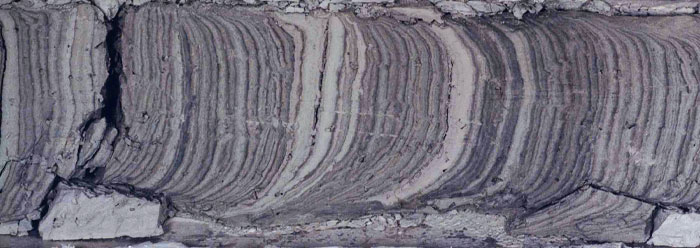
Visit any anti-creationist website and you're certain to find a discussion of varves, tiny laminae thought to be annual deposits within sedimentary strata. In some areas millions of these are found in succession, which are offered as "proof" of long ages. More importantly, many feel that this proves the Bible's account of recent creation to be in error.
Most often mentioned is the Green River Shale in the western U.S., famous for its precisely preserved fossilized fish. Here several million varves are found, one on top of the other, throughout this wide depositional basin. Does this discovery really disprove the biblical chronologies, or is there another explanation? First, let's gather the data.
It is true that under perpetually calm and regular conditions, varves do form in winter-summer couplets, with coarser materials on the bottom. But it's also true that in many natural settings, multiple pseudo-varves have formed quickly due to individual storms or unusual conditions. In many field observations and in laboratory experiments, multiple laminae can form almost instantaneously in simulated bottom-hugging density flows, now widely recognized as frequent throughout the geologic strata. Few knowledgeable geologists still cling to the myth of one varve equals one year.
One major problem has to do with the untold millions of fish fossils entombed within, exquisitely preserved over the extensive area. These fish are complete with eyes, scales, and other fine details. But fish quickly rot and disintegrate unless they are rapidly buried and kept away from scavengers, oxygen, and bacteria. Some appear to have burst from gases formed in their body cavities after death, but no evidence for much time can be adduced. Furthermore, the fish fossils are found in great numbers, which is hardly how fish carcasses behave under normal circumstances. Perhaps during a rapid deposition event one fish might be rapidly buried, but millions? Some of the fish appear to have been caught in life activities, such as in the process of eating another fish, not in a position a dead fish would assume if it quietly floated to the bottom of a lake to slowly await burial and fossilization.
This problem for uniformitarian thinking is compounded by the great numbers of other fossils present in the same formation. Many species of fish are preserved, seemingly from different habitats. Certainly different habitats are implied from the many reptile fossils found, as well as the varied plant fossils, upland species along with sub-tropical species. Many insects are present, as are marine invertebrates. Most remarkable are the multitudes of bird fossils, from shorebirds to forest dwellers to ocean feeders. Truly a remarkable mix of environments! Surely, this was not an everyday event. A rapid burial of organisms from varied life zones over wide portions of the continent is demanded.
Creationists haven't solved all the problems associated with this classic site, but research is continuing. We can be certain it won't be solved by the sterile uniformitarian thinking of the past. However, reasoning from the standpoint of the great Flood of Noah's day and its aftermath holds promise.
* Dr. Morris is the President of the Institute for Creation Research.
Cite this article: Morris, J. 2007. Varves: Proof for an Old Earth? Acts & Facts. 36 (10): 13.