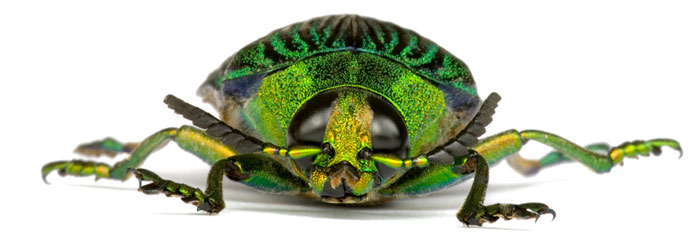
Recently scientists made a startling discovery in the world of insects. It involved a common beetle called the jewel beetle which is designed with the uncanny ability to detect flames of a forest fire perhaps 80 kilometers (approximately 50 miles) away.1 Not only that, but it can also hear the cracking of the wood and even sense combustion products in very small amounts using supersensitive receptors.
The jewel beetle (genus Melanophila) was first discovered and superficially described in 1960 by Canadian entomologist William George Evans. Dr. Evans insisted that the tiny pits of this curious beetle contained infrared receptors. The more research entomologists have conducted on this little creature the more amazed they become. For example, the black fire beetle (as it is called in Canada), like many animals in creation, requires special conditions in which to breed. This insect needs burnt wood from a blazing forest fire! But how does it find such conditions? It has been designed with special sensors—sensilla—in tiny pits on its underside that can actually pick up infrared (IR) radiation from the flames of a fire. This capability to detect infrared radiation (either from a fire, or heat produced by an animal) is quite amazing and has no evolutionary mechanism of development. As is known, this beetle (there are several species on several continents) and some snakes such as the pit viper are the only creatures with this ability.
Not surprisingly, with this capacity, jewel beetles are the first creatures to move into such an inhospitable environment. Because they are the first arrivals, there are no jewel beetle predators to worry about and they can proliferate in large numbers. The female flies to the still smoldering bark of a tree to lay her eggs. The young hatch and are safe inside the dead wood. The usual defense mechanism of a living tree to such insect predation (i.e., resin secretion and toxic chemicals—see Origins Issues: http://www.icr.org/article/2461) is, of course, halted. She finds these trees with the incredible infrared detector/feelers God has given her. Secular scientists state these feelers are just "modified mechano-sensors," but the creation scientist would say these are tools created for the job.
Jewel beetle research has been long and detailed, involving not just entomologists, but also chemical ecologists, physiologists, and a physicist. Scientists at the University of Bonn (Germany) are currently trying to mimic the features of the infrared feelers to see if they can cheaply manufacture thousands of these sensing devices. If they can, the devices can be mounted around forests, ready to register and alert foresters of a fire. The military is also interested in such capabilities. But as is often the case with man's attempts to mimic God's creative work, the first prototype sensor is large, cumbersome, and not nearly as accurate as the tiny jewel beetle.
Let's remember that random genetic mistakes, called mutations, cannot make all of the special apparatus described above. This is not the result of evolution, but the fingerprint of the Master Designer. In fact, the apostle Paul said that such highly sensitive infrared sensors studied today are evidence of God's creation. This is indeed "clearly seen" (Romans 1:20).
Reference
*Frank Sherwin is a zoologist and seminar speaker for ICR.
Cite this article: Sherwin, F. 2007. The Amazing Jewel Beetle. Acts & Facts. 36 (5).