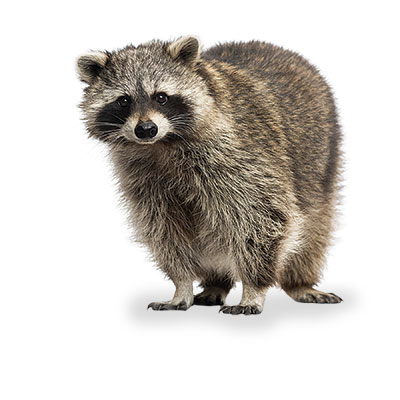
Consider the following scenario. A population of organisms, let’s say racoons, lives in an environment somewhere on Earth and eats a variety of foods. Its kind has thrived in that relatively stable environment for centuries. The weather suddenly cools for an extended period, and the creatures’ main food source diminishes. The racoons promptly respond by shifting their diet and behavior and search out more of their secondary foods. Their physiology appropriately adjusts to the change in diet. The creatures also respond to the temperature change by altering their metabolism—perhaps growing thicker coats and additional layers of fat that enable them to better cope with the cold. And the codes for these trait variations can rapidly transfer to the next generation. So, the racoons innately and quickly respond to the environmental changes in several appropriate ways.
One might claim that the environment influenced the racoons to change. Yet, the environment is only a collection of conditions to which organisms are exposed. The environment doesn’t possess any agency to make any of the changes happen. When people project human-like abilities onto nature it’s called personification. What actually caused the creature to change? Did nature send some sort of message to the racoons? Did nature select for their changes and survival? No, the act of sending requires a mind and a will to determine the signal’s content as well as the power and means to send the signal. Nature possesses none of these attributes.
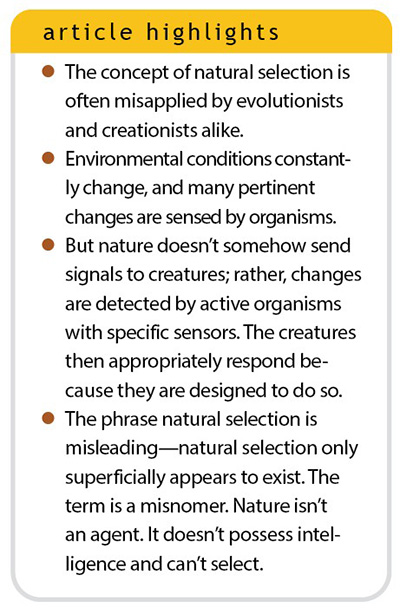
It’s clear the environmental conditions changed, but the change was actively detected by the creature rather than being sent to the creature. Information possessed within creatures is what specifies any given condition to be a stimulus for reaction.
We don’t observe natural selection “working,” “acting on,” or “favoring.” Applying these verbs is inaccurate and misleading. This pseudo-activity is misused by some to project agency onto nature and to view it as a substitute Creator. But all the activity—all the sensing, triggering, processing, and selecting— originated within the creature. The racoon is the active, causal entity in each step. Its built-in sensors actively look for the many changes in the environment that specifically relate to its wellbeing and that of its offspring.
The creature’s body systems are specifically engineered to do all these active things: they sense changed conditions, sort the incoming data, employ the innate if-then logic built into their systems for proper response—often quickly and predictively. The systems then execute responses from a number of potential actionable options, enabling the creature to adjust to and thrive in its new conditions. The systems then conduct “surveillance” for the next changes. All these phenomenal attributes are innate to the creature. They were specifically designed and placed into the creature from the moment of its creation.
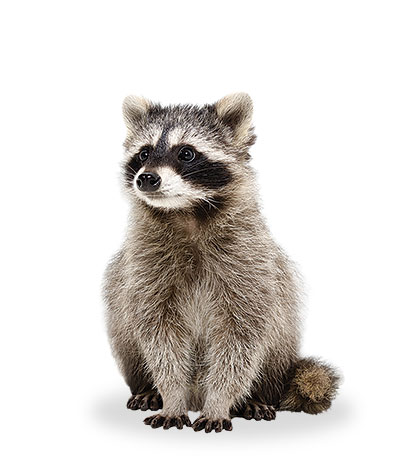
Going back to our example, if environmental conditions revert back to their initial state, the racoon usually retains the built-in ability to change itself, and its subsequent generations, back to what worked best for that context.
Darwin knew virtually nothing of the profoundly complex genetic and epigenetic codes creatures possess when he came up with the misleading concept of natural selection. Darwin based his concept on mere appearance. I can select, you can select, but nature can’t select. Natural selection is clearly an illusion. Conditions simply exist. They are real and often change, but they can’t create precise new code to cause change. The complex code must be written by a writer, designed by a designer, programmed by a brilliant programmer: Christ Jesus.
References
- Natural Selection Part 1: A Darwinian Deception. Creation.Live Podcast. Episode 1. June 20, 2022.
* Mr. Stamp is an editor at the Institute for Creation Research.