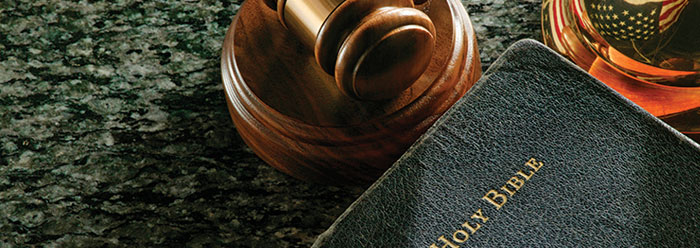
When an American astronaut quotes Psalm 24 and is faulted for violating the so-called separation of church and state, it’s time to learn about balance.1 Just as mountain goats need a body designed for balance, we also need deliberate balance in the political arena, where Christians are routinely told to shut up to avoid offending non-Christians.
The balance of individuals’ civil liberties—such as religious freedom and free speech rights—and the stability of a mountain goat on steep slopes are both examples of high-stakes balancing acts. Consider the agility of the sure-footed mountain goat.
Their hooves are structured to [optimize] balance and grip; the outer hoof is strongly reinforced and the bottom is lined with rubbery material, making the whole structure rather like a good hiking boot.2
The high-altitude dexterity of the mountain goat is so phenomenal that it routinely spends time on precipitous terrain steeper than a 40o or even 60o angle.3 God purposefully designed mountain goats for balance because living among alpine rocks is a high-risk lifestyle.
The same is true for religious liberty in American society. Legitimate needs of church and state are deliberately balanced with the personal rights of individuals. Securing fundamental religious freedoms is no lackadaisical endeavor and is not easily obtained or maintained.4
The First Amendment is purposefully designed for balance.
Congress shall make no law respecting an establishment of religion, or prohibiting the free exercise thereof.5
It is to this legal text that the “separation of church and state” concept is retroactively attached, often with backdated interpretations that clash with the First Amendment’s original intent. However, as a matter of honesty and valid interpretation, the real meaning of any message must be matched to the composer’s intent. Thus, the only legitimate understanding of the First Amendment is the one that matches the meaning assigned by its human source.5-7 As a text drafted by statesmen in the late 1700s (principally by James Madison), the authorial intent balanced a rejection of government-established church organizations (such as the official Church of England) with an affirmation of peaceful expression of individual religious beliefs and moral values. In other words, the First Amendment acknowledged that Christians owned the right to freely express their religious viewpoints at the personal level, yet Congress shall not officially endorse or establish any specific ecclesiastical organizations, such as Baptists, Presbyterians, or Anglicans. This balancing of freedom and order—free exercise of religion without any federal sponsorship of a particular religious denomination or hierarchy—fits the overall checks-and-balances equilibrium designed in 1791.6
The real object of the First Amendment was not to countenance, much less to advance, Mohammedanism, or Judaism, or infidelity, by prostrating Christianity; but to exclude all rivalry among Christian sects, and to prevent any national establishment which should give to a [religious] hierarchy the exclusive patronage of the national government.8
This political balancing act was planned and intended by America’s founding fathers. Yet now the phrase “separation of church and state” is used to force-fit an off-balanced understanding of the First Amendment. How? The constitutional jurisprudence of America became “evolutionized” during the late 1800s, upsetting the proper balance between religious liberty and governmental interference.5-8
How evolutionary thinking infected American law will be reviewed in an upcoming article. Meanwhile, don’t believe it when someone tells you the First Amendment prohibits an individual from reading his Bible—on Earth or in space—or from sharing that personal fact via Facebook. That someone has obviously lost his balance.
References
- On April 3, 2016, U.S. astronaut Col. Jeff Williams posted on Facebook, “We finally have a quiet Sunday and I’m reading, ‘The Earth is the LORD’s and all that fills it’ in Psalm 24 and viewing this sight [Earth as seen from the International Space Station]. No matter how long you’re here, the grandeur strikes and the wonder never fades.” An individual retorted, “Jeff Williams could you please leave your personal religious views out of your public posts. You are a government employee. In America we have a separation of church and state. Don’t use your publicly funded position to promote personal views….Please keep it private and keep posting these wonderful scientific pictures without the religious OPINIONS.”
- Kricher, J. C. 1998. A Field Guide to Rocky Mountain and Southwest Forests. Boston: Houghton Mifflin, 235-236.
- Constantz, G. 2014. Ice, Fire, and Nutcrackers: Rocky Mountain Ecology. Salt Lake City, UT: University of Utah Press, 224-226.
- Most nations prohibit the free exercise of religious liberty, either by establishing one religion to the prejudice of others or by persecuting theistic religions.
- U.S. Constitution, First Amendment (Free Exercise and Establishment clauses), ratified 1791. The balancing of civil government powers, ordained by God’s delegation, with jurisdictional limits to facilitate religious freedom, accords with relevant Scriptures, e.g., Matthew 22:21; Romans 13:1-4; Daniel 2:21 and 4:25—and with Israel’s separation of religious offices (tribe of Levi) from the monarchy (tribe of Judah).
- The entire Bill of Rights (i.e., Amendments 1-10) limited federal government powers. Ironically, most of the Constitution’s later amendments expanded those powers. Eidsmoe, J. 1995. Institute on the Constitution: A Study on Christianity and the Law of the Land. Marlborough, NH: Plymouth Rock Foundation, 71-73. See also Eidsmoe, J. 1987. Christianity and the Constitution: The Faith of Our Founding Fathers. Grand Rapids, MI: Baker Books, 77-178. Ironically, Thomas Jefferson (author of the phrase “separation of church and state”) was in France during the Constitution’s and Bill of Rights’ drafting and approval process, so his opinion of the First Amendment’s intent is interpretatively irrelevant.
- The First Amendment’s meaning is contextually blended to the axiological fabric of the Declaration of Independence (referring to our Creator, Nature’s God, the Supreme Judge of the world, and Divine Providence) and to the Christian worldview evidenced by the U.S. Constitution’s Article VII, which refers to “the year of our Lord.”
- Eidsmoe, Institute on the Constitution, 76, quoting Justice Joseph Story. 1833. Commentaries on the Constitution of the United States, vol. 2. Boston: Hilliard, Gray & Co., 593.
* Dr. Johnson is Associate Professor of Apologetics and Chief Academic Officer at the Institute for Creation Research.