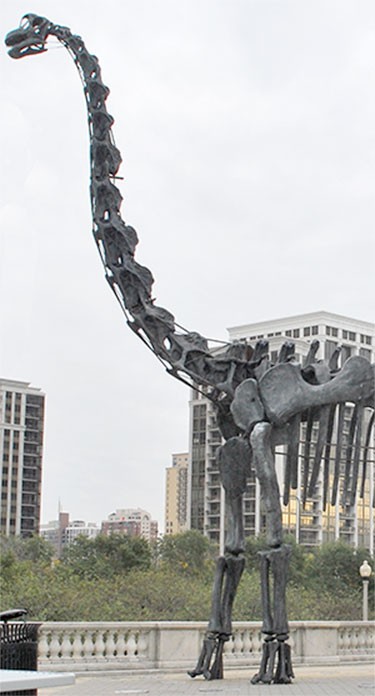
 When someone says "ribs," people immediately think of those organ-protecting bones that wrap around a thorax. Well, cervical ribs are different, and cervical ribs on extinct long-necked dinosaurs were very different. They ran the whole length of certain sauropods' necks. Each rib attached to a neck vertebra, and each rib stretched across the length of three total vertebrae. Were these cervical ribs an evolutionary happenstance, or did they serve some kind of function as though created on purpose?
Dr. Michael Habib has an interesting job. He "reconstructs the performance and motion of fossil animals" for the Natural History Museum of Los Angeles County.1 Presenting at the 75th annual meeting of the Society of Vertebrate Paleontology, Dr. Habib revealed some amazing design features from his analysis of sauropod cervical ribs.2
First, the rib material was probably not hard bone. Dr. Habib said that the cervical ribs he excavated were warped, having conformed to the shape of vertebrae beneath them. Strangely, this sauropod specimen had been buried belly-up. The cervical ribs were probably made of ossified (partly biomineralized) tendons, meaning they had more cartilage and less mineral than hard supportive leg bones.
More cartilage means more flexibility. Imagine a sauropod trying to bend its neck upward or sideways, only to break one of its long and slender cervical ribs. Ossified tendons could bend farther than typical bones.
In modeling various deflection forces, Habib considered that long structures anchored at only one end, like an airplane wing, tend to wobble with a certain frequency depending on the structure's total length. Imagine the various lengths of piano strings sounding different notes. For example, when a brachiosaur took a step toward a tree branch to eat leaves, what would keep its neck reverberations from sending its head lurching and wobbling?
One solution would have an intricate array of muscles between each vertebra that counteracted those pesky wobbles. But powering and coordinating muscles costs energy. Instead, according to Habib, certain sauropods relied on their cervical ribs to dampen the wobble without exertion.
Habib compared the cervical ribs to leaf springs—structured somewhat like the bow in a bow and arrow—to passively and efficiently control the would-be wobble along the sauropod's neck. He told the audience that cervical ribs acted as "passive energy-dispersing bands [leaf springs] situated out-of-phase with the oscillation patterns of the whole neck." In other words, the brachiosaur's cervical ribs absorbed the wobble energy of its neck, leaving its tiny head in a stable enough position to eat as many leaves as it wanted. This amazing design feature allows us to appreciate the Creator's ingenuity. He who "made the heavens and the earth, the sea, and all that is in them, and rested the seventh day" clearly crafted cervical ribs to take care of creatures that He foreknew would point back to His wisdom even after they went extinct.3
References
- Research Associates. Fact Sheet, Natural History Museum, Los Angeles County. Posted on nhm.org, accessed October 22, 2015.
- Habib, M., and L. Chiappe. Elastic titans: Functional analysis of sauropod necks reveals potential for elastic dampening and a novel blood flow assistance mechanism. Technical Session XVII, October 17, 2015, 1:45pm. Dallas, TX: 75th annual meeting of the Society of Vertebrate Paleontology.
- Exodus 20:11.
*Mr. Thomas is Science Writer at the Institute for Creation Research.
Article posted on November 5, 2015.