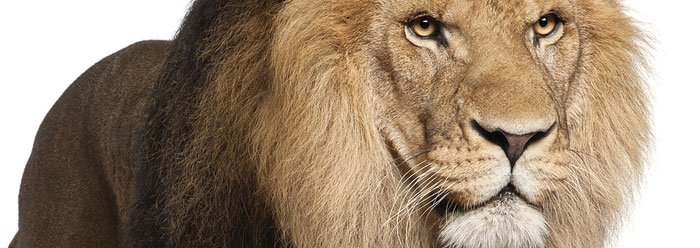
Lions look designed to kill, both inside and out. Sharp teeth and claws, a short digestive tract, powerful limbs—all these features suggest “predator,” not tame and gentle pet. Yet in the beginning, God gave “to every beast of the earth…wherein there is life” plants as food, not animal flesh (Genesis 1:30). Only after man sinned (Genesis 3) did human and animal death enter the world (Genesis 1:31; Romans 5:12; 8:20-22). So where did today’s carnivous lions come from?
Our modern conception of lions stems from the meat-eating cat species that currently dwells in Africa and India. Recent hybridization evidence indicates that this species belongs to the cat “kind,” a grouping of related species that includes tigers, jaguars, leopards, ocelots, domestic cats, and likely all cat species large and small.1 Since God commanded Noah to take two of every “kind”—not two of every species—on board the Ark, our modern lion species was probably not on the Ark but, rather, descended from the two cats (felids) that did board the Ark.
Could lions have existed before the Flood? God permitted predatory behavior among all potentially carnivorous animals when He instituted the Curse of Genesis 3. Furthermore, the fossils of now extinct feline carnivores indicate that ferocious-looking saber-toothed cats once inhabited this planet. Hence, lions of a different sort may very well have attacked animals in the pre-Flood world.
How did these big cats acquire their sharp teeth? At the Curse, God probably didn’t speak sharp teeth into existence out of nothing. His acts of global creation were finished by day seven of the creation week (Genesis 2:1-3; Exodus 20:11; Hebrews 4:3). So where did the lion’s teeth come from?
Traditionally, creationists have invoked several types of mechanisms to explain how the creation went from “very good” (Genesis 1:31) to “cursed” (Genesis 3) without a second creation event. For example, God may have created creatures with latent genetic information to be “switched on” only after Genesis 3, a concept similar to the “mediated design” model.2
Alternatively, God may have created anatomical and physiological features capable of multiple purposes. Powerful jaws, now used to kill and tear flesh, may have initially been used to open fruits and plant seeds of the size and hardness of modern watermelons and coconuts. Could the lion’s teeth have been used for tearing tough plants and roots in the beginning?
Biblically, this latter hypothesis is compelling. Consider the effects of the reversal of the Curse in Isaiah 11:6-7: “The wolf also shall dwell with the lamb, and the leopard shall lie down with the kid; and the calf and the young lion and the fatling together…the lion shall eat straw like the ox.” In reversing the Curse, God doesn’t seem to change the lion’s anatomy; He simply changes the lion’s behavior.3 Furthermore, Scripture explicitly mentions God switching the mental states of animals after the Flood (Genesis 9:2). Might He also have done something much like this at the Curse?
Scientifically, predatory behavior and herbivorous diets show up in unexpected places. “Darwin’s finches”—the species inhabiting the Galápagos Islands—seem designed to crack plant seeds and probe cactus flowers. Yet one of these gentle-looking species drinks the blood of other birds.4 Conversely, the panda bear has sharp teeth and a short digestive tract—hallmarks of a flesh diet—yet it survives strictly on bamboo, a phenomenon that continues to puzzle scientists.5 Clearly, the diet of an animal cannot be identified solely from its anatomy.
Did lions parade past Adam in the Garden, sharp teeth and all? Quite possibly, though they would have been tame and strictly herbivorous.
References
- Pendragon, B. and N. Winkler. 2011. The family of cats—delineation of the feline basic type. Journal of Creation. 25 (2): 118–124.
- Wood, T. C. 2003. Mediated Design. Acts & Facts. 32 (9).
- Special thanks to Dr. Paul Benware for bringing these verses to my attention.
- Weiner, J. 1994. The Beak of the Finch. New York: Vintage Books.
- Li, R. et al. 2010. The sequence and de novo assembly of the giant panda genome. Nature. 463 (7279): 311-317.
* Dr. Jeanson is Deputy Director for Life Sciences Research and received his Ph.D. in Cell and Developmental Biology from Harvard University.
Cite this article: Jeanson, N. 2013. Did Lions Roam the Garden of Eden? Acts & Facts. 42 (7): 13.