In this month’s Impact article, Dr. James Johnson and I introduced the concept of megasequences in geology, which are confirmed by a literal reading of Genesis.1 Recognition of the fact that the sedimentary geologic layers are not separate entities, but are grouped in “packages,” came through plotting the sediment types, location, and “ages” on the continental scale. The megasequences were first discovered by professional geologists who were primarily involved in oil and gas exploration through field identification of correlating layers, and oil well logs and cuttings. The concept was much extended through the use of subsurface seismic exploration, and now all professionals have adopted and use the concept.
Each grouping of sedimentary layers contains features best understood in the sense of a transgression of the ocean onto the continents, followed by a regression back into the sea and the resulting erosion, followed by a second sequence, and then another. Uniformitarians interpret each sequence as having taken many millions of years.
During transgression, the waters brought and deposited sediment (usually marine) on the continent. During regression, the waters eroded much newly deposited and older sediments as they ran off the continents, producing a recognizable erosional boundary called an unconformity. The six (or more) megasequences comprise the entire Phanerozoic (fossil-bearing) geologic column, and have been correlated with beds right across North America and even onto other continents. Since rapidly moving water can accomplish much geologic work, while stationary water does little, this concept bears promise as the primary character of the great Flood of Noah’s day.
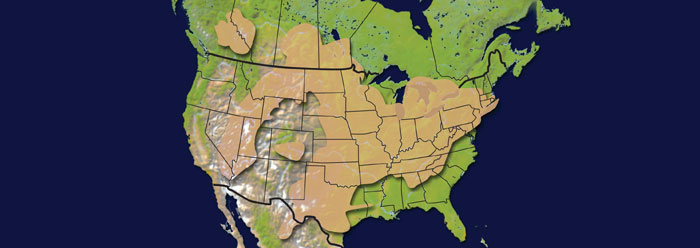
Each sequence begins with a basal sandstone containing sand grains of lessening diameter as one moves upward through the layer. This is typically covered by shale or siltstone composed of tiny particles, which in turn is covered by extremely tiny, precipitated particles. The lowest megasequence is the Sauk Megasequence, which was followed by an erosional unconformity. The overlying megasequence is called the Tippecanoe Megasequence. The pure quartz sandstone at its base is called the St. Peter Sandstone, and above that lie shale and limestone beds, also followed by an unconformity.
The erosion and resulting unconformity that ended the Sauk Megasequence was totally unlike anything we have ever witnessed, and would actually be wholly impossible today. This erosional episode worked on the recent Sauk deposits and planed them off to a nearly flat, featureless plain. On the entire continent, no mountain remained, for the St. Peter Sandstone covers essentially the entire continent with a sheet of sand roughly three thousand miles by one thousand miles in area, yet less than 300 feet thick! Evidently, even though subsequent erosion has now removed the sandstone in some areas, it was essentially continuous at first, implying there were no high places on the continent that received no sediment. This can be better comprehended by considering a sheet of paper 0.1 millimeters thick measuring 1 kilometer by 0.6 kilometer draped across a surface flattened with extreme care. This could not have been accomplished by river erosion. The only adequate mechanism is by “sheet erosion”—rapidly flowing water of equal depth that covered a wide area.
Uniformitarianism considers the sand to have been deposited by a transgressing shoreline, with sand accumulating on the beach and offshore over about five million years, all the while migrating across the continent. They consider the St. Peter Sandstone to be Early Ordovician in age, or about 480 million years old. But the widespread catastrophic conditions required make the Flood proposal more likely.
Reference
- Morris, J. and J. J. S. Johnson. 2012. The Draining Floodwaters: Geologic Evidence Reflects the Genesis Text. Acts & Facts. 41 (1): 12-13.
Image: Area covered by the St. Peter Sandstone and correlating strata, the basal sandstone deposited at the beginning of the Tippecanoe Megasequence.
* Dr. Morris is President of the Institute for Creation Research.
Cite this article: Morris, J. 2012. The St. Peter Sandstone. Acts & Facts. 41 (1): 14.