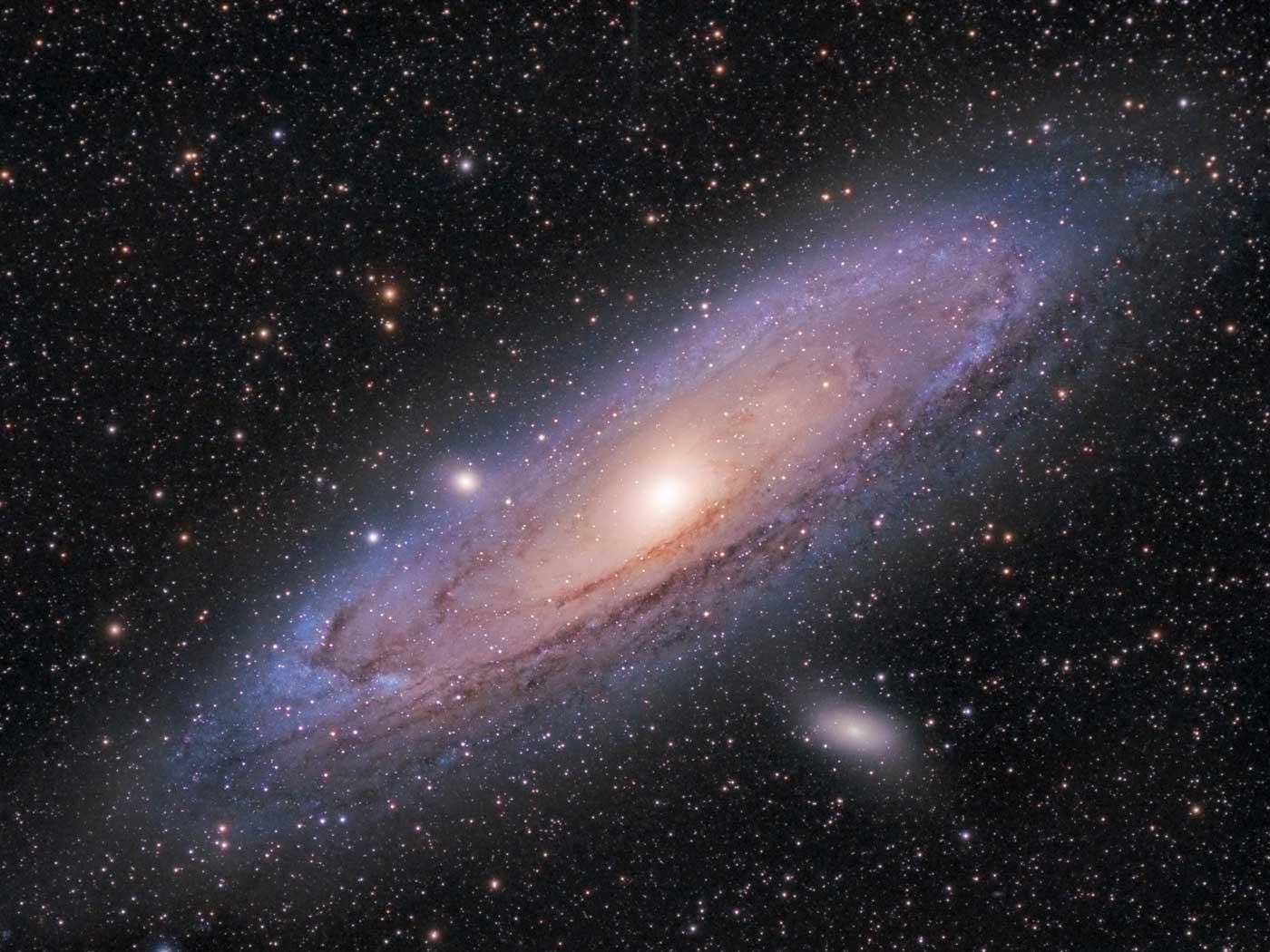
On June 10, ICR News featured a report on the latest "sky map," an immense 3-D look at distant galaxies that clearly shows that matter is concentrated in massive clumps separated by giant voids.1 Just days later, a new paper presented similar findings. These cosmological clumps pose an enormous conundrum to naturalistic theories of origins.
According to standard cosmologies, an explosive beginning such as the Big Bang should have distributed matter more smoothly across the universe. Shaun Thomas, lead author of the research appearing in the journal Physical Review Letters, told Wired Science, "This potentially could be one of the first signs that something peculiar is going on."2 Potentially? Such signs have been abundant.3, 4, 5
Thomas and his colleagues used data from the Sloan Digital Sky Survey, which represents an unprecedented "zoom out" view of the universe, to analyze the 3-D distribution of hundreds of thousands of galaxies. Seen from such a great distance, and assuming a naturalistic origin, matter should appear to be twice as smooth (i.e., evenly distributed) as it actually is. However, the matter is "clumpier than astronomers expected."2
This new observation adds to others that together demonstrate how poorly the matter distribution in the universe fits nature-only models, and therefore how much better it fits the creation model. Much like the arrangement of molecules in a living cell, the arrangement of galaxies in the universe is best explained by purposeful placement.
In an effort to model the level of "clumpiness" that had already been known up to this point, researchers invoked unobserved entities called "dark matter" and "dark energy." Supposedly, the gravity of some invisible matter or the force of some undetectable energy could have attracted the matter that makes up galaxies into their current clumped arrangements, leaving gigantic voids where no galaxies reside.
But invoking the distribution of dark matter or energy to solve the problem of the distribution of real matter raises even more questions than before. What is dark matter and where did it come from? And what process distributed the dark matter into clumps and voids so that real matter would follow its lead?
This new study describes a universe with characteristics that cannot be accounted for even by an ad hoc distribution of dark matter or energy. For this reason, the authors wrote that clumps this big imply "an anomaly on the largest physical scales probed by galaxies."6
According to Wired Science:
The result could mean cosmologists need to reassess their understanding of dark energy, the mysterious force that drives the universe outward at an ever-increasing rate. Dark energy itself is supposed to be almost perfectly smooth, but clumps of dark energy could draw clumps of visible matter around them.
The extra lumps could also mean dark energy doesn't exist at all. Instead, gravity could behave differently on very large scales than it does on smaller scales, meaning Einstein's theory of general relativity needs an overhaul.3
So, rather than consider the possibility that galaxies have been put in place on purpose, which best fits the data, these scientists instead questioned the fundamental laws of physics, such as general relativity. What would cause gravity to behave differently over very large distances, and where would that cause have originated?
If Scripture is correct that "the LORD…stretcheth forth the heavens, and layeth the foundation of the earth, and formeth the spirit of man within him,"7 then it would make sense that God constructed the universe with particularly non-random features, so that those who observe them would be without excuse for choosing to disbelieve in Him.
The newfound clumpiness of matter in the universe, which is "much clumpier than current cosmological models predict,"2 looks like just this kind of signature feature.
References
- Thomas, B. New Sky Map Shows Big Bang Even More Unlikely. ICR News. Posted on icr.org June 10, 2011, accessed June 17, 2011. Although the map may look like random dots to some viewers, the dots in this map represent different galaxies that are clustered in some regions and absent from others.
- Grossman, L. Clumpiness of Distant Universe Surprises Astronomers. Wired Science. Posted on wired.com June 16, 2011, accessed June 17, 2011.
- Thomas, B. Inflation Hypothesis Doesn't Measure Up to New Data. ICR News. Posted on icr.org January 29, 2009, accessed June 20, 2011.
- Thomas, B. Bursting Big Bang's Bubble. ICR News. Posted on icr.org October 10, 2008.
- Coppedge, D. 2008. Cosmology's Error Bars. Acts & Facts. 37 (7): 15.
- Thomas, S. A., F. B. Abdalla and O. Lahav. 2011. Excess Clustering on Large Scales in the MegaZ DR7 Photometric Redshift Survey. Physical Review Letters. 106 (24): 241301.
- Zechariah 12:1.
Image credit: Volker Springel/Max-Planck-Institute for Astrophysics, Garching, Germany
* Mr. Thomas is Science Writer at the Institute for Creation Research.
Article posted on June 30, 2011.