by Brian Thomas, M.S., & Frank Sherwin, M.A. *
Ask any judge—when reconstructing the past, the testimony of reliable eyewitnesses rountinely trumps other forms of evidence. And there are more than a few ancient eyewitness testimonies that provide the best answers to questions about dinosaurs.
The first and most important eyewitness was the Creator Himself. He wrote in Genesis 1:25:
And God made the beast of the earth after his own kind, and cattle after their kind, and every thing that creepeth upon the earth after his kind.
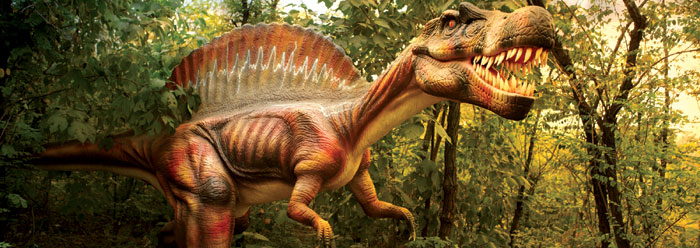
“Cattle” refers to domesticated animals, “creeping things” refers to small creatures, and “beasts of the earth” are the large, non-domesticated animals. There were about 50 different basic “kinds” of dinosaurs, and their fossils show that they had well-proportioned bodies that were well-designed for the life each led. Some dinosaurs, like Compsognathus or Mussaurus, were small “creeping things.” But others, like Tyrannosaurus or Ultrasaurus, were large “beasts of the earth” made alongside man on Day 6 of the creation week, according to the testimony of the only One who was actually there.
So, if dinosaurs were created and once lived in abundance, as the fossil record testifies, then why are they not still alive?
Genesis 7:22 states that during the Flood, “all in whose nostrils was the breath of life, of all that was in the dry land, died.” Dinosaurs living on earth at that time would have perished in its waters, since their fossil skulls show nostrils and they would have therefore had “the breath of life.” Also, dinosaur fossils are most often found in jumbled assemblages, having been buried in water-borne mud that hardened into rock layers covering enormous regions.1 These fossils are found on all continents, just as would be expected from a worldwide Flood.
For example, thousands of Centrosaurus remains cover an estimated 568 acres in Alberta, Canada. The discoverers said that “the likely culprit in this scenario was a catastrophic storm, which could quickly have routinely made the waters flood up as high as 12 to 15', if experiences with modern floodplains are any guide.”2
In fact, evolutionists admitted that this planet could have once been covered with water (almost). Mike Tice of Texas A&M University said, “We are talking about a time when, if you were looking at the Earth from space, you would hardly see any land mass at all. It would have almost been an ocean world.”3
Though most land creatures were drowned and preserved in vast sedimentary rock units, at least two of each basic kind, including dinosaurs, went aboard the Ark. Genesis 7: 8-9 states, “Of clean beasts, and of beasts that are not clean, and of fowls, and of every thing that creepeth upon the earth, there went in two and two unto Noah into the ark, the male and the female, as God had commanded Noah.” The three sons of Noah were firsthand eyewitnesses to these events and co-authored this section of Scripture, which ends with their “signatures” in Genesis 10:1.4
Those who claim that dinosaurs could not have fit on the Ark might recall that the average dinosaur size was on the order of that of a large dog. Even the massive dinosaurs started out from football-size eggs, and juveniles of these groups could have easily been selected to board the life-saving vessel.
What about the descendants of the dinosaurs that stepped off the Ark after their year-long stay? Again, eyewitness evidence confirms that dinosaurs lived for centuries after the Flood. Many encounters with “dragons” were recorded as stories, in ancient news and scholarly reports, and in conquest records.
St. George had to deal with a dragon. Alexander the Great’s army encountered a dragon. Marco Polo recorded dragon dealings. Flavius Philostratus provided this sober account in the third century A.D.:
The whole of India is girt with dragons of enormous size; for not only the marshes are full of them, but the mountains as well, and there is not a single ridge without one. Now the marsh kind are sluggish in their habits and are thirty cubits long, and they have no crest standing up on their heads.5
Pliny the Elder also referenced large dragons in India in his Natural History. More recently, historian Bill Cooper described many ancient news accounts of dinosaur encounters from England and Europe, which to this day contain place names that reference the dragons that were once there, like “Knucker’s Hole,” “Dragon-hoard,” and “Wormelow Tump.”6
Similar accounts have been handed down orally within North, Central, and South American Indian groups. The fact that so many different peoples told the same details authenticates their testimony. The book Fossil Legends of the First Americans relays information about anatomy, habitat, and hero tales related to “a water monster that ‘grew so huge’ (p. 29), a Pawnee giant raptor called Hu-huk (p. 189), a Yuki story of giant lizards that ‘were so huge that they shook the earth’ (p. 208), Sioux legends of thunderbirds (p. 239), and many other legends.”7 The Chinese and over 200 other cultures have detailed stories about “dragons.” Why, if such creatures were only mythical beasts?
In the Bible, Job appears to have observed a dinosaur. God commanded him:
Behold now behemoth, which I made with thee; he eateth grass as an ox. Lo now, his strength is in his loins, and his force is in the navel of his belly. He moveth his tail like a cedar. (Job 40:15-17)
Since Job lived 300 to 400 years after the Flood, the dinosaur he beheld had to have been a descendant of one of those on the Ark. How did mankind handle post-Flood dinosaur encounters? Most likely, the dinosaurs were eliminated by humans trying to protect themselves. This is a common theme in the many dragon legends.
It is generally agreed that “the current extinction crisis is caused primarily by human impacts upon wild populations,”8 and it is the largest, most dangerous wild creatures that are the first to go when humans move into an area. Thus, dinosaurs likely went extinct gradually the same way that scientists today observe extinctions.
People who wished to move into a dinosaur-inhabited area would undoubtedly have preferred at some point to eliminate the life-threatening dragons. Wolves, bears, and large cats have been driven far away from many of the areas of North America they once abundantly inhabited. As another example, the moa was a huge flightless bird that once constantly threatened New Zealand’s native Maori. They were entirely gone by the 19th century.
The idea that post-Flood dinosaur extinctions were recent and were mostly due to human encounters is consistent with what science has observed, and is also consistent with the best historical sources—eyewitness accounts. The big questions about dinosaurs are explained well with the Bible’s reliable history.
References
- Hoesch, W. A. and S. A. Austin. 2004. Dinosaur National Monument: Jurassic Park or Jurassic Jumble? Acts & Facts. 33 (4).
- Choi, C. World’s largest dinosaur graveyard linked to mass death. LiveScience. Posted on livescience.com June 23, 2010, accessed March 16, 2011.
- Bergeron, L. Stanford study: Earth’s early ocean cooled more than a billion years earlier than thought. Stanford University press release, November 11, 2009.
- Dr. Henry Morris states, “This is the fourth toledoth of the book of Genesis (previously noted at [Genesis] 2:4; 5:1; 6:9), presumably marking the signatures of Shem, Ham and Japheth after completing their narrative of the flood and the immediate post-flood years.” Morris, H. M. 2006. The New Defender’s Study Bible. Nashville, TN: World Publishing, Inc., 45.
- Flavius Philostratus (c170-c247 A.D.). 1912. The Life of Apollonius of Tyana, volume I, book III. F. C. Conybeare, trans. New York: Macmillan Co., 243-247.
- Cooper, B. A. 1995. After the Flood. Chichester, UK: New Wine Press, 130-145. Available online at ldolphin.org/cooper.
- Thomas, B. 2010. Oblivious to the obvious: dragons lived with American Indians. Journal of Creation. 24 (1): 33. This is a book review of Mayor, A. 2005. Fossil Legends of the First Americans. Princeton, NJ: Princeton University Press.
- Woodroffe, R. 2000. Predators and people: using human densities to interpret declines of large carnivores. Animal Conservation. 3 (2): 165-173.
* Mr. Thomas is Science Writer and Mr. Sherwin is Senior Science Lecturer at the Institute for Creation Research.
Cite this article: Thomas, B. and F. Sherwin. 2011. Eyewitnesses to Extinction. Acts & Facts. 40 (6): 16-17.