"For our light affliction, which is but for a moment, worketh for us a far more exceeding and eternal weight of glory" (II Corinthians 4:17)
Evolutionists have long thought that man descended from an unknown ape-like ancestor. This hypothetical "missing link" wasn't an ape in the modern sense, but if you had seen this imaginary creature coming toward you on a jungle trail, you would have called it an ape.
The idea is that modern apes and humans are cousins, having split into separate categories some 7-10 million years ago. Unfortunately, no fossil traces of the ancestor have been discovered. The best specimen on our wing of the split, dated at 3.2 million years, thus the one closest to the hypothetical missing link, is the well-known "Lucy." Officially, named Australopithecus afarensis, this 3'6" tall "ape-man" was quite like a bonobo chimpanzee, with a chimp-sized brain, long curved fingers and toes for climbing trees, a protruding face, and large molar teeth. But advocates claim she may have walked slightly more erect than other chimps, thus man's ancestor.
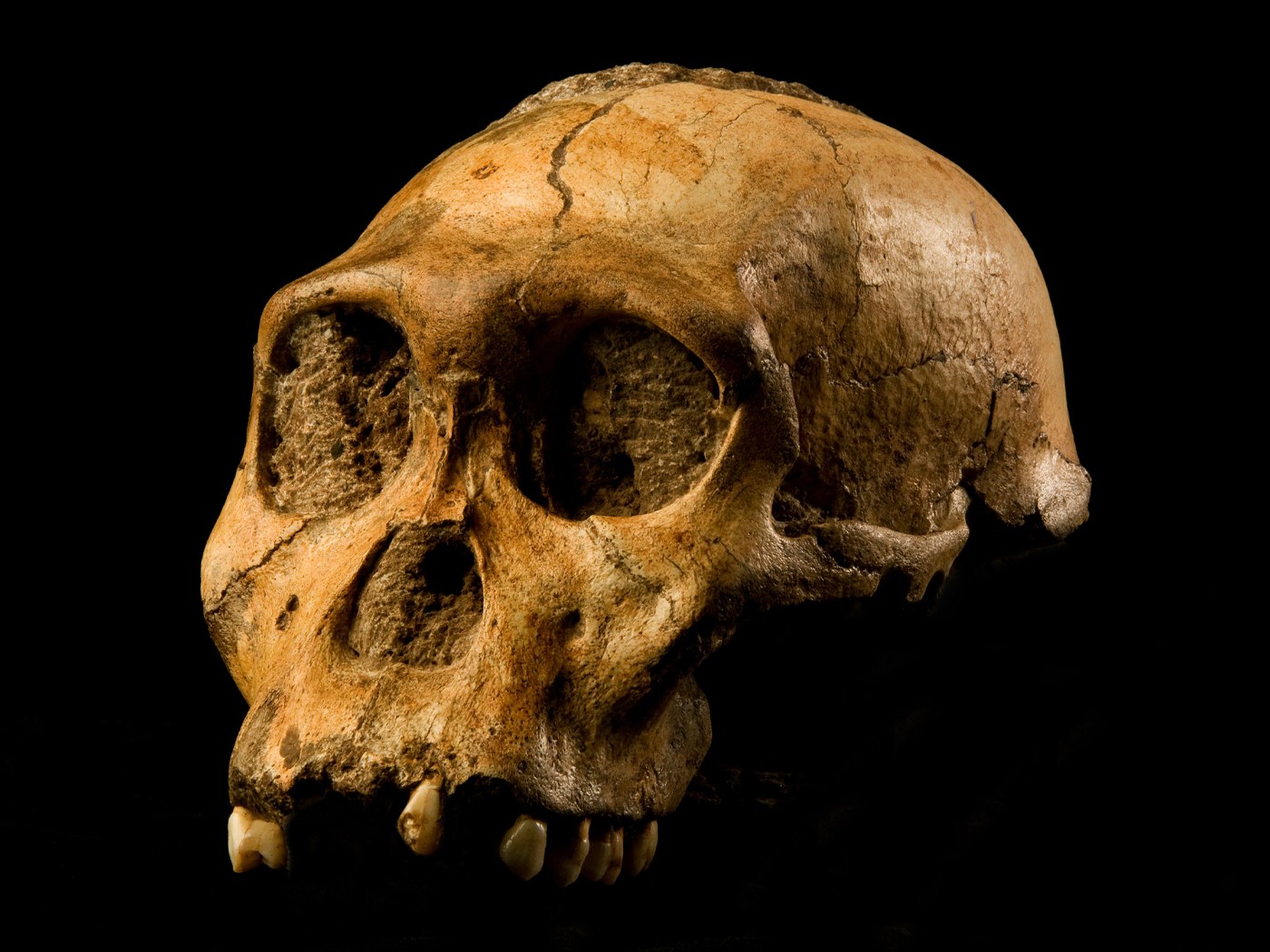
The March 22, 2001, issue of Nature revealed an older specimen named Kenyanthropus platyops. It was dated at 3.5 million years old, and consisted of several bones and teeth, but especially a fairly complete, although "distorted" cranium. It is this skull which mainly distinguishes it from Lucy, for the face seems flatter, with jaw protruding slightly less than other chimps, and somewhat smaller molars. Since humans have relatively flat faces and small molars, platyops, being older and more "human," knocks Lucy right out of our family tree.
This is an event of no small magnitude, for Lucy has been the darling of evolutionists since the 1970s. It was claimed that she "proved" that man came from an ape-like ancestor, and she found her way into museums, textbooks, TV specials, and kids books. Diatribes against creationist critiques of Lucy were arrogant and vicious. Losing her should hurt!
Of course, creationists have long pointed out that she, at most, was an unusual chimp-like creature, which may have walked slightly more erect than other chimps. Thus the admission printed in the USA Today (March 21) that "Lucy has been losing favor over the past 10 years" was astounding, as was the quote by Rick Potts of the Smithsonian Institute that "I and many others believe Lucy needs to be replaced." Why hasn't this skepticism over Lucy been made public? Why have experts allowed a controversial claim to brainwash millions? It seems that now that they have a better candidate, they are willing to let a poor one go.
But is platyops better? According to Meave Leakey et al. in Nature, the "distorted" skull exhibits "expansion" and "compression" subsequent to burial. Furthermore, the flatness of the face is not visible in the photographs published. The jaw protrudes noticeably, and must be only a fraction less pronounced. The teeth were small for Australopithecus, but variety is expected with such a low number of specimens.
Of primary interest is the lack of agreement on the interpretation of any particular bone or on the overall theory. The relinquishing of a favorite story in favor of one supported by questionable data should encourage those who hold that man, created in the image of God, is totally distinct from the animals.