Squid, octopus, nautilus, and cuttlefish are unlike any other marine creatures. With brain, eyes, mouth, tentacles, and, for squid, jet-propulsion siphon clustered at one end of the body, the cephalopod design is so effective that most of these creatures successfully hunt fast-swimming fish for food. But was their body design engineered by a Creator or chanced upon by nature?
A fossilized soft-bodied creature was recently featured in a study published in Nature,1 and its anatomy and position in the rocks have a bearing on this question. The tiny five-centimeter-long creature has been called "squid-like" because it only had two tentacles and no internal shell such as modern squids have. Scientifically named Nectocaris pteryx, it was first described in the 1970s from fragmentary evidence. Can newer, more complete fossils discovered in the Burgess Shale formation shed more light on its history?
While finding this unique cephalopod was exciting, finding it "out of place" in the fossil record has stirred more interest because it forces a re-working of an already sparsely sketched story of squid origins. Martin Smith of the University of Toronto stated in a university press release, "We know very little about the relationships between the major groups of molluscs, and the early history of the group."2
The evolutionary story of cephalopods was summarized by paleontologist Donald Prothero thus:
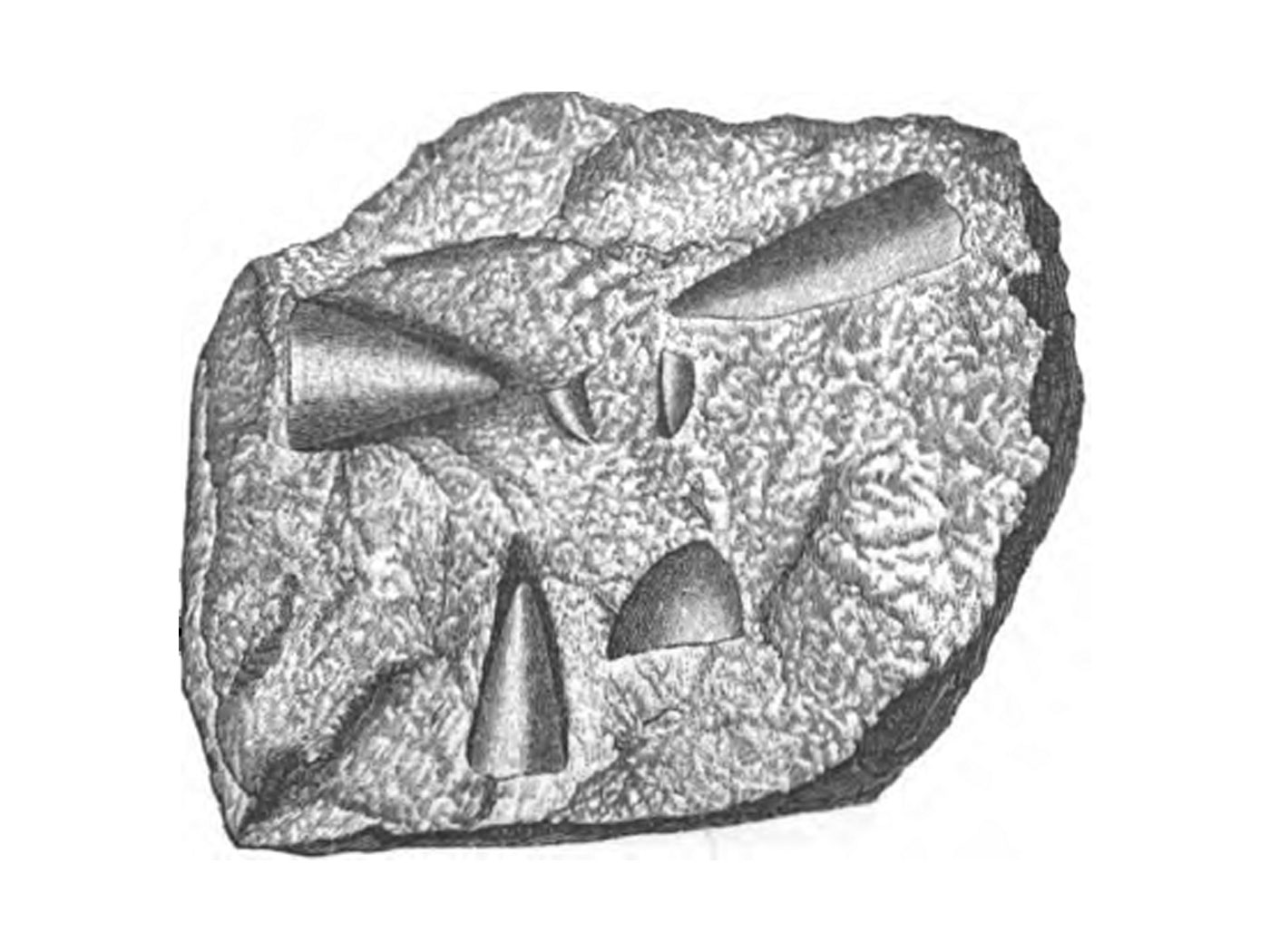
The earliest known cephalopod, Plectronoceras, is a tiny Late Cambrian form with a simple conical shell, but it has chambers, septa, and a siphucle [a central tube connecting the chambers]. From such simple origins, the straight-shelled cephalopods underwent a spectacular Ordovician radiation.3
But Nectocaris contradicts that. It shows that the story was wrong and must have been based more on belief in broad-scale evolution than on data. The newly discovered animal fossil also shows that Prothero was wrong in asserting that early cephalopods were "simple." According to both the creation model and the data, they were never "simple."
Since Nectocaris was found in Middle Cambrian strata, it is now the "earliest" cephalopod, found "30 million years earlier than we thought [they even existed]."2 Since it had no shell, paleontologists must now construct an evolutionary scenario whereby the first cephalopods were active swimmers and hunters that later acquired shells--internal shells for squids and external shells for nautiloids.
Instead of filling in a longstanding blank spot in cephalopod origins, Nectocaris only muddies the waters. For one thing, it appears with no trace of transition. It is fully formed with side fins, large gills, a flexible siphon for propulsion, a streamlined body for moving quickly through water, and refracting-lens eyes--like vertebrate eyes--on long eyestalks.4
The presence of these fully formed eyes in such a low geologic stratum is a huge problem for evolution, because it should have taken eons for nature to select each of the many required parts for the eye to have any functionality--let alone be able to see clearly enough in deep waters to effectively hunt prey. Instead, Nectocaris appears in full form with all the necessary features near the very bottom of the fossiliferous sedimentary layers. If the fossil record is supposed to show increasingly complicated features over time as one ascends the geologic column, then why does this extraordinarily complicated creature suddenly appear in the bottom layers?
In addition, this find confutes one of Charles Darwin's chief explanations for the absence of the profusion of transitional forms that his theory predicts: "No organism wholly soft can be preserved."5 Yet Nectocaris, like so many other fossilized specimens, was a "wholly soft" creature, and its preservation was "exquisite," according to Nature.
Thus, Nectocaris "poses challenges for classification," according to evolutionists.1 Its descendants might have evolved an internal shell, or maybe an external one first. Or, it could have been a "dead end" that never developed any further. Or, it could have come from shelled creatures that were never recorded in the fossil record. Perhaps it lost that shell, and some of its descendants regained it--or didn't. Nobody knows, and nobody ever will.
Of course, the alternate explanation is that this find was a uniquely created cephalopod that was trapped in the earliest days of the Flood year.6 Nectocaris' fully formed body features and position in the rocks would then make complete sense.
References
- Smith, M. R. and J. Caron. 2010. Primitive soft-bodied cephalopods from the Cambrian. Nature. 465 (7297): 469-472.
- Bettam, S. U of T paleontologists solve mystery of 500 million-year-old squid-like carnivore. University of Toronto press release, May 27, 2010.
- Prothero, D. 2004. Bringing Fossils to Life: An Introduction to Paleobiology, 2nd ed. Boston, MA: McGraw-Hill, 314.
- Specifically, the authors stated in the Nature study that dark muscovite crystals formed inside the hollow eye-cavity and were "consistent with a camera-type construction."
- Darwin, C. 1968. The Origin of Species. J. W. Burrow, ed. Middlesex, UK: Penguin Books Inc., 298.
- The University of Toronto press release noted that some of the specimens had "large gills [that] were choked with mud, suggesting that the animals were fossilized after being caught in an underwater mud-flow," a finding consistent with burial during a widespread watery cataclysm.
* Mr. Thomas is Science Writer at the Institute for Creation Research.
Article posted on June 7, 2010.