Gravity holds us firmly on the ground and also keeps the earth circling the sun. It draws rain from the sky and causes the tides. This mysterious gravity force continues to puzzle scientists even as it gives stability to the universe. How is gravity able to act across empty space, and why does it exist in the first place? Science has never been very successful in explaining such "natural" laws. After all, these universal rules cannot slowly arise by mutation or natural selection; they have been here since the very beginning. Gravity, as well as every other intricate physical law and constant, is actually an absolute testimony to creation.
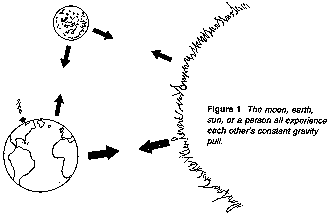
Galileo (1564-1642) first explored the motion of falling objects. Isaac Newton (1642-1727) later described the law of gravity: All objects in the universe attract each other. This attractive force is proportional to the objects' masses and decreases as the square of the distance separating them. Figure 1 illustrates the gravity force; Table 1 gives some representative values. Henry Cavendish (1731-1810) finally measured the gravitation constant which allowed the gravity force to be precisely calculated. Comments from these science pioneers show their respect for gravity's origin:
Galileo: From the Divine Word, the Sacred Scripture and Nature did both alike proceed.[1]
Newton: This most beautiful [gravitational] system of the sun, planets, and comets could only proceed from the counsel and dominion of an intelligent and powerful Being.[2]
Newton: When I wrote my treatise [principia] about our [solar system], I had an eye on such principles as might work with considering men for the belief in a Deity; and nothing can rejoice me more than to find it useful for that purpose.[3]
The origin views of Cavendish are not known because he left very little written material. One will search in vain for these creation quotes, or anything similar, in most science books. Texts typically give only half the story; they accept gravity without any discussion of its origin and implications.
The properties of gravity illustrate just how unique this essential force is. Consider six points, chosen from many others.
- Gravity does not change with time. Many researchers have looked for a possible variation in the strength of gravity, without success. Some feel that stronger gravity in the distant past might possibly have helped trigger star formation or the Big Bang itself. Even with a long time scale, however, gravity appears to be perfectly constant.[4] Gravity therefore does not solve the problems of Big Bang cosmology.
- Aside from air resistance, large and small objects fall downward in exactly the same time. Drop two compact objects and you should see and hear them hit the floor simultaneously.
- Gravity is always attractive, while other forces such as magnetism can either repel or attract. This beneficial property makes gravity the universal "Elmer's Glue" which binds the universe together. Even the distant galaxies, which appear to have been created with an outward expanding motion, are gradually slowing due to the inward gravity pull from all other galaxies in the universe.
 Gravity cannot be fumed off or shielded in any way. Intervening objects have no effect on the original gravity force between two separated masses. This means that there is no antigravity chamber available in which the occupants can continually float freely. The weightless, gravity-free feeling you may have experienced on an amusement park ride results from a temporary falling motion. Orbiting astronauts appear weightless only because their fall toward the earth is balanced by the outward directed centrifugal force.
 - Gravity attraction does not depend on the composition of objects, only on their mass or weight. Several blocks composed of glass, lead, ice, or Styrofoam, if they all have equal mass, will attract each other identically.
- The gravity force decreases with distance but is actually infinite in its extent. Gravity acts instantly between the earth and moon, as well as across the millions of light years of space between galaxies, according to classical theory.
 Two Bible verses especially help us understand the nature of gravity. First, Colossians 1:17 explains that Christ is before all things, and by Him all things consist. The Greek verb for "consist" (sunistano) means to cohere, preserve, or hold together. Extra-biblical Greek use of this word pictures a vessel holding water within itself. The word is used in Colossians in the perfect tense, which describes a present continuing state arising from past action. This perfect tense also implies permanence of the act of holding the universe together. One mechanism used is obviously gravity, established by the Creator and still maintained without flaw today. Consider the alternative: If the Lord turned His back on the universe for one moment, instant chaos would result. Without gravity, the earth, moon, and stars would immediately disintegrate.
A second reference, Hebrews 1:3, declares that Christ upholds all things by the word of His power. Uphold (Greek, fero) again describes the sustaining or maintaining of all things, including gravity. The word uphold means much more than simply supporting a weight. It includes control of all the ongoing motions and changes within the universe.[5] This infinite task is managed by Christ's almighty Word, whereby the universe itself was first called into being (Hebrews 11:3).
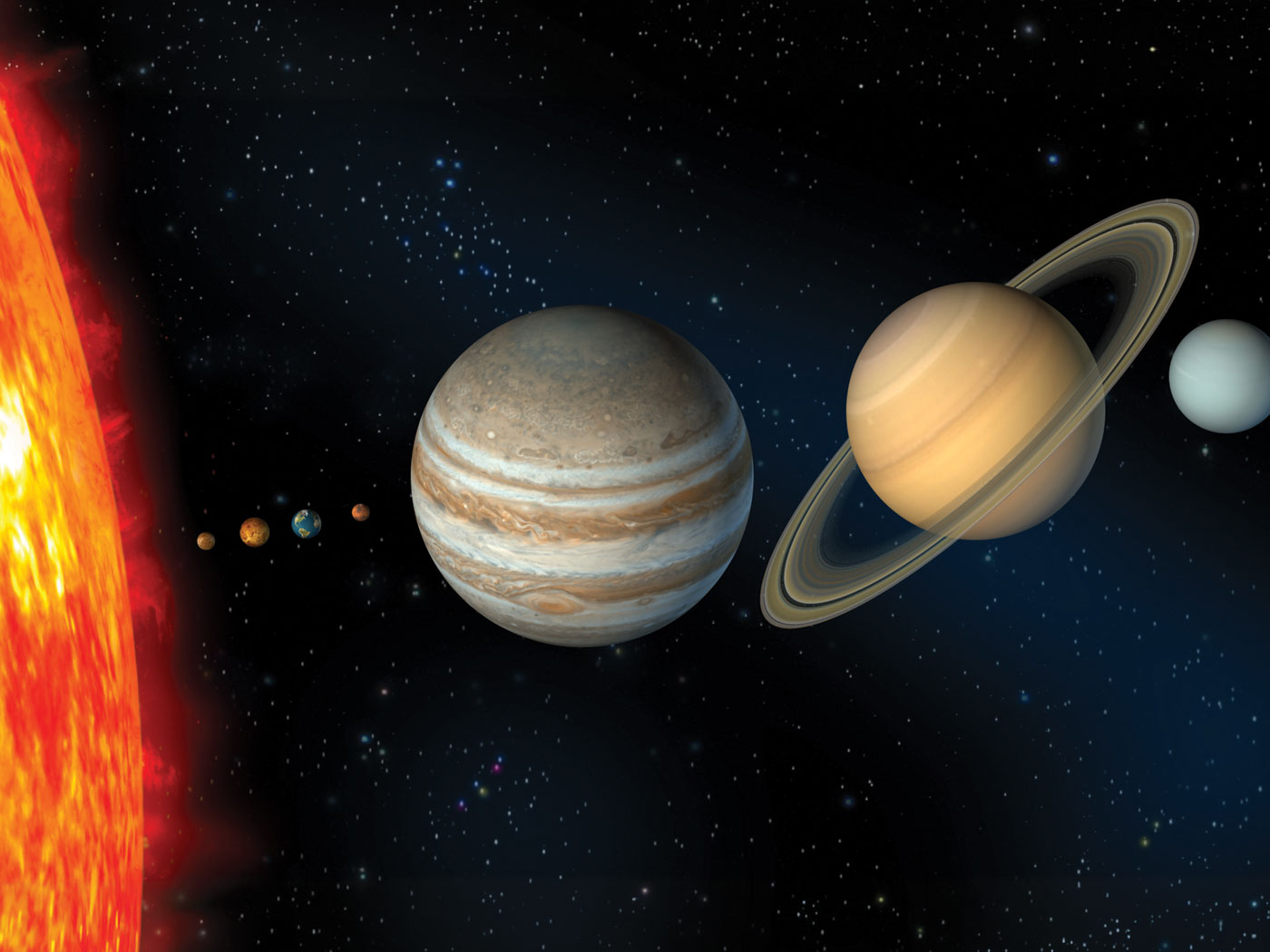
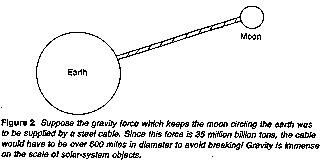
We know of just four fundamental forces in nature. First, there is the electromagnetic force which operates electric motors, radio, television, and particle accelerators. Second and third, the strong and weak nuclear forces arise within the nuclei of atoms. Finally, there is gravity, actually 1040 times weaker than electromagnetism, and the only force known in Newton's day. Gravity dominates other forces on the larger scale of space objects (Figure 2).
| TABLE 1 | Some example values of the attractive gravity force between objects. |
| Objects | Gravity Force (Pounds) |
| You and this Impact article | 10-10 |
| You and the moon | .001 |
| Two locomotives | .005 |
| You and the earth | Your Weight |
| Moon and earth | 7 x 10¹⁹ |
| Earth and Sun | 8 x 10²¹ |
Physicists have long attempted to unify these four basic forces into just one entity or theory. Initial success was shown by Faraday and Maxwell 150 years ago when electricity and magnetism were combined. So far, however, gravity has proven a special challenge to the experts. Gravity should reveal both wave and particle (quantum) properties, to fit the pattern of the other forces. Traveling gravity waves, suggested by some researchers, should slightly compress or curve space-time, according to Einstein. The hypothesized particles called gravitons, with no mass or charge, are thought to stream back and forth continually between the earth and moon, resulting in the observed gravity force. Neither gravity waves nor graviton particles have been observed yet. One wonders if scientists will ever discover the actual method by which the Lord maintains the gravity system. Perhaps, similar to the creation process itself, such details lie forever beyond our probing.
It is a fair question to ask natural science why basic laws such as gravity exist. Why is the universe filled with intriguing technical relationships, symmetry, and unity? Some experts are quick to reply that the task of science is only to find out the how of nature, not the why. But this excuse simply reveals the incompleteness of natural science alone. Ultimate truth about the universe must also deal with God's initial provision and his continuing care for us. The Creator is clearly an intimate part of every physical detail, including gravity.
- From Galileo's letters of 1613-1600. Quoted by Gerald Holton, Introduction to Concepts and Theories in Physical Science (Addison-Wesley Pub. Co., Reading, MA, 1973,) p. 57.
- In the second edition of Newton's Principia. Quoted by J. De Vries, Essentials of Physical Science. (Wm. B. Eerdmans Pub. Co., Grand Rapids, MI, 1958), p. 15.
- From a 1692 letter. Quoted by Gerald Holton, p. 192.
- "Timeless gravity." Nature (15 November 1990) 348 (6298), p. 195.
- [Vincent, M.R., Word Studies in the New Testament on Hebrews, first published in 1886 (MacDonald Pub. Co., McLean, VA, 1970), p. 1093.
* Dr. DeYoung is an Adjunct Professor of Physics at ICR.