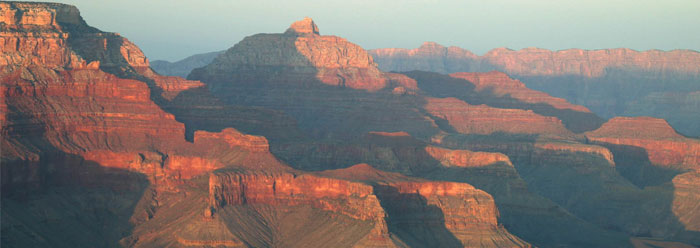
Geologists tend to be very provincial. Rarely do they stand back and look at "the whole canvas" of the sedimentary rock record. When they do, some remarkable things emerge. For example, consider the Tonto Group, a succession of three well-layered formations in the lower part of Grand Canyon. In one of earth's grandest exposures, the familiar triad of Tapeats Sandstone -- Bright Angel Shale -- Muav Limestone can be seen in profile view for nearly the full 200 miles of Grand Canyon.
Geologists generally agree that the Tapeats Sandstone accumulated as coarse sand grains that were washed up on the North American continent as part of the first great "marine transgression" of the Paleozoic. Later the grains were cemented into sandstone. Typically a few hundred feet thick, it grades from coarse sand and pebbles at its base to fine-grained sand at its top. Among the sedimentary "particles" in the basal part of the Tapeats Sandstone are boulders up to 30 feet in diameter that were obviously rolled at a time when the continent was under water. The sandstone is generally unfossiliferous, but peculiar bed markings, interpreted as "worm borrows" (called Skolithos), are ubiquitous in the upper part. Beneath it is a wide variety of Precambrian rocks, which come in contact with the Tapeats Sandstone at an extraordinary erosional surface called the Great Unconformity. If one is looking for the boundary between pre-Flood rock below and Flood strata above, look no further. This is a logical place to put it.
By the way, the rock layer called the Tapeats Sandstone is not restricted to Grand Canyon. The same rock layer in central Utah is known as the Tintic Quartzite; in northeastern Utah it is the Lodore Quartzite; in Wyoming and Montana it is the Flathead Sandstone; in Colorado it is the Sawatch Sandstone; in South Dakota it is the Deadwood Quartzite; in the Midwest it is the St. Simon Sandstone; in the Ozarks it is the Lamotte Sandstone; and in northern New York state it is the Potsdam Sandstone. The confusion of names should not obscure the fact that it is one continuous sandstone layer; the Potsdam Sandstone of the Northeast is unbelievably similar to the Tapeats Sandstone of Arizona, complete with the Great Unconformity at the base and worm burrows near the top!
Lying above the Tapeats Sandstone in Grand Canyon, in succession, are the greenish-colored and iron-rich Bright Angel Shale, and the thin-bedded and silty Muav Limestone. Marine fossils in these rocks include a host of so-called "Cambrian explosion" organisms, most notable of which are the trilobites. In Grand Canyon this succession called the Tonto Group is 800-1,300 feet thick. Tonto Group equivalents, that are also amazingly similar, are found across much of North America and are reported also across wide portions of Canada, Eastern Greenland, Scotland, and South Australia. Such persistence of strata is enough to baffle creationist and evolutionist alike. Picture a sheet of copy paper 0.1 millimeters thick that measures 1 kilometer by 0.6 kilometer, then stack three on top of one another. You then have a picture of how thin these three layers are across the breadth of North America.
A sufficient process is needed to explain such persistence. The Genesis Flood is sufficient.
*William A. Hoesch, M.S. geology, is Research Assistant in Geology.
Cite this article: Hoesch, W. 2007. Geological Provincialism. Acts & Facts. 36 (6).