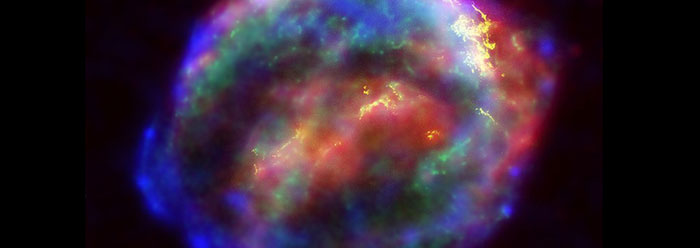
They had told us a particular supernova exploded 10,000 years ago. How then, did the Chinese see it in AD 185? The answer is a case study in scientific inference.
Supernova remnants (SNRs) are shells of material expanding outward from stellar explosions. Presumably, one can tell how long ago a star exploded by measuring the velocity of the expanding shell and extrapolating it backward in time. In the case of RCW 86 in Centaurus, the calculated time of explosion was 10,000 years. According to Space.com (9/26/2006), astronomers now realize it was witnessed by Chinese astronomers 1,821 years ago. This means the earlier date was off by over 80%. What happened?
From the Chandra X-ray data, they now believe the expanding shell rammed into interstellar material, slowing it down and making it pile up. Extrapolating the current speed backward linearly was based on a flawed assumption.
One of the most widely dispersed SNRs in northern skies has a similar tale to tell. The Veil Nebula arches into graceful loops over a large region in Cygnus. Earlier estimates of its age were in the tens of thousands of years. In 2001, however, Sky & Telescope (2/2001) reported a surprise. By comparing Hubble views with photographs taken in 1953, astronomers recalculated its age at 5,000 years.
Light echoes from two "ancient" SNRs in the Large Magellanic Cloud were reported in Nature (12/22/2005) to be merely 410 and 610 years old.
Astronomers use supernovas as age and distance indicators. It's hard to have confidence in the pronouncements of professionals who consider it normal to be off by 80% or more. Would this be acceptable in other fields? Yet upsets in astronomy are common. For instance, the behavior of V838 Monocerotis, after its explosion in 2002, caused astonishment. Scientists don't know how to classify this object or what produced the outburst.
Supernova-prone stars were thought to be well understood. Last November, however, one was found more massive than the upper limit permitted by theory. This opens up a "Pandora's box" for theorists, reported a press release from Lawrence Berkeley National Laboratory. Nature (9/28/2006) made the comical statement that "Clearly, stars with masses >10 solar masses exist, so there must be a way for them to form."
We should remember that once upon a time all supernovae were thought to be alike. Now they fall into two types, each with several classes and subclasses -- and some types can switch classes.
One final case should be recalled when reading confident claims by astronomers. A pulsar thought to be 24,000 years old was photographed by the Chandra telescope in 2001. Astronomers later realized it lined up with a supernova observed by the Chinese in AD 386. This means the earlier date was less than 7% correct. Hamlet might have the better wisdom: "There are more things in heaven and earth, Horatio, than are dreamt of in your philosophy."
*David F. Coppedge works in the Cassini program at the Jet Propulsion Laboratory. (The views expressed are his own.)
Cite this article: Coppedge, D. 2007. Supernova Shell Shock. Acts & Facts. 36 (5).