The Day Of Atonement | The Institute for Creation Research

The Day Of Atonement

"And this shall be an everlasting statute unto you, to make an atonement for the children of Israel for all their sins once a year. And he did as the LORD commanded Moses" (Leviticus 16:34).

One of the greatest feasts of the Lord observed by the children of Israel while in the wilderness was that in which two goats were to be selected and offered to God by the high priest once each year to make an atonement for the sins of all the people. One of the goats would be slain as a sin-offering, depicting the lethal consequences of sin. The other, called the "scapegoat," would be sent away into the wilderness, symbolically showing that, once the atonement had been provided, then all their sins would have been carried away and forgotten.

The Lord Jesus, of course, fulfilled once and for all both aspects of this unique "feast" (this and the other six observances of special feast days described in Leviticus 23, were "feasts of the LORD," not feasts of Israel, offering sacrifices to God, not feasting themselves). The death of the first goat signified the redemptive work of Christ, as we have been redeemed "with the precious blood of Christ" (I Peter 1:19). The second goat depicted the cleansing work of Christ, "which taketh away the sin of the world" (John 1:29).

The details of this unique feast are given in Leviticus 16, and it is still being nominally observed by the Jews today—in fact, on this very date. It is called Yom Kippur, meaning "day of atonement."

The tragedy, of course, is that there is no sacrifice being offered—no slain goat and no scapegoat—in the modern version, and certainly no acceptance of Christ as the "one sacrifice for sins for ever" (Hebrews 10:12). But "without shedding of blood is no remission" (Hebrews 9:22). HMM

The Latest
NEWS
Wings of Beauty: Designed Detail in Butterflies
A butterfly wing may look like painted glass, but beneath its beauty is a living control system. A recent study on South American butterflies and a...

NEWS
Jupiter's Moons Io and Ganymede: Still Problematic for ''Billions...
Two of Jupiter’s four Galilean moons, Io and Ganymede, were recently featured in science news stories—stories that remind us that these...

NEWS
Can Ice Build Life?
Can a freezer make life? A recent paper in Chemical Science suggests that freezing and thawing may have helped early “protocells” grow,...

NEWS
Conventional Scientists Still Struggle to Explain Saturn’s...
Saturn is famous for its beautiful rings, which are composed mostly of water ice particles. A team of scientists recently proposed that the rings were...

NEWS
Centipede-Like Fossil Walked on Land, Not the Ocean Bottom
A new species of what appears to be a fossil centipede was found in sediments that conventional scientists believe were deposited offshore.1...

NEWS
Rewriting the Origin of Spiders and Horseshoe Crabs . . . Again
According to the fossil record, arthropods—in all their complexity—have always been arthropods.1,2 They belong to the phylum...

NEWS
June Wallpaper
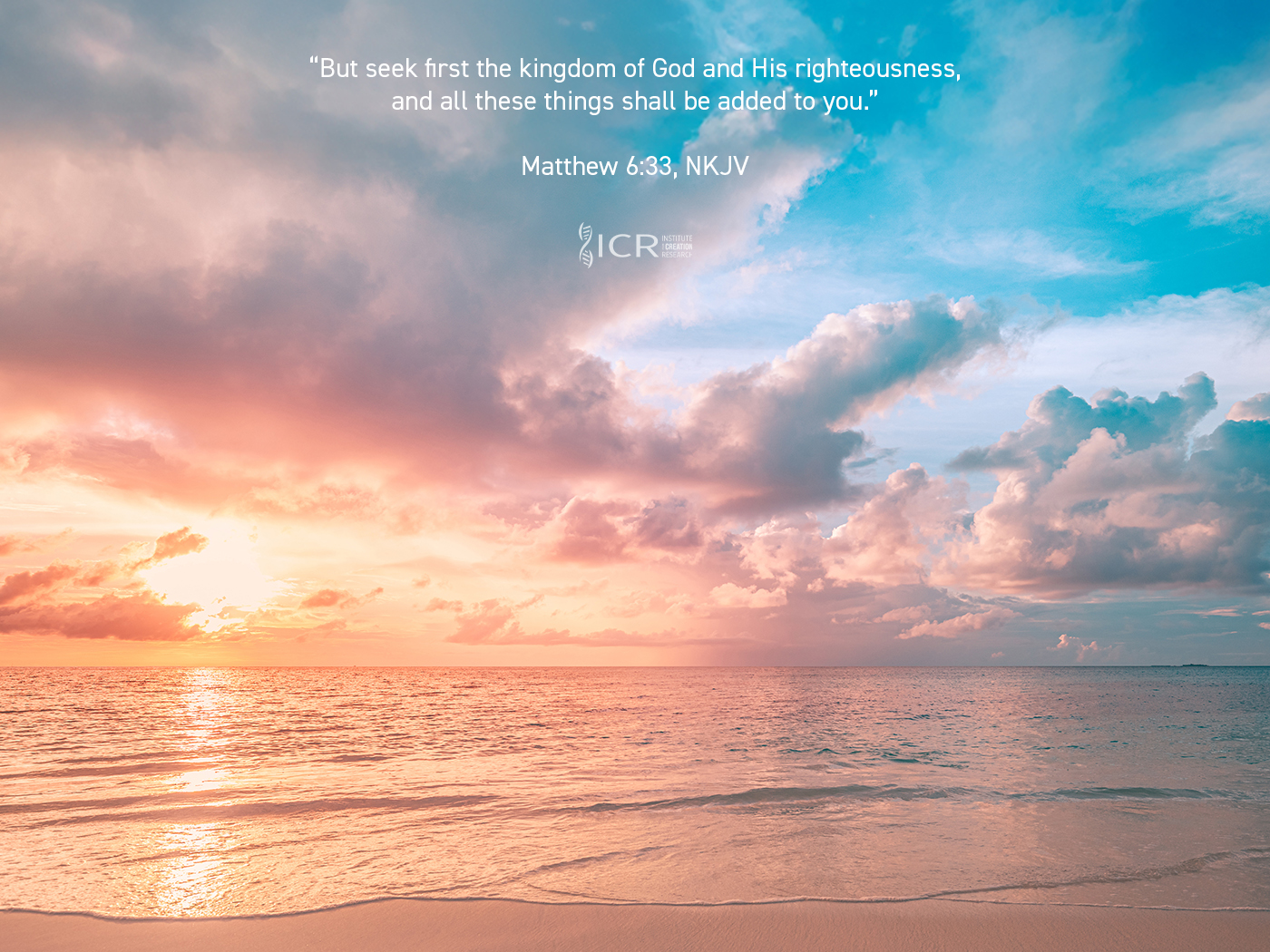
"But seek first the kingdom of God and His righteousness, and all these things shall be added to you."  (Matthew 6:33, NKJV) ICR's...

NEWS
Rapid Change, Fixed Design: Rethinking Genetic ''Accelerators''
What if so-called rapid evolution is not a process of building something new, but it simply reveals what was already there? A recent peer-reviewed study...

NEWS
Designed to Adapt: Examining Plankton After Chicxulub
What if new species could appear in just a few thousand years? A recent study reports that many new plankton species showed up quickly after the supposed...

NEWS
A Call To Remembrance
I have considered the days of old, the years of ancient times. I call to remembrance my song in the night: I commune with mine own heart: and my spirit...