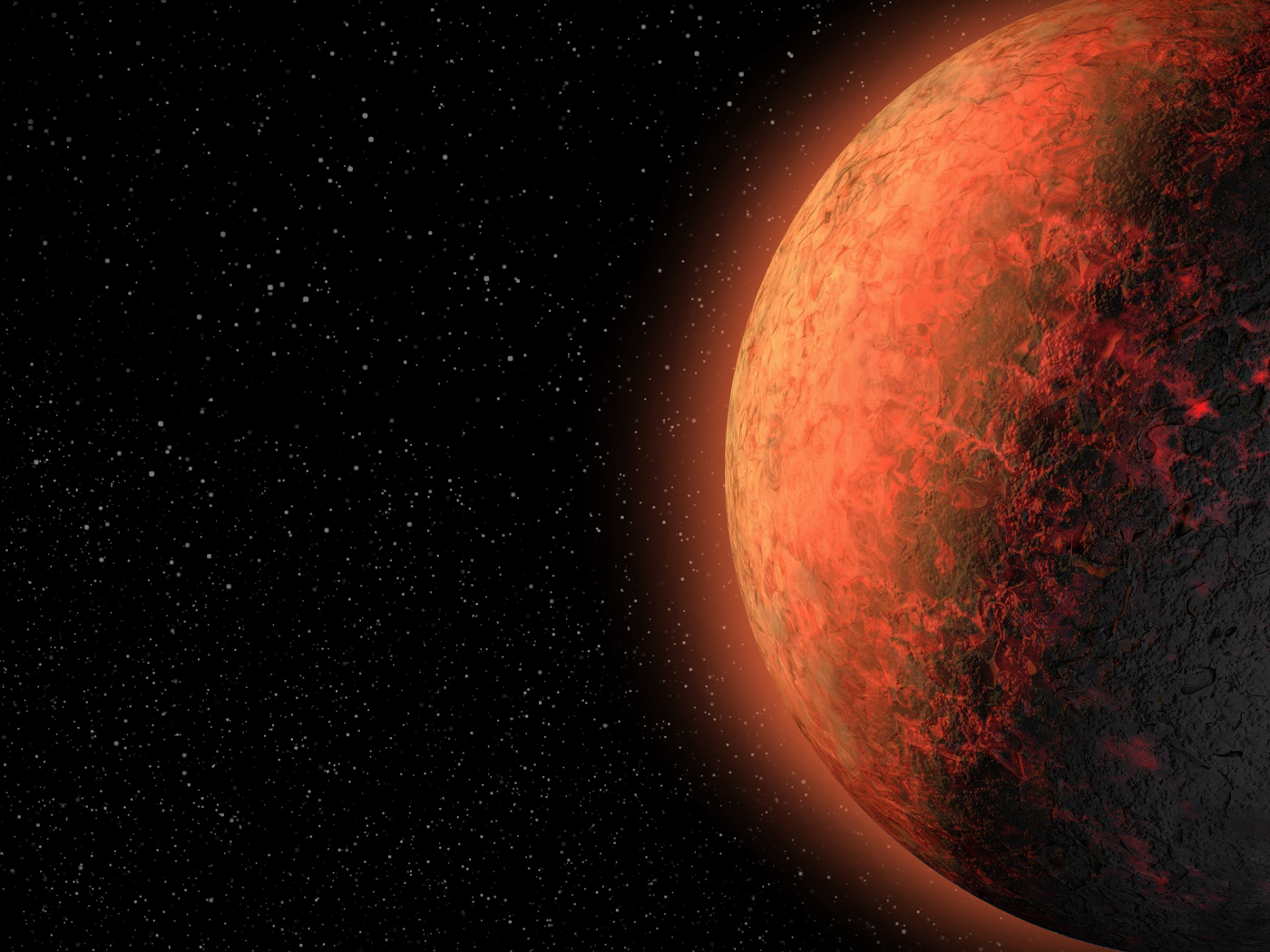
Designated TOI-2109b, the planet takes just 16 hours to orbit its host star, as opposed to the earlier record-holder, which orbited its host star in 18 hours.2 TOI-2109b is called an “ultrahot Jupiter” because it, like Jupiter, is a gas giant, but it orbits so closely to its host star that its dayside is as hot as the surface of a small star! The planet’s short orbital period is a consequence of a well-known rule of celestial mechanics called Kepler’s Third Law of Planetary Motion. Planets close to their host stars must orbit those stars very quickly.
In fact, astronomers think that TOI-2109b is so close to its star that its orbit is slowly decaying, not unlike “bathwater circling the drain.” They think they might be able to observe subtle changes in the planet’s orbit in just a couple of years.1
Do exoplanets in general, and this exoplanet in particular, have any creation implications? Yes. Secular astronomers think solar systems form from rotating clouds of gas and dust over billions of years. A consequence of this theory is that planets should both rotate on their axes and revolve around their stars in the same way as their host stars. Their orbits should also lie in the same plane (or very close to the plane) as does the equator of their host stars. Yet these expectations are routinely contradicted.3 Of course, since the Lord Jesus created the planets, He could certainly give them any orbital characteristics He desired, not just those that happen to agree with a given secular hypothesis.
This particular exoplanet also has implications for the age of the universe, as secular astronomers were very surprised to find hot Jupiters and ultrahot Jupiters that have already begun “death spirals” into their host stars. In 2019, Sky & Telescope said this about another hot Jupiter (WASP-12b) whose orbit is noticeably decaying:
Back in 1996, when the very first hot Jupiters had been discovered, Fred Rasio (Northwestern University) and his colleagues predicted that their orbits could very slowly decay due to tidal interactions with their parent stars. However, the rapid change in WASP-12b’s orbital period implies that we’re observing the planet at the last moments of its inspiral. That might seem a rather improbable coincidence, but David Latham (Center for Astrophysics, Harvard & Smithsonian) says, “one such case could be the result of a lucky accident.”4
In context, “the last moments” of exoplanet WASP-12b’s inspiral is estimated to be a few million years. This may seem like a long time, but it is a figurative “blink of an eye” for a planet thought to be billions of years old. Hence, as the above quote demonstrates, secular astronomers thought it extremely unlikely they would be able to observe death spirals of more than one hot Jupiter or ultrahot Jupiter. Yet multiple hot Jupiters with decaying orbits have been observed.2 Another ultrahot gas giant is losing its atmosphere so quickly that even secular scientists acknowledge that it should no longer have an atmosphere after billions of years. Yet it does have an atmosphere—and a substantial one at that!5
Exoplanets often seriously challenge secular planet formation scenarios, and multiple observations of hot gas giants with decaying orbits are surprising if these planetary systems really are billions of years old.
Challenges confront both the young-universe and old-universe positions,6 but the preponderance of evidence here on Earth and within our solar system strongly favors relative youth.7 And even in deep space, where evidence of great age often seems strongest, anomalies (including ultrahot gas giants like TOI-2109b improbably teetering on the “verge of destruction”) indicate that all is not well with the Big Bang model and its 13.8 billion years of assumed history.8
References
1. Chu, J. One year on this giant, blistering hot planet is just 16 hours long. MIT News. Posted on mit.edu November 23, 2021, accessed November 29, 2021.
2. Hebert, J. “Hot Jupiter” on the Verge of Destruction. Creation Science Update. Posted on ICR.org March 19, 2020, accessed November 29, 2021.
3. Musser, G. Why don’t exoplanets match astronomers’ expectations? A dispatch from the American Astronomical Society Meeting. Scientific American. Posted on scientificamerican.com January 13, 2011, accessed November 29, 2021.
4. Schilling, G. Planet WASP-12b Might Be on a Death Spiral Into Its Parent Star. Sky & Telescope. Posted on skyandtelescope.org September 3, 2019, accessed November 29, 2021.
5. Hebert, J. Hot Neptune Atmosphere “Shouldn’t Exist.” Creation Science Update. Posted on ICR.org November 5, 2020, accessed November 29, 2021.
6. Hebert, J. Does the Universe Look Old? Acts & Facts. 50 (10).
7. Hebert, J. 2018. Our Young Solar System. Acts & Facts. 47 (9).
8. Hebert, J. 2019. Deep-Space Objects are Young. Acts & Facts. 48 (9).
Image: Artistic impression of an exoplanet system
Image Credit: ESA/ATG medialab, CC BY-SA 3.0 IGO © 2021. Adapted for use in accordance with federal copyright (fair use doctrine) law. Usage by ICR does not imply endorsement of copyright holder.
*Dr. Jake Hebert is Research Scientist at the Institute for Creation Research and earned his Ph.D. in physics from the University of Texas at Dallas.