



Public school textbooks assert that apes and humans emerged from an ape-like animal, whereas Genesis 1 says that God created humans and the different animal kinds right from the start. What difficulties would one expect researchers to encounter as they search for evidence of human evolution if humans never actually evolved? Two excuses in a recent summary of the sad status of human evolution unwittingly verify what the Bible has been saying all along about where humans came from.
Publishing in America’s top journal, Science, Sergio Almécija at the American Museum of Natural History led a small team to report big difficulties with the story that primates and people share an ancestral animal.1 The big problem? Almécija summarized it in a research post, saying, “When you look at the narrative for hominin origins, it’s just a big mess—there’s no consensus whatsoever.”2
This messy lack of consensus is exactly what creation researcher Chris Rupe found as he reviewed hundreds of technical journal articles while writing Contested Bones, the aptly titled book about disputes over ape and human fossils.3 In it, Rupe quotes paleo experts’ disagreements over the status of every fossil candidate. Secular scholars now confirm this chaos.
It’s every expert for himself, spinning his or her unique web of story lines around selected bones. But Almécija’s team strongly defends human evolution as a fact despite the bedlam in their field.
They wrote, “Evolutionary scenarios are appealing because they provide plausible explanations based on current knowledge, but unless grounded in testable hypotheses, they are no more than ‘just-so stories.’”1
Strong enough evidence would leave no room for just-so stories. Could all this room for storytelling arise in the wake of an absence of evidence for human evolution?
If we really evolved from animals, shouldn’t we find enough fossils for objective scientists to reach some level of consensus over? Shouldn’t the fossils dictate which animal morphed into the next in a chain that led to us? The Science report offered at least two reasons—which amount to excuses—for the difficulties that paleo experts face in constructing an anti-Bible human history.
For one excuse, the study authors decry a “highly incomplete and fragmentary nature of the hominoid fossil record.”1 How convenient to claim that the record of the story we want to tell is simply missing the key elements of that story. How can we know that a record is incomplete—let alone “highly incomplete”—if we don’t even have the record?
An alternate hypothesis fits the evidence from fossils that we do have instead of wrapping suppositions around undiscovered fossils. If we never actually evolved, then we wouldn’t have fossils that show human evolution. That would explain what we see, but it’s an impossible stance to take under a religiously held bias that “humans diverged from apes.”1
Another quotation contains a second excuse for the dumpster fire status of paleoanthropology. The study authors wrote, “Besides their fragmentary nature, a persistent challenge is understanding the phylogenetic relationships among fossil apes, which exhibit mosaics of primitive and derived features with no modern analogs.”1
To understand phylogenetic relationships means to decide which creature evolved into the next. And nobody agrees on an order. For every expert that claims human ancestry for their discovery, another expert sees that discovery as an evolutionary dead-end or the like.
Claims of “primitive” and “derived” (read, “more recently evolved”) are arbitrary and—of course—hotly contested, but what makes a “mosaic?” Each extinct ape fossil is supposedly made up of a “mosaic of…features.” Different reports use “mosaic” in different ways. Sometimes workers use it to refer to mixtures of ape bones and human bones that they pretend belonged together.
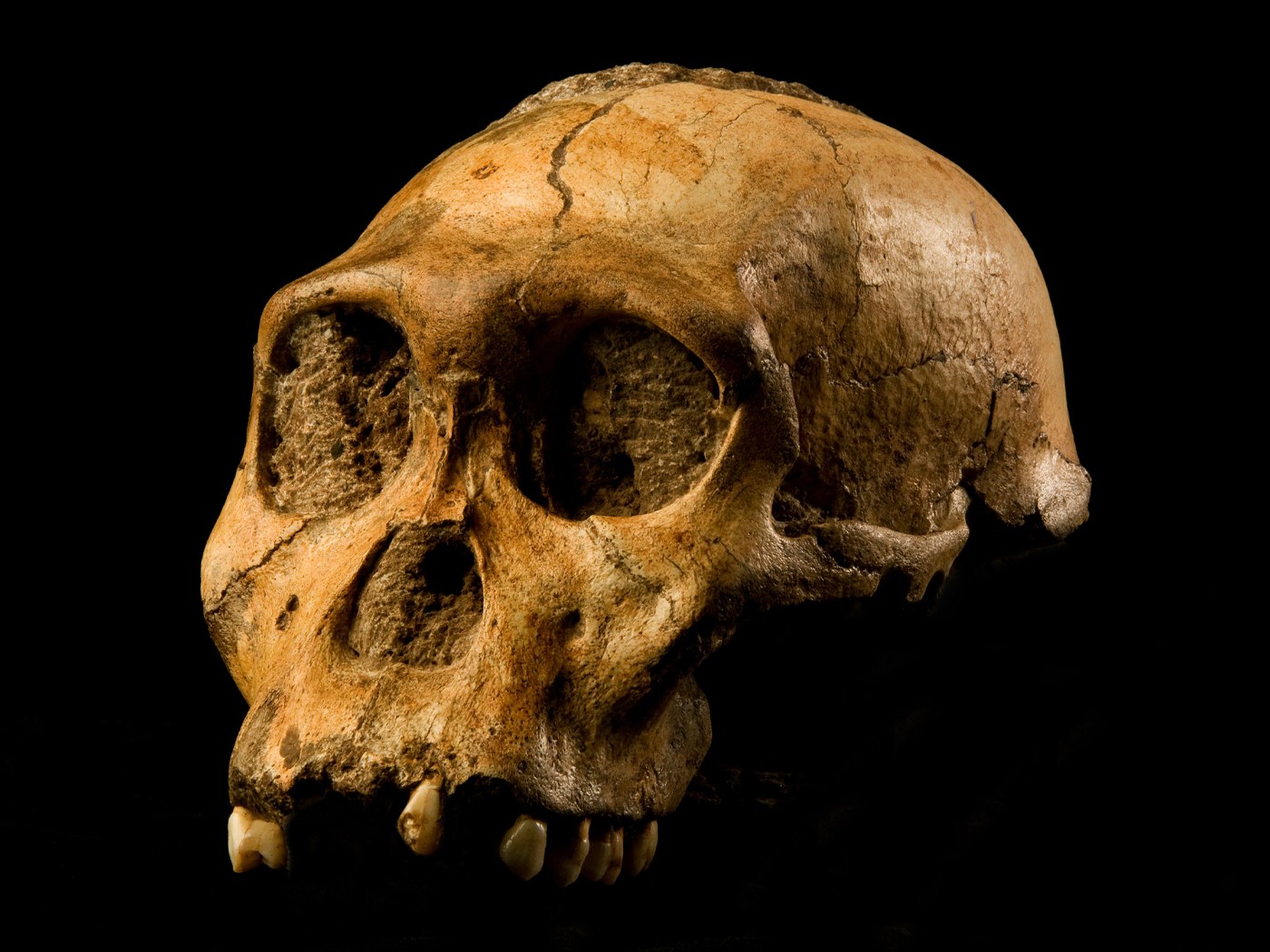
For example, those who promoted Australopithecus sediba as a missing link candidate referred to its “mosaic” of ape-like and human-like bones.4 However, more careful comparisons of sediba bones found them to match either ape or human remains.5,6 Those bones never did belong to the same skeleton.
But in cases where the bones actually articulate, “mosaic” can refer to body parts that fit and function with one another. Think of a Roman mosaic’s tile fragments, each expertly tailored to form a whole picture. In other words, these fossil discoveries show body parts that look like someone shaped them to mesh with one another into a whole and working creature—whether ape or human.
Whether a mosaic fossil consists of a jumble of ape and human bones that don’t belong together or a system of articulated bones like those in modern humans or apes, it shows no evolutionary transition or pattern. This fits biblical creation’s idea of separately created kinds just fine.
Two excuses for the “big mess” of human evolution unwittingly uphold God’s account of creation. The fossil record only looks incomplete to those who expect it to contain pre-human fossils. And mosaics of either mixtures from different kinds or well-fitted bones from one kind or another follow from Genesis creation.
References
1. Almecija, S. et al. 2021. Fossil apes and human evolution. Science. 372 (587).
2. Why Fossil Apes Are Vital to Understanding Human Evolution. American Museum of Natural History. Posted on amnh.org May 6, 2021, accessed May 12, 2021.
3. Purchase Contested Bones at ICR.org/store.
4. Berger, L.R. 2013. The mosaic nature of Australopithecus sediba. Science. 340 (6129): 163-165.
5. Sediba had an ape skull: Carlson, K. et al. 2011. The endocast of MH1, Australopithecus sediba. Science. 333 (6048): 1402-1407.
6. Sediba had human hands: Nuwer R. and S. Richards. The mosaic pre-man. The Scientist. Posted September 18, 2011.
*Dr. Brian Thomas is a Research Associate at the Institute for Creation Research and earned his Ph.D. in paleobiochemistry from the University of Liverpool.
Two Excuses for Human Evolution Confusion
More Fossils Show Stasis and No Transitional Forms
Centipede-Like Fossil Walked on Land, Not the Ocean Bottom
A new species of what appears to be a fossil centipede was found in sediments that conventional scientists believe were deposited offshore.1...
A Beautiful, Extinct Bird
In 2021, a fossil of an evidently beautiful bird the size of a bluejay was unearthed from sedimentary deposits in northeastern China. The bird—named...
Giant Rhinos Are Still Rhinos
Fossils from two giant rhinos dated by evolutionists to be “22 million years old” in the evolutionary timetable have been discovered in China.1...
More Fossil Record
Was a Franken-Fish "Created"?
In 2020, Hungarian zoologists described the hybridization of a Russian sturgeon and American paddlefish.1 Some sources have reported the scientists...
Spinosaurus Swam! How a Swimming Spinosaurus Fits Scripture
Spinosaurus aegyptiacus had a longer body than the enormous T. rex. In Nature journal, researchers published a new reconstruction of the extinct reptile’s...
Rapid Burial in the Flood Explains Strange "Squid" Attack
A new study published in Proceedings of the Geologists’ Association has found what is claimed to be the oldest recorded attack by a squid-like creature.1...
More Man Was Created by God
Coast Guards and Corvids: Flying to the Rescue!
Days ago, a fishing boat near the Shetland Islands needed emergency help, and received it in a timely manner. So, a fearful predicament had a happy ending.1
In...

God’s Providence Seen in Internal Clocks
Internal clocks are amazing examples of God’s providential care for his creation. One recent study showed embryonic “clocks” in chickens...

John Walton’s Twisted Views on Disease and Suffering
John Walton is an influential Old Testament theologian at Wheaton College with an unorthodox and non-literal view of Genesis.1 He is also an...
More Man Was Created Distinct from Apes
Fossil Confusion in Ethiopia: Are Evolutionary Trees Bu.,.
A new study published in Nature describes the discovery of 13 fossilized teeth from the Ledi-Geraru site in Ethiopia. They have been dated to between...

How Can I Know Evolution Is Wrong?
Evolution pushes Christians to doubt what our Bibles say about creation by asserting impersonal processes made everything over eons. Scripture asserts...
Ape Spit Radically Different from Human
In their quest to try and find some sort of evolutionary similarity between humans and apes, scientists have compared DNA, proteins, anatomy, behavior,...
More Creation Science Update

Fossil Crocodile Shows Clever Design
Some discoveries stand out, not because they change the story of evolution, but because they show clear design from the start. That is what happened...
Built by Homo sapiens?
Preserved wood was recently found in Kalambo Falls, Zambia, where evolutionary anthropologists from Aberystwyth University and the University of Liverpool...
December 2025 ICR Wallpaper
"Come now, and let us reason together," Says the LORD, "Though your sins are like scarlet, They shall be as white as snow; Though they...
The Latest
Can Metals Explain the Origin of Life?
A spark plug can make a spark, but no one would say a spark plug can build a car. In much the same way, a chemical reaction can do one useful job without...
Jumping Genes: Engineered to Move
Scientists recently found a “jumping gene” in an odd place. An RNA molecule from a tiny predatory bacterium had entered the cells of a very...
Institute for Creation Research Partners with Louisiana Baptist...
The Institute for Creation Research (ICR) announced today a strategic handover of its School of Biblical Apologetics (SOBA) educational content to Louisiana...
A Tangled Human Tree—or One Human Family?
What if the “ghosts” in our DNA are not lost steps in human evolution? A new Science study found DNA patterns that may point to two unknown...
Mapping the Sense of Smell
Your sense of smell involves much more than enjoying a hike through an aromatic pine forest or appreciating delicious foods.1,2
Our ability...
September 11, 2001: We Will Never Forget
“Fret not thyself because of evil men, neither be thou envious at the wicked: for there shall be no reward to the evil man; the candle of the...
What Can Fossil Teeth Really Tell Us?
A few tiny fossil teeth have been asked to carry a very large story. Researchers used them to name a new order of marsupials, Keeunamorphia, and to...
Man and His Labor
“Man goeth forth unto his work and to his labour until the evening.” (Psalm 104:23)
The 104th Psalm is a beautiful psalm of creation and...
Changing Climates, Stable Primates
What do you picture when you think of the first primates? Conventional scientists have long proposed warm forests, thick vines, and tropical heat as...

September Wallpaper
"[Cast] all your care upon Him, for He cares for you." (1 Peter 5:7, NKJV)
ICR's September 2026 wallpaper is now...
Shop Related Products
Living in Light of Genesis
$15.99
Dinosaurs and the Bible
$4.99

Adam or Apes
$12.99
Living in Light of Genesis
$15.99