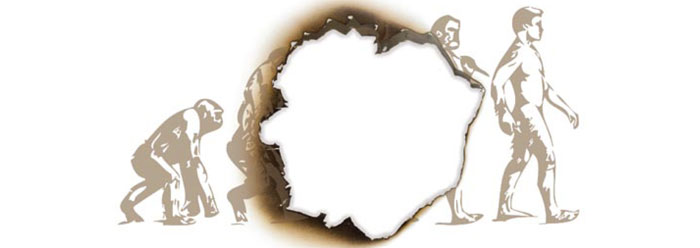
A favorite argument of creationists has always been the lack of transitional organisms preserved in the fossil record. The argument goes like this: If one basic type of animal evolved into another basic type, it must have passed through "in between" stages, or transitional forms. Whether or not these transitions were ever preserved as fossils, they must have existed. In fact, they must have existed by the trillions.
Consider an evolutionary favorite—the evolution of a four-legged land animal (variously described as cow-like or wolf-like), into a whale. Surely this incredible transition couldn't take place in just a few steps—legs into flippers, fur into oily skin, etc. Where are the transitional forms?
Evolutionists sometimes brag that they have abundant evidence of transitions, but when pressed, the examples are almost always minor variations within a category, as expected within creation thinking, and thus certainly not proof of evolution.
In general, evolutionists are quick to admit the almost complete lack of transitional fossils. In fact, many of the current leaders in evolutionary thought have made their careers attempting to explain this lack by proposing that evolution of isolated groups went so rapidly in the past that no individuals of the in-between forms were fossilized. Why should we expect to find fossils of organisms which existed only for a short time? Furthermore, they point out that fossilization rarely occurs today. It usually takes massive flooding and rapid burial.
But then a new question arises. How complete is the fossil record? Can we legitimately expect to find these transitions?
Dr. Michael Denton, an agnostic but a decided non-evolutionist compiled a chart on "The Adequacy of the Fossil Record" in his book, Evolution: A Theory In Crisis, by comparing the number of living types to fossil types, gleaning information from Romer's classic book, Vertebrate Paleontology. He found that 97.7% of living orders of terrestrial vertebrates are found as fossils. (Orders are larger groupings of families which are larger than genera which are larger then species.) Many creationists consider the groupings family or genus to best approximates the Genesis kind. Of living families of terrestrial vertebrates, 79.1% are represented, a number which jumps to 87.8% if birds (hardly ever preserved) are excluded. Thus, the fossil record of even terrestrial vertebrates is seen to be remarkably complete.
But far less than 1% of all fossils are terrestrial vertebrates. Approximately 95% are marine invertebrates, with the rest being mostly plants, fish, and insects. Land fossils are notoriously scarce, and when found are usually fragmentary. With partial evidence an evolutionary story can sometimes be told.
When we look at the invertebrates, we see separate and distinct categories (i.e., clams, corals, trilobites, etc.) existing in the earliest strata with no hint of ancestors or of intermediates. We find clams by the trillions, with a lot of variety among them, but no evolution. Furthermore, we have no idea how vertebrate fish could have arisen from any invertebrate. Where there are good data, we see no evolution. Where the data are scanty, evolutionists can tell a story. The fossil record is voluminous and apparently substantially complete. Yet no evolution is seen.
Speaking of this issue, Darwin wrote in an 1881 letter that "the case at present must remain inexplicable and may be truly argued as a valid argument against the views here entertained." Evolution—a theory of change without any evidence of change.
*Dr. John Morris is the President of ICR.