 Last month’s Engineered Adaptability article considered two examples of human-designed structures that were exposed to identical conditions but did not respond in the same way.1 For review, the picture below shows a home designed to withstand hurricanes.2 The surrounding homes lacked its vital features and were destroyed when Hurricane Michael hit in October 2018. We also considered buildings exposed to a devastating earthquake in Nepal in 2015. Some buildings had built-in features that withstood the earthquake’s challenges, but many others did not and collapsed.
These examples demonstrate that every designed entity has some unique traits, features, or combinations of these that determine their capabilities. They highlight two design principles that all engineers utilize:
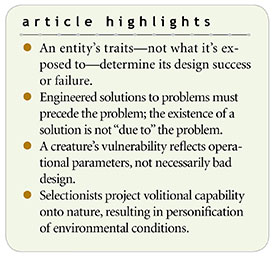
1. It is an entity’s traits—not its exposures—that determine its design success or failure.
2. Engineered solutions to problems must precede the problem; the existence of a solution is not “due to” the problem.
Throughout this article series, we’ve observed many examples of a tight correlation between human-engineered systems and their elements to systems that perform similar functions in creatures. These observations support a theory of biological design that is based on the premise that biological functions are best explained by engineering principles.
Vulnerability Reflects Operational Parameters, Not Necessarily Bad Design
All known creatures and human-engineered things have vulnerabilities. Since biological systems operate according to the same laws of chemistry and physics human engineers use to govern their designs, there should be a correlation to explain why even the most brilliant designs still have points of vulnerability.
Some critics of intelligent design equate “poor design” with the vulnerabilities of organisms. They believe these vulnerabilities shouldn’t exist if the creatures were produced by an omnipotent, omniscient Creator. But if we are looking for evidence of intelligent agency to explain the designs found in creatures, then those designs should be held to the same standard we apply to marvelously designed things by human engineers.
We know engineers don’t design things that will have unlimited resources to build them. Even sophisticated designs are expected to operate only within various ranges of different exposures. These ranges are called the design parameters.
Engineers usually add a safety factor that enables what they’ve designed to withstand exposures somewhat outside these parameters. Even so, they know that given an excessive exposure, the entity will eventually fail. That failure, however, is not indicative of a faulty design. Faulty designs specify features from the outset that are unable to withstand the exposures necessary to meet the design’s intended purpose. Thus, even homes that were flattened by Hurricane Michael were not necessarily poorly designed or shoddily constructed. Since they likely withstood prior hurricanes, they probably were not designed to ever resist one of Michael’s force.
The same is true for organisms. When one of their appendages or organs breaks because it was exposed to conditions outside its design parameters, it reflects a situation in which design parameters were exceeded rather than a faulty design. Why would anyone think that creatures should have design parameters that could never be exceeded, even if designed by an omniscient Creator? Surprisingly, failure may also be due to parts that are designed to break, like a car’s crumple features or a gecko’s tail.
Engineered Features Determine Stimuli, Favorability, and More
If two different creatures eat the same shrub, why might it be nutritious to one and toxic to the other? If a man walks his dog and someone blows a dog whistle, why does only the dog respond? Situations where two or more different creatures are exposed to identical conditions clearly show it’s an organism’s traits—not its exposures—that determine design success.
Recognizing that fact helps clarify how biologists’ regular use of some terms is misleading. Evolutionists regularly talk about “favorable” or “unfavorable” conditions “working on” organisms to “drive” them in one evolutionary trajectory or another. Since they reject looking at creature features as if they were designed, they fail to recognize that it’s an organism’s traits—and the capabilities those traits confer—that determine whether an exposure is favorable or not.
Last month, we learned of the “superhero” traits of a tiny creature called a tardigrade, which withstood the radiation of space for 10 days. If humans and tardigrades were exposed to the same radiation, selectionists would say that it’s “unfavorable” to humans but “favorable” to tardigrades. The difference isn’t the radiation but the fact that for tardigrades “it is mainly down to a bizarre protective protein…that somehow shields their DNA from radiation damage….[It] appears to work by physically cuddling up to DNA and cocooning it from harm, but without disrupting its normal functions.”3
Evolutionists talk about environmental “stresses” that “induce” a genetic response. But not all exposures are equally stressful. Just as a one-pound load applied to a steel beam or placed on a piece of spaghetti has different stresses, so it is with organisms that their traits determine the extent that any condition is a stress. In addition, we now know that intracellular machinery is what controls genetic responses.
One organism will live in a certain location but another will not. It is a creature’s traits that define its environmental niche. A space isn’t even a “niche” until creatures inhabit it. Mars is exposed to some of the same conditions as Earth, but these conditions are only stimuli on Earth. Conditions are not stimuli in and of themselves. It’s information in a creature that specifies certain conditions to be stimuli to the exclusion of others. Additionally, creatures must be equipped with a sensor to detect that specific condition…or it remains a non-stimulus.
Engineering Causality Exposes the Mysticism of Selectionism
Suppose you are the lead engineer of a board recommending new hurricane-resistant building codes in Mexico Beach, Florida. Would you be satisfied receiving a study that doesn’t contain an engineering analysis of successful construction methods, building materials, and designs but rather claimed that the differential survival of homes was because Hurricane Michael “selected for” Dr. Lebron Lackey’s home and “selected against” the demolished homes?
How would your counterpart engineer in Nepal react if the study he or she received didn’t include detailed analysis of buildings’ design features but rather explained that some withstood ground motion because they were “favored” by the earthquake and demonstrated “highly selectable traits” when “driven” by the “strong selective pressure” of seismic loads? Asserting that hurricanes and earthquakes can select for buildings is just as magical as claiming that antibiotics, droughts, cold weather, or any other condition can “select for” or “disfavor” organisms.
Engineers would sound silly if they incorporated these personifications of conditions into their explanations. No one has ever seen nature “select,” ever quantified a “selection pressure,” or accurately identified the “unit of selection.”4 Selectionists readily absorb mystical mental constructs into biological scenarios that other scientific fields wouldn’t accept. Prior to Darwin, biologists didn’t invoke magical metaphors.4
Conclusion
For buildings, tardigrades, or humans, the unique traits that determine their capabilities explain their range of responses. It is the anti-design bias of most evolutionary biologists that leads them to view organisms as passive modeling clay molded by personified environmental conditions. How much better to acknowledge the clearly seen design and consider the real superhuman power, intellect, and wisdom of the Lord Jesus Christ, through whom and for whom “all things were created” (Colossians 1:16).
Click here for other articles in the Engineered Adaptability series.
References
- Guliuzza, R. J. 2019. Engineered Adaptability: Engineered Features Determine Design Success or Failure. Acts & Facts. 48 (6): 17-19.
- Carr, W., J. McDonald, and E. Shapiro. Mexico Beach home survives Hurricane Michael virtually untouched: ‘We intended to build it to survive.’ ABC News. Posted on abcnews.go.com October 15, 2018, accessed April 29, 2019.
- Coghlan, A. World’s hardiest animal has evolved radiation shield for its DNA. New Scientist. Posted on newscientist.com September 20, 2016, accessed April 2, 2019.
- Guliuzza, R. J. Doolittle’s Recycled Evolutionary Theory Is Old News. Creation Science Update. Posted on ICR.org May 10, 2018 accessed on April 2, 2018.
* Dr. Guliuzza is ICR’s National Representative. He earned his M.D. from the University of Minnesota, his Master of Public Health from Harvard University, and served in the U.S. Air Force as 28th Bomb Wing Flight Surgeon and Chief of Aerospace Medicine. Dr. Guliuzza is also a registered Professional Engineer.