 Evidence of our Creator is all around us. Romans 1:19-20 states, “What may be known of God is manifest in [people], for God has shown it to them. For since the creation of the world His invisible attributes are clearly seen, being understood by the things that are made.” God’s handiwork is certainly manifested in the exquisite engineered design of His creatures.
The Salmon
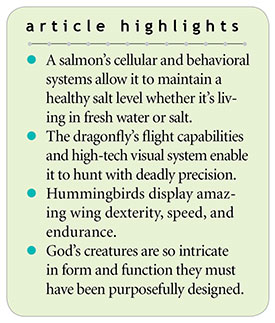
One example of God’s creative genius is the salmon. This fish is born inland in freshwater streams miles from the ocean, migrates to live in the salty sea, and then returns to fresh water so it can spawn. The salmon has a unique ability to maintain a constant healthy level of saltiness. Its internal cellular and organellar systems adjust automatically in response to environmental tracking systems that monitor external salt levels.1
Chief among these engineered systems are specialized sodium pumps embedded in the cell membranes. The pumps’ activity is coordinated not only within the internal apparatus of the cell but also with other systems in the salmon’s various organs, especially those on the forefront of osmoregulation (the maintenance of body-fluid pressure) such as the gills and kidneys.
In addition to these integrated cellular systems, the salmon has built-in behavioral traits to also manage its salt levels. Instead of immediately charging into the ocean or back into fresh water, it pauses to temporarily equilibrate its body in transitionary zones between the two.
The Dragonfly
The field of bioengineering makes use of the design found in living creatures. One flying creature human engineers have tried to copy is the dragonfly. These insects are expert fliers. They can maneuver straight up and down, hover in place like a helicopter, and even mate in midair.
The dragonfly’s optics are also amazing, with almost its entire head composed of visual sensors loaded with engineering that’s only beginning to be understood. It has very complex eyes constructed of individual visual sensory units called ommatidia. A single compound eye has an integrated lens system containing up to 30,000 ommatidia. Each individual ommatidium collects its own stream of visual information that’s transmitted to the dragonfly’s brain, where it’s decoded and processed to form a mosaic image with intricate visual depth and detail.
Combined with its flight capabilities, the dragonfly’s high-tech visual system allows it to track and grab aerial targets like flies with deadly precision. A study of caged dragonflies found they were able to successfully snatch their rapidly moving prey out of the air with 95% accuracy.2
The Hummingbird
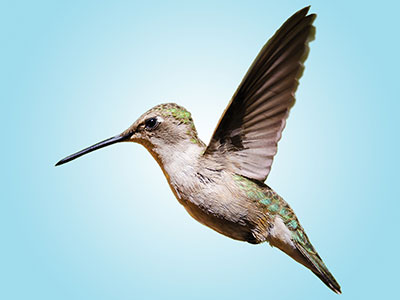
The hummingbird is another animal that glorifies the Creator. This little creature is distinctly different from all other bird kinds. Hummingbirds are the only bird that can fly backward. They can literally zip around in just about every direction due to their wings’ ability to rotate in a full circle and flap up to 80 times per second.
Hummingbirds have much larger and more complicated brains than insects. One study determined that “the hummingbirds had faster reaction times than those reported for visual feedback control in insects.”3 The endurance and speed of hummingbirds are also phenomenal. They can fly at 25 to 30 mph and dive at speeds of up to 60 mph. The ruby-throated hummingbird has the ability to travel up to 500 miles across the Gulf of Mexico to reach its breeding grounds.
The V-22 Osprey is human engineers’ attempt to create something with roughly similar flight capabilities. This military aircraft requires constant fueling, maintenance, supervision, and construction since it can’t feed itself or reproduce like the hummingbird. Human efforts to copy the intricate form and function of God’s creatures is further evidence of our Creator’s engineering genius.
References
- Vargas-Chacoff, L. et al. 2018. Effects of elevated temperature on osmoregulation and stress responses in Atlantic salmon Salmo salar smolts in fresh water and seawater. Journal of Fish Biology. 93 (3): 550-559.
- Gonzalez-Bellido, P. T. et al. 2013. Eight pairs of descending visual neurons in the dragonfly give wing motor centers accurate population vector of prey direction. Proceedings of the National Academy of Sciences. 110 (2): 696-701.
- Cheng, B. et al. 2016. Flight mechanics and control of escape manoeuvres in hummingbirds. I. Flight kinematics. Journal of Experimental Biology. 219 (22): 3518-3531.
* Dr. Tomkins is Director of Life Sciences at the Institute for Creation Research and earned his Ph.D. in genetics from Clemson University.