On September 22, 1994, the news hit the headlines. "New Chimpanzee-size link to humans found in Ethiopian Desert" (USA Today). Similar articles appeared everywhere.
The articles reported a paper published in the British science journal, Nature, authored by Dr. Tim White of U.C. Berkeley and others. Despite a few "qualifying" words, the newspaper articles clearly asserted that humans had evolved from an undiscovered ape-like ancestor and that this new evidence was from a species close to that missing link. Does the evidence support this conclusion?
From the newspaper articles, we learn that 17 scraps of bone and teeth were found, and that these had been gnawed by carnivores. Some were fragments of skulls which had been crushed, others were teeth or tooth fragments, one of which was still embedded in a portion of the jaw no bigger than a man's thumbnail, but labeled "a child's jaw." A significant portion of an upper arm bone was also found. Nothing was found from below the waist, but the anthropologists concluded from the elbow and one tooth that this species had already split off from the apes, and was walking somewhat erect.
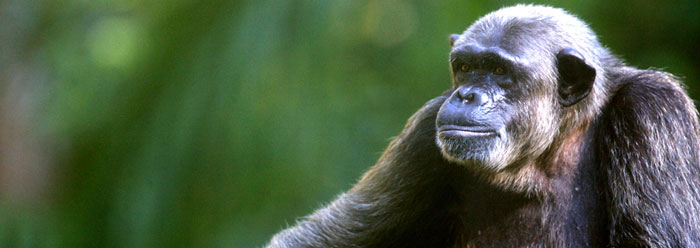
Specifically, what was concluded was that these creatures showed some features which were not completely apelike, but more so than the fossil dubbed "Lucy." This remarkable fossil, 40% complete and three feet six inches tall, was found by Dr. Donald Johanson in 1974, who admits that Lucy was chimplike. Although Lucy's skull was not recovered, others of the same species exhibit a chimp-sized brain and chimp-like teeth and jaws, with a few minor differences.
From the neck down, certain clues suggested to Johanson that Lucy walked a little more erect than today's chimps. This conclusion, based on his interpretation of the partial hipbone and a knee bone, has been hotly contested by many paleoanthropologists. But even the most generous view of Lucy was that she was chimp-like, possessing certain features reminiscent of humans. Long curved fingers and toes showed that her species was at home in the trees, although able also to walk on the ground. Perhaps they walked partially erect, but not in the human manner.
Unfortunately, Lucy has come to be considered as "the earliest human," a misstatement seldom (if ever) corrected by knowledgeable evolutionists. This deception continues to influence many, and even creeps into the evaluation of this most recent find.
Note the conclusion and the logic behind it. Lucy was the first human, or clearly on the road to man. The new find was more apelike. Therefore, it now becomes our most ancient ancestor. But without the religiously held conviction that humans came from animals, this evidence would be of little significance. At most, it would reveal evidence of a now extinct species, surely of some interest, but not frontpage headlines.
A great deal is at stake here—the concept that man is an animal. The concept that man was created by God who will one day pass judgment on each individual's actions and attitudes is rejected by many. How much more comfortable it is to think that there is no right and wrong, no external authority over one's life, no heaven or hell. Thus, any scrap of bone, which can be used to justify this position, makes headlines, even if it reflects poor science.
*Dr. John Morris is the President of ICR.