Think of all the jobs that our good working sense of smell fulfills. First, the nose detects a chemical—the source of the scent. It distinguishes that scent from literally billions of others. Our sense of smell even gauges the strength of the scent. Finally, the sense rapidly scans memories of past smells to interpret the odor’s level of pleasure or toxicity or something in between. Human engineers would need a large lab full of specialized equipment and caretakers to accomplish all this. Researchers peered into the inner workings of nerve cells to discover the ingenious genetics that enable something as small as a nose to accomplish every olfactory task.
Humans have around 400 genes dedicated to olfactory reception. These genes reside in many different chromosomes. Scientists, including a group in Stavros Lomvardas’ lab at the University of Columbia in New York, have wondered how so few genes genetically separated so far from one another within each nerve cell nucleus coordinate to form such a formidable sense of smell. The researchers looked at the development of nose nerve cells called olfactory neurons in mice and made a startling discovery.
Most biologists think of genes and the various factors that regulate them as working mostly within the same chromosome that carries that gene. Mice have some 1,000 olfactory receptor genes spread across 16 of their 20 chromosomes.1 Columbia University News wrote, “How this process results in such a finely tuned sense of smell remained mysterious for decades.”1 Lomvardas’ team discovered that as olfactory neurons develop, tiny cellular machinery physically gathers the olfactory receptor genes from different chromosomes into one place like a hen gathering chicks that somehow scattered across the county.
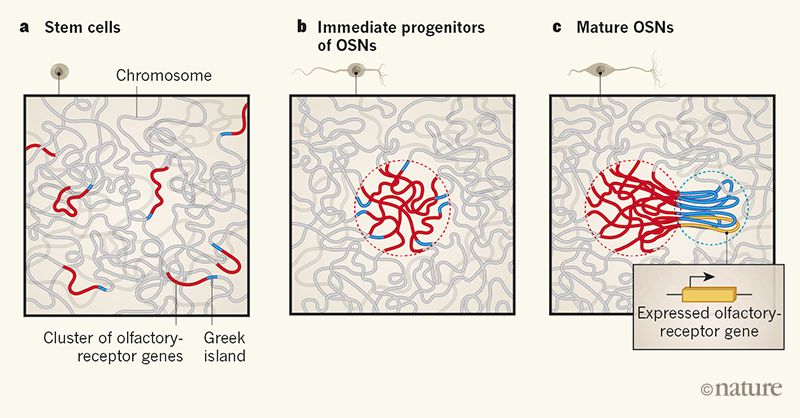
Image Credit: Nature.
Writing a summary of these findings for Nature, François Spitz said, “Monahan et al. show that, in the nuclei of mouse olfactory sensory neurons, certain regions of multiple chromosomes assemble in a structure that controls the expression of the full repertoire of olfactory-receptor genes in the nose, while making sure that each cell expresses only one type of receptor.”2
Kevin Monahan works in the Lomvardas lab and was co-first author of the team’s report in the journal Nature.3 He told Columbus University, “These teams of genes endow the olfactory system with the ability to respond in diverse ways. The flexibility of this process could help to explain how we easily learn and remember new smells.”1
The team deleted the LHX2 gene from certain mice. It codes for a transcription factor—proteins that regulate DNA—that regulates olfactory genes. In other mice, they deleted the LDB1 gene; it codes for a cofactor, or helper, of LHX2. Either deletion hindered the proper development of olfactory centers within the nose’s nerves. So a sense of smell requires at least LHX2, LDB1, and a suite of olfactory genes.
On a given chromosome, a handful of olfactory receptor genes group together. Each of these clusters has a unique olfactory receptor gene enhancer. Working in concert with transcription factors and cofactors, these enhancers help build the interchromosomal 3D structures that become unique to each olfactory neuron and enable hundreds of genes to combine in different ways to detect as many as a trillion different odors.
Remove the receptor genes, and smell ceases. Remove the necessary transcription factors or gene enhancer sequences, and smell ceases. And, of course, one also needs whole neurons, a nose in which to house them, a place to put the nose, and a brain to store and process smelly data. All these parts must have been in place in the beginning.

Our exquisite sense of smell does not merely warn us of toxic odors to avoid. It opens a universe of pleasurable smells as though roses were made for noses. The Creator, not His creation, deserves thanks for His skill in constructing bodies that can rebuild new and ingenious noses every generation and for His gracious provision of a sense that can both warn of chemical dangers and bring endless smiles.
References
1. Genes on the Move Help Nose Make Sense of Scents. Columbia University News, Zuckerman Institute. Posted on zuckermaninsititue.columbia.edu January 9, 2019, accessed January 14, 2019.
2. Spitz, F. Chromosomes come together to help mice distinguish odours. Nature. Posted online before print, January 9, 2019, accessed January 14, 2019.
3. Monahan, K., A. Horta, and S. Lomvardas. LHX2- and LDB1-mediated trans interactions regulate olfactory receptor choice. Nature. Published online before print, January 9, 2019, accessed January 14, 2019.
Brian Thomas is Science Writer at the Institute for Creation Research.