No doubt you've noticed the recent flurry of newspaper articles and TV interviews which have been proclaiming that the Big Bang theory had finally been proved. An observation by the COBE (Cosmic Background Explorer) satellite had verified a basic prediction of the Big Bang, so astronomers claimed. In fact, this discovery was so stupendous, "It was like looking at God, if you're religious," one said.
Within a week of the pronouncement, I happened to be at a major observatory, and discussed the find with a resident astronomer. He, too, was bubbling with excitement as he spoke. The Big Bang was now a fact, not merely a theory, I was told.
Upon further questioning, he admitted that the Big Bang concept had been at death's door, despite the fact that students have always been taught it, without reservation. This discovery had "saved" the Big Bang.
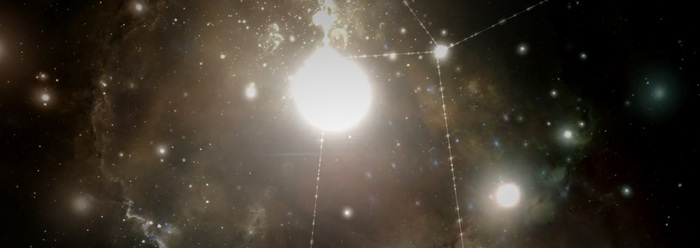
This astronomer admitted that many recent discoveries had seriously weakened the Big Bang theory. You see, the theory predicts some 15 or so billion years ago, all the matter and all the energy in the entire universe was packed into a single "cosmic egg," a super-dense electron-sized particle. An instability arose, and it exploded (i.e., in a big bang), producing an even distribution of matter and energy in all directions.
This was "proven" by the discovery, in 1964, of a very low-level background radiation the leftover "whisper" of the Big Bang. In all directions, the background radiation was measured at 2.7° Kelvin (equivalent to -270.5° Celsius!) with no variation—perfectly smooth.
But recent observations of the universe have revealed a very "lumpy" universe, with huge clusters of millions of galaxies and immense voids—not at all as expected from theory or the smooth background radiation. This led astronomers to propose that there must have been irregularities in the original "bang" to account for the present "lumpy" universe.
So now you know why astronomers were ecstatic when the COBE satellite measured small fluctuations in the background radiation, for now the Big Bang—everybody's favorite story—had been fully "proved."
But wait! It must be recognized that the variation has not been verified yet by others. No one has yet carefully examined the data. Most telling, the variation was extremely slight—only 30 millionths of a degree. At a lecture this week, one of the designers of the satellite told Dr. Gish that the COBE was not capable of measuring such a small variation. Others have said it is impossible for anything to be perfectly smooth, and even with these variations, the background radiation is smooth! And given the large-scale "lumpiness" or non-homogeneity of the universe, these small variations hardly seem related.
The astronomer I talked to said he was "quite religious, in a way." He knew there must be a God, since there were many things in astronomy he couldn't understand. But now he knew that God either must either be the Big Bang or have caused the Big Bang.
No, the Big Bang hasn't been "saved." At best, its death has been postponed for a few years. Worse, astronomers now have an excuse to continue in their "willful ignorance" (II Peter 3:3) and unbelief.
*Dr. John Morris is the President of ICR.