On a recent visit to the Royal Tyrell Museum in Alberta, Canada, I headed straight to the famous Dinosaur Hall that houses over 40 mounted specimens, including the Tyrannosaurus rex known as “Black Beauty.” However, a seemingly insignificant pair of fossil fish caught my eye—fossils that illustrate the fallacy inherent in uniformitarian thought and interpretation.
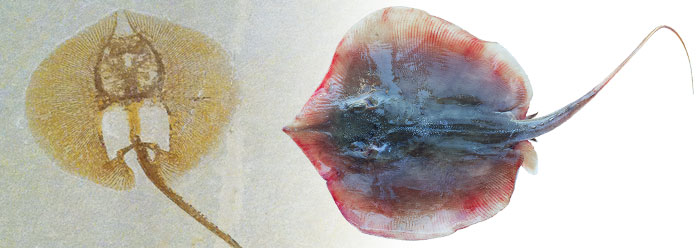
The first display was a beautifully preserved fossil herring with signage stating, “Modern herring live in salt water, but close Eocene relatives were abundant in the fresh water lakes of western North America.” A second display featured a spectacularly preserved fossil ray and claimed, “Rays are rarely preserved as fossils, in part because their skeletons are made of cartilage rather than bone. Most rays prefer salt water, making this fresh water form an even more remarkable fossil.”
Why are these fossil fish, which look nearly identical to modern herring and rays that live exclusively in the marine realm today, claimed to be ancient fresh water fish in this museum? Uniformitarian scientists make this claim because these fish were found in the Green River Formation of Wyoming, and this rock unit also contains a lot of fish, like gar, paddlefish and sand fish, that are found only in fresh water, therefore they have to conclude that the entire rock unit represented an ancient fresh water lake deposit.
In a recent Acts & Facts article, I discussed several similar examples of marine and terrestrial environments mixing within the same rock layer.1 Five species of sharks have been found in the same strata as T. rex fossils. And the deep-ocean-dwelling coelacanth fish has been found in rock layers with the dinosaur Spinosaurus.1
Contrary to the claims of uniformitarian scientists, there is no evidence that these fish lived in fresh water and somehow evolved to live in salt water—the claims are entirely speculative. These fossils are nearly identical to modern fish found only in the ocean. The spectacular preservation of these specimens serves as a stunning testament to rapid burial and the globe-sweeping catastrophic nature of the floodwaters. Huge tsunami-like waves must have transported these marine fish onto the continents, mixing them in the same sedimentary deposits as the dinosaurs and other land animals.
There are many other examples of land animals transported by floodwaters into the sea, many miles from shore. The deepest dinosaur bone ever discovered was found in an oil-well core taken from the North Sea, between Greenland and Norway.2 Coal fragments from land plants have been found in marine sediments thousands of feet below the surface in an oil well off the coast of Labrador, Canada.3 Finally, terrestrial plant debris and lignite have been found hundreds of miles east of the Falkland Islands in nearly 10,000 feet of water4 and also in deep water off the coast of California.5
Uniformitarian scientists often ignore or downplay these discoveries because they are not readily explainable in their worldview. By refusing to accept the Word of God, these scientists have no recourse but to explain away the evidence as insignificant anomalies or use a rescuing device such as claiming these marine fish lived in fresh water. They forget that only the great Flood can explain the turbulence necessary to transport marine animals hundreds of miles onto the continents and sweep terrestrial organisms into the deep ocean.
References
- Clarey, T. 2015. Dinosaurs in Marine Sediments: A Worldwide Phenomenon. Acts & Facts. 44 (6): 16.
- More information on this discovery is discussed in: Clarey, T. 2015. Dinosaurs: Marvels of God’s Design. Green Forest, AR: Master Books. Available at www.ICR.org.
- These coal fragments were found in the Chevron Skolp E-07 well.
- Harris, W. K. Palynology of cores from Deep Sea Drilling project Sites 327, 328, and 330, South Atlantic Ocean. In Barker, P., et al. 1977. Initial Reports DSDP, 36. Washington D.C.: U.S. Government Printing Office, 761-815.
- Rullkötter, J., et al. Organic petrography and extractable hydrocarbons of sediments from the eastern North Pacific Ocean, Deep Sea Drilling Project leg 63. In Yeats, R. S., et al. 1981. Initial Reports DSDP, 63. Washington D.C.: U.S. Government Printing Office, 819-836.
* Dr. Clarey is Research Associate at the Institute for Creation Research and earned his Ph.D. in geology from Western Michigan University.