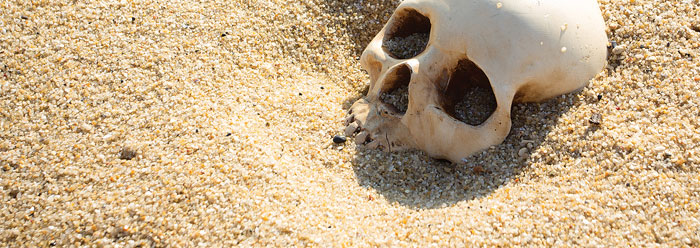
The human population in Noah’s day was extensive, likely numbering in the multimillions. With the exception of the few people on the Ark, this entire population was annihilated by the Flood. Since the Flood also deposited nearly all of the sediment that later became Earth’s geologic strata in a single year, one would think that at least some of the bodies would have been buried and preserved as fossils.1 So, why don’t we find more human fossils in Flood strata?
Human remains are scarce in the fossil record, but so are all land-dwelling mammal, bird, and reptile fossils. The overwhelming majority of animal fossils are marine invertebrates. We find innumerable clam fossils but very few mammals. Why is that? Terrestrial vertebrate animals have a lower fossilization potential than marine organisms, which often have hard outer shells. When a mammal fossil is found, it usually consists of a piece of only one bone. Whole-body mammal fossils are extremely rare. The hydraulic forces that simultaneously deposited sediments and dead animals were typically strong enough to be highly destructive. Muddy sediments moving at great speeds generate powerful shear forces. Few animal bodies would have remained intact.
Similar water and sediment movements occur today on a smaller scale. In March 2014 disaster struck near Oso, Washington, when a mudslide buried a small community.2,3 While our hearts and prayers go out to everyone affected by this devastating tragedy, the results have something to teach us about the great Flood.
When the Oso slide occurred, rains had been falling for several days, and the soil on the hillside above reached an unsupportable weight. It slumped away, not at an excessive speed, but with an unstoppable force. The relentless slide devastated the community and buried scores of unsuspecting residents. Hundreds of people from the local community joined in a heroic search, working alongside rescue teams utilizing modern equipment and dogs. A few residents in protected pockets were thankfully rescued alive, but many people were entombed in the mud. The thick layer of mud (over 100 feet in places) and the square-mile area covered by the deposit stymied recovery goals. Forensic experts were called on to help identify the remains. A few of the victims had suffocated, but most died by blunt-force trauma. Recognizing the bodies was often difficult, since many were no longer intact due to the forces involved.2
During the Flood, countless animals and people died as torrents of fast-moving water and mud scattered their remains over the entire planet. Efforts to find human fossils in geologic strata compare poorly to the recovery efforts in Washington, where approximately 100 people were buried by slow-moving mud in one small area. Almost immediately, hundreds of searchers were present knowing generally where to look. Conversely, the energy and extent of the flows during the great Flood dwarfed the tiny slide in Washington. Most bodies would almost certainly have been dismembered, broken, and scattered beyond recognition.
In reality we wouldn’t expect to find many human bodies, with their long extremities and weak connective tissue, fossilized in Flood strata. It would be quite rare for a fragile human body to be buried in recognizable condition by the mudflows and then be discovered in the thick sedimentary record and identified by a knowledgeable observer.
The strata are reminders of God’s righteous anger as well as His saving grace in plucking Noah and his family out of the destruction.
References
- Sedimentary rock is the type of rock that often contains fossils, the remains of buried plants and animals. Creation scientists are convinced that nearly all of Earth’s sedimentary rock, by definition deposited by moving water, was laid down as sediments by the great Flood of Noah’s day. In other words, both the rock layers and the fossil records are the result of that Flood.
- Lovett, I. Loggers Join in Search for Washington Landslide Victims. The New York Times. Posted on nytimes.com March 27, 2014, accessed April 3, 2014.
- Valdes, M. and M. Volz. Weary mudslide rescuers battle rain, exhaustion. Associated Press, March 27, 2014.
* Dr. Morris is President of the Institute for Creation Research and received his Ph.D. in geology from the University of Oklahoma.