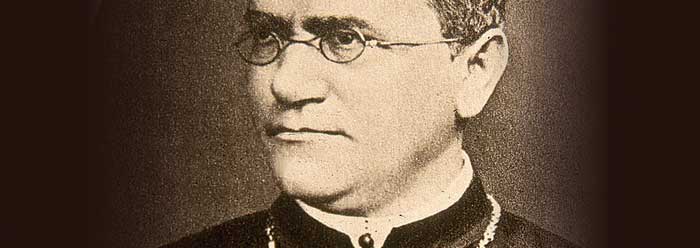
One of the “heroes” of evolutionists is Gregor Mendel, a European monk who experimented with plant breeding in the latter half of the 1800s. While his contemporary Charles Darwin specifically tried to replace belief in creation, Mendel claimed he was trying to understand God’s creation. Evolutionists like to quote Mendel’s findings as proof for their beliefs, but in reality he demonstrated the strict limitations of biological change.
Mendel was a good experimentalist, working with plants in his monastery’s garden. He bred varieties of garden peas to enhance certain features and noticed that while there was variability in plants, there was a clear limit to that variability. The plants could be bred in one direction but there was a limit to how far they could go. He saw no evidence of evolution; indeed, he observed the opposite of evolutionary change. A plant with one color blossom might be encouraged to produce a plant with another color blossom, but the basic plant remained the same. Mendel’s efforts established the laws of genetics but uncovered no evidence for evolution.
He concluded what the Bible had been saying all along, that God created each animal or plant type after its kind and placed in each one the genetic “seed” to reproduce only after that kind. Plants and animals do not have the potential to vary into another kind. In biology this is called stasis—a condition in which things basically remain the same. They are “stationary”— fundamentally unchanging. They do not have the ability to become something different.
We see much the same thing in fossilized plants and animals, those that lived and died in the past. Each fossil can be placed into a grouping of similar plants or animals. Clam fossils look much the same as modern clams. There is variability among the clams, but clams remain clams. Clams are not sea snails, nor are they roses. There is variability among sea snails and variability among roses, but they each are separate and distinct kinds. There is absolutely no evidence that a coral will evolve or ever did evolve into a sea snail. Each basic type remains that basic type.1
This is exactly what we read in Genesis 1. Scripture says that God created each type after its kind 10 times in that chapter (see verses 11-12, 21, 24-25). It seems that the writer of Scripture went out of his way to insist that animals and plants were created fully formed as particular kinds and did not get here by altering previous existing kinds, nor do they change into other basic kinds.
We see in biology exactly what Scripture describes: stasis—not evolution. In the Bible we are told that plants and animals were created with a mechanism ensuring stasis, seemingly ruling out the possibility of large-scale evolution. The obvious correlation of scriptural truth with scientific truth encourages us to believe Scripture in other areas as well (John 3:12). We can have confidence in what it teaches about things we cannot confirm, such as our home in heaven and the forgiveness of sin. We can believe these things because His Word is so reliable and accurate every time it is put to the test.
Reference
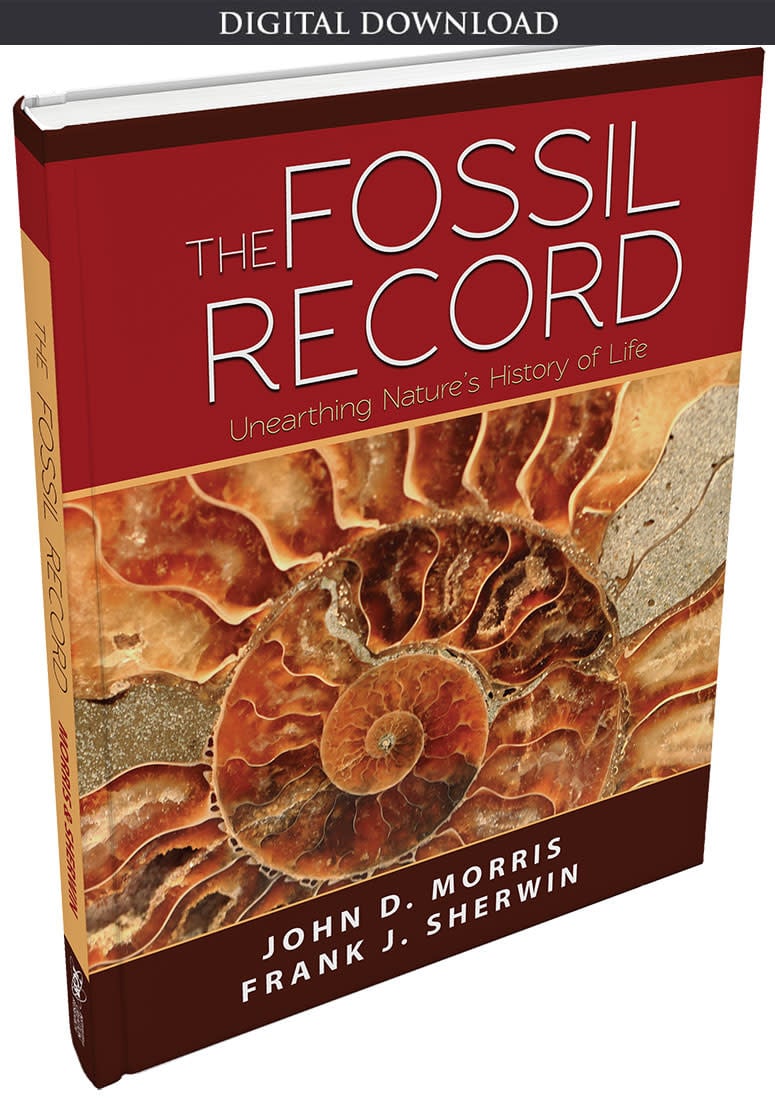
- For more information on what the fossil records reveals, see Morris, J. D. and F. J. Sherwin. 2010. The Fossil Record: Unearthing Nature’s History of Life. Dallas, TX: Institute for Creation Research.
* Dr. Morris is President of the Institute for Creation Research and received his Ph.D. in geology from the University of Oklahoma.