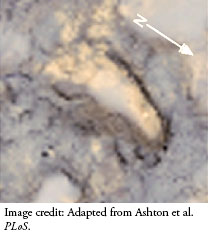
News headlines worldwide recently reported Europe's oldest human footprint discovery at Happisburgh on England's east coast. How old are the tracks? It appears the media and research team answer this question by following the same misleading trends.
What do these headlines have in common?
- "Scientists find 800,000-year-old footprints in UK"1
- "850,000-year-old human footprints found in Norfolk"2
- "Scientists find 800,000-year-old footprints in England"3
- "800,000-year-old footprints found in England -- then they washed away"4
Are these dates based on solid science?
Though all the headlines mention that human footprints were found and that they are at least 800,000 years old, empirical science only really confirms the presence of what look like footprints. Without a time machine or a date stamp on some coin or other artifact directly associated with the tracks, deciding on an age requires some assumptions.
For example, Fox News relayed the AP release, which stated, "Scientists dated the footprints by studying their geological position and from nearby fossils of long-extinct animals including mammoth, ancient horse and early vole."3 How do researchers know they have the correct age assigned to the prints' "geological position" or to the "nearby fossils"?
Journalists, like the rest of us, rely on what scientists say. Although sometimes necessary, this "appeal to authority" argument can trap us when our authority has it wrong. Did the researchers who published in PLOS ONE get it right?5
Their article lends importance to the phrase "Early Pleistocene," repeating it at least six times throughout the text. The study authors wrote, "The estuarine sediments at Happisburgh are part of the Hill House Formation (HHF) and are Early Pleistocene in age, dating to between 1 and 0.78 My [million years]."5
Calling the rock formation Early Pleistocene is one thing—anybody can assign a name to an object. But who assigned the age range to that name and how did they do it? Like the media, did the scientists make an appeal to authority? It's possible. After all, they cited the work of other scientists who had already assigned the name and its expected age to the sediments.6
These articles reference the "Geologic Time Scale," a chart that pins year ranges to names like "Pleistocene."7 Secular scientists almost never assign an age to a rock or fossil without referencing some version of this chart. Maybe one reason why so few geologists question the chart's contents is because it is taught to them as established fact during school.
 Should we trust it simply because so many geologists trust it? If that's our only reason, then we're in danger of participating in the "bare assertion fallacy."8
There must be a more scientific means to validate the age of the footprints than merely citing them as Early Pleistocene then matching the label to the corresponding dates on a chart.
The PLOS ONE study authors wrote, "The sediments also contain a rich assemblage of fauna and flora which suggest that the archaeological evidence can be attributed to the later part of an interglacial."5 Interglacials are supposedly very long periods (many thousands of years) of warmer weather in between multiple ice ages, or "glacials." These scientists made an assumption when assigning the footprint-bearing rocks to a supposed interglacial period, and others made assumptions when they pinned those periods onto charts with ages already designated.
The entire concept of interglacials assumes vast time without proving it—a circular argument.9 Although the Genesis Flood did cause the single post-Flood Ice Age, multiple glacial/interglacial cycles never actually happened. But even if they had occurred, can we really know when they occurred?
Secularists attribute glacials to small changes in high latitude summer sunlight resulting from subtle, long-term cycles in the earth's orbit—despite evidence that these small changes are far too weak to cause continent-covering ice ages. Nevertheless, separate scientific authorities tied these cycles to oxygen isotope fluctuations in seafloor sediments in a process called "astronomical tuning."10 The very term betrays the model's circularity. The process "tunes" or adjusts supposed ages of sediment layers to the assumption that for untold eons astronomical cycles created climate changes that then caused the oxygen isotope readings within seafloor mud layers.
Of course we will find vast eons in sediments if we initially assign vast eons to their layered patterns!11
So, at first glance, the processes of correlating fossils, denoting interglacials, assigning ages to seafloor sediments, and marking astronomical cycles each appear to independently confirm an 800,000-year context for these human prints. But each tactic turns out to have been hand-molded to meet expectations.
Secular journalists, astronomers, glaciologists, sedimentologists, archaeologists, and geologists followed the same trend.12 They helped ensure that the footprints' published dates agree with the prevailing belief in millions of years, even if that means appealing to an authority, making bare assertions, or using circular reasoning.
References
- Lawless, J. Scientists find 800,000-year-old footprints in UK. Yahoo! News. Posted on news.yahoo.com February 7, 2014, accessed February 20, 2014.
- Kennedy, M. 850,000-year-old human footprints found in Norfolk. The Guardian. Posted on theguardian.com February 7, 2014, accessed February 20, 2014.
- Associated Press. Scientists find 800,000-year-old footprints in England. Fox News. Posted on foxnews.com February 7, 2014, accessed February 20, 2014.
- Netburn, D. 800,000-year-old footprints found in England -- then they washed away. Los Angeles Times. Posted on latimes.com February 7, 2014, accessed February 20, 2014.
- Ashton, N. et al. 2014. Hominin Footprints from Early Pleistocene Deposits at Happisburgh, UK. PLoS ONE. 9 (2): e88329.
- Parfitt S. A. et al. 2010. Early Pleistocene human occupation at the edge of the boreal zone in northwest Europe. Nature. 466 (7303): 229–233.
- The Geological Society of America issued their fourth official version of their time scale in 2012.
- Ipse dixit. n. An unproved assertion resting only on the authority of a speaker; a dogmatic statement; a dictum. From Brown, L., ed. 1993. The New Shorter Oxford English Dictionary. Oxford, UK: Clarendon Press, 1415.
- Ironically, inserting the time required to support interglacials undermines the very means by which ice could have accumulated during the Ice Age. See Hebert, J. 2013. Was There an Ice Age? Acts & Facts. 42 (12): 20.
- For one of many examples, see Huang, C. et al. Astronomical tuning of the Aptian Stage from Italian reference sections. Geology. 38 (10): 899–902.
- As with ice core layers and varves, seafloor sediments could have been deposited recently and rapidly—by storms, for example.
- Groupthink. n. A process of reasoning or decision-making by a group, especially one characterized by uncritical acceptance or conformity to a perceived majority view. Bell, K., ed. Open Education Sociology Dictionary. Posted on sociologydictionary.org, accessed March 5, 2014.
Image credit: Adapted from Ashton et al. PLoS.
* Mr. Thomas is Science Writer at the Institute for Creation Research.
Article posted on March 7, 2014.