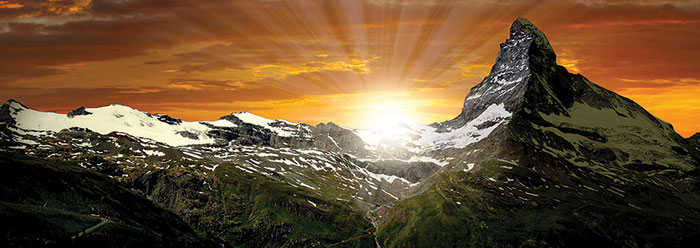
Of all the beautiful and awe-inspiring mountains in the Alps, the Matterhorn can elicit the strongest emotions. From snow skiing to mountain climbing, or just sitting and admiring it, none can match its majesty.
In earlier days, when scientific creation thinking was new, the Matterhorn became somewhat of an icon for creationists. The classic book The Genesis Flood described it as an “upside down mountain,” with fossils in the wrong order according to evolutionary predictions, and thus evidence for the great Flood of Noah’s day.
Sedimentary rocks near a mountain’s summit are supposed to be the youngest (i.e., they contain fossils thought to be more recently evolved) and should overlie lower strata that should be older, all things being equal. Yet on the Matterhorn, the reverse is true. Rocks dated as Cenozoic (containing fossils thought to be some 40 million years old) underlie rocks dated as Mesozoic (thought to be 200 million years old) according to evolutionary uniformitarianism. If they really were deposited on the Matterhorn in that order, then the whole system is wrong—it’s literally flipped on its head. Creationists of the day insisted that the great Flood was not constrained to deposit things in an evolutionary order, and the observed order was only due to the dynamics of Flood waves.
But The Genesis Flood was written in 1961, before the evidence for plate tectonics began to accumulate. Now, while specific theories vary widely, no student of Earth history doubts that past world-restructuring events have taken place. Creationists have accepted this in the form of catastrophic plate tectonics or a variety of other models. This is not a capitulation to evolution, but a healthy response to new data. It has been recognized by all serious creationists that the great Flood, described in such breathtaking terms in Scripture, must have been nothing less than a worldwide tectonic episode that forever altered the entire planet. Everywhere we go, we should see its results—and we do! The Flood would have involved mega-volcanoes, super earthquakes, colliding tsunamis, extensive sheet erosion, and more. The vagaries of the Flood could have produced almost any geologic feature. Often, evidence for the dynamic hydraulic processes of the Flood is misinterpreted as evidence for great ages of slow and gradual processes.
Following Flood deposition of vast layers of sedimentary rock, the Alps were formed as Africa collided with Europe, rumpling the flat sediments into massive mountains. The sediments on the Matterhorn were still soft at the time of deformation, for they are tightly folded. It doesn’t take a long time for sediments to harden, given proper conditions. Those on the Matterhorn appear folded close together, not like hard rock that readily breaks when bent. The time between deposition and folding was perhaps just the months of violent tectonic activity during the Flood, not millions of years. Local high areas might have slid downward, resulting in a seeming reversed order. The Ice Age that followed the Flood covered much of Europe with moving glaciers that scoured the uplifted, and by then hardened, rocks into the majestic mountains we admire today.
Remember, there is nothing about the sediments or their fossil content that speaks of millions of years of age. These are imposed strictly by the assumption of evolution. The application of a biblically compatible history to the rocks results in better scientific understanding and more satisfying personal implications as well.
“Before the mountains were brought forth, Or ever You had formed the earth and the world, Even from everlasting to everlasting, You are God” (Psalm 90:2).
* Dr. Morris is President of the Institute for Creation Research.
Cite this article: Morris, J. 2013. The Upside-Down Mountain. Acts & Facts. 42 (8): 13.