by John D. Morris, Ph.D., and Tim Clarey, Ph.D. *
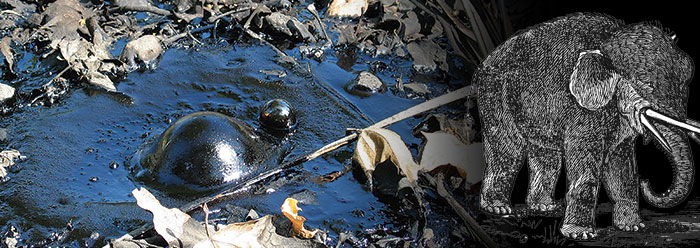
Modern college textbooks still maintain that the famous Rancho La Brea tar pits in southern California are evidence of sticky, tar-like material (bitumen) trapping and engulfing animals slowly over time.1 An alternative explanation contends that the collection of fossils is the result of catastrophic water transported by episodic flooding events during the Ice Age.2, 3, 4
The pits are famous for their rich collection of Pleistocene Epoch or Ice Age fauna initially excavated by the University of California, Berkeley and the Los Angeles County Museum of Natural History between 1906 and 1915. Over 230 types of vertebrate animals are found in the La Brea pits, including saber-toothed cats, mastodons, bears, wolves, camels, birds, insects, and even a few human bones and artifacts.2 These fossil remains are surrounded by naturally formed asphalt that seeped into the pits from underground oil reservoirs.
The first description of the bitumen, bubbling up at the foot of the Santa Monica Mountains, was made by geologist William Blake in 1853. He described one 30-foot diameter circular tar pit where bitumen had emerged from the ground and mixed with the surrounding sediment, forming a hard surface much like pavement but still soft near the pit’s center.
The first to recognize the bones of extinct animals in the tar pits was William Denton, a geologist prospecting for oil in 1875. Denton wrote a rather obscure report on a large canine tooth from a saber-toothed cat.2 In 1901, Union Oil geologist William Orcutt visited the site and found a complete skull of a saber-toothed cat along with numerous other bones. Finally, the Berkeley scientists heard about Orcutt’s finds and began their own excavation. Today, the George C. Page Museum in Los Angeles houses many of the specimens found over the years.
The pits themselves likely formed as methane gas and oil escaped from natural seeps through subterranean openings and collected in small, narrow openings resembling “blow-holes”2 where most of the bones are found. The major pits average around 15 feet in diameter, tapering downward from about 25 feet in rough conical shapes to just a few inches in width. The bones were commonly found as entangled masses packed tightly together, dismembered, and interlocking with the majority that were damaged in some fashion.2 Reconstructions of the various mammals on display are often composites of jumbled bones from different animals of the same species.
The conventional burial story of animals becoming trapped in the exposed tar and slowly sinking was initially questioned when the size of the pits and the size of the animals became known.3 Pit 36 had an opening of 4 feet by 2 feet and was only 11 feet deep, yet it contained six sizable carnivore fossils.2 Trying to fit whole mastodons and mammoths down similar-sized openings became even more problematic. In addition, scientists discovered evidence in the enclosing sediments around the bones that indicate fluvial (river) conditions.
Test cores revealed four distinct layers of floodplain deposits surrounding the pits, indicated by weathered and rounded gravels, as well as sand and clay that are typical of river deposits elsewhere.3 In spite of these apparent problems with the tar entrapment theory, it is still generally accepted by the scientific community, and this is what the Page Museum still illustrates in its displays today.
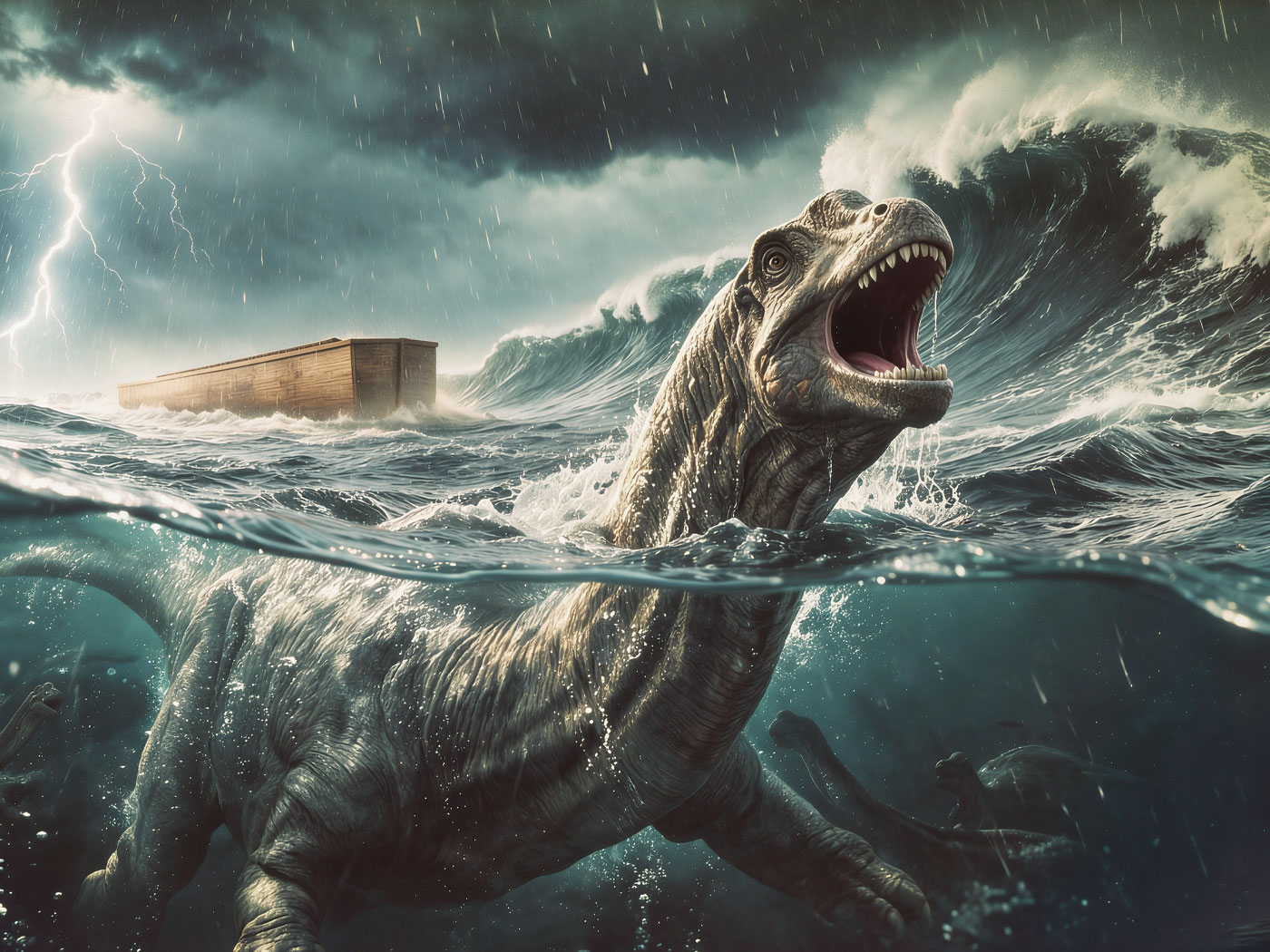
Uniformitarian scientists maintain that the fossils were deposited in episodes over thousands of years as rivers slowly built the landscape at the foot of the Santa Monica Mountains.3 Creation scientists, as well as some secular scientists, have proposed another explanation—water must have initially killed the animals, rather than the tar itself, and caused the concentration and eventual preservation of their fossils at the La Brea tar pits. Large flooding events (sometime after the Great Flood) could have swept the animals into the tar pit openings and deposited the bones in tight, jumbled masses. Biblical scientists have reinterpreted the fossil deposits as a consequence of closely spaced, catastrophic flood events that likely occurred in the waning of the post-Flood Ice Age.4 The immediate post-Flood years were likely chaotic and more geologically active than today as the earth’s surface recovered from the catastrophic activity of the Flood.
Uplift of the nearby Santa Monica Mountains and associated earthquakes could have instantly changed river directions and the levels of the land surface, setting local floods in motion. Rapid melting of the glaciers at the end of the Ice Age could have also contributed catastrophic outpourings of floodwaters from the mountains, depositing animal remains in the process. Close-spaced catastrophic events likely continued until Earth reached the relatively stable balance we now experience.
Creation scientists and some secular scientists question the animal entrapment theory for the La Brea tar pits based on close examination of the data. The entrapment theory only survives as myth, perpetuated by those not familiar with the geological evidence. The better explanation for the fossils in the La Brea tar pits matches perfectly with the biblical perspective of recent creation.
References
- Wicander, R., and J. S. Monroe. 2010. Historical Geology, 6th ed. Belmont, CA: Brooks/Cole Cengage Learning, 395.
- Jang, A. W. and W. Weston. 2006. The La Brea Tar Pits: A Field Trip & Self-study Guide. Vancouver, Canada: Fifth Province Media, Columbia Pacific University Press.
- Woodward, G. D. and L. F. Marcus, 1973. Rancho La Brea fossil deposits: A re-evaluation from stratigraphic and geological evidence. Journal of Paleontology. 47 (1): 54-68.
- Auldaney, J. 1994. Catastrophic fluvial deposition at the asphalt seeps of Rancho La Brea, California, Proceedings of the Third International Conference on Creationism, Technical Symposium Sessions, R. E. Walsh, ed. Pittsburgh, PA: Creation Science Fellowship, Inc., 25-35.
* Dr. Morris is President and Dr. Clarey is Research Associate at the Institute for Creation Research.
Cite this article: Morris, J. and T. Clarey. 2013. The La Brea Tar Pits Mystery.Acts & Facts. 42 (6): 14-15.