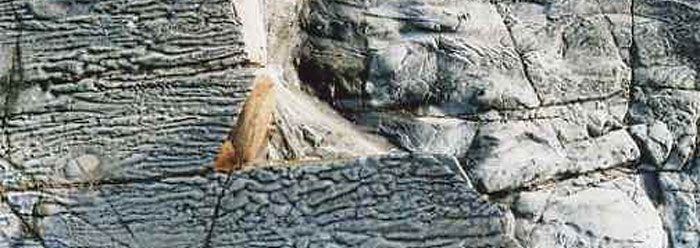
When secular scientists assume that fossil-bearing sedimentary rock layers are records of bygone eras, they encounter a sticky conundrum. The lowest fossil-rich rock layers, called Cambrian rocks, have all the basic types (phyla) of creatures, plus many extinct types. But hardly any fossils exist in the Precambrian or “Ediacaran” layers immediately below them. How could all those creatures have evolved so rapidly from so few predecessors? After decades of attempts, evolutionists still have not adequately explained how all major life forms suddenly appeared in the Cambrian explosion of life, supposedly requiring “only” five million years or so.
Darwin taught that environments shape creatures through natural selection. But one recent study of Precambrian worm burrows shows the futility behind thoughts of natural conditions generating creatures and of rock layers representing separate epochs instead of successive Flood layers.1
The animals that made the fossilized worm burrows in Yakutia, Russia, were clearly equipped for burrowing, and the team of Russian paleontologists who wrote about them in Geology described them as organisms that “actively burrowed by peristalsis,”2 which is a coordinated wavelike contraction of both longitudinal and transverse muscles. The esophagus uses this method when swallowing, caterpillars use it when crawling, and worms living on the seafloor use it when burrowing.
So, do the worms help explain how all those living phyla evolved in only a few million supposed years between the Ediacaran and the Cambrian?
The authors suggested that worm churning of sediment became “the triggering mechanism” for rapid evolution of Cambrian creatures.2 Dima Grazhdankin, coauthor of the Geology study, told ScienceNews, “We think that Ediacaran organisms diversified as a reaction to habitat remodeling by…burrowing.”3
In other words, “that newly plowed seafloor in turn might have helped to spur the rise of new kinds of macroscopic life late in the Ediacaran period—just before the Cambrian explosion produced most of the major animal groups around today.”3
But passive environments do not build machines. Habitats present challenges that creatively designed mechanisms must overcome, but habitats alone never build problem-solving structures. That is why phrases like “helped spur the rise” and “diversified as a reaction” are evolutionary “magic words” with no scientific content.4
Following the evolutionary reasoning of the Russian study authors, one might say that earth layers were “the triggering mechanism” that “helped spur the rise” of oil drilling rigs that “diversified as a reaction” to petroleum buried beneath rocks. In reality, just as people constructed oil rigs, the Lord Jesus constructed burrowing worms—complete with all the features necessary for peristalsis.5 And oil rigs are extremely simple when compared to any living cell.
Creation and the Flood straightforwardly explain the rocks and fossils. Creatures appear suddenly and fully formed in the fossil record because they descended from suddenly created and completed kinds, according to Genesis 1. And they were fossilized in the Cambrian and most other sedimentary rocks because the Flood buried them. If the major fossil-bearing rock layers do not represent distinct epochs, but instead tsunami-like pulses of catastrophic sedimentation during the Flood year, then the Cambrian conundrum disappears.
Mud flats did not trigger the exactly fitted muscles, nerves, and connective tissues required for peristalsis in worm burrowing. Like any environment, a muddy environment is passive, inanimate, and unthinking—an illegitimate candidate for creating a worm or anything else. Those who attribute the creation of biological mechanisms to changing seafloor environments have “changed the glory of the uncorruptible God into an image made like to corruptible man, and to birds, and fourfooted beasts, and creeping things”6—and mud.
References
- Thomas, B. Is the Cambrian Explosion Problem Solved? ICR News. Posted on icr.org November 12, 2011, accessed April 27, 2012.
- Rogov, V. et al. 2012. The oldest evidence of bioturbation on Earth. Geology. 40 (5): 395-398.
- Powell, D. Fossils show signs of earliest burrowing. ScienceNews. Posted on sciencenews.org March 27, 2012, accessed April 27, 2012.
- Guliuzza, R. 2010. Unmasking Evolution’s Magic Words. Acts & Facts. 39 (3): 10-11.
- “All things were made by him; and without him was not any thing made that was made” (John 1:3).
- Romans 1:23.
* Mr. Thomas is Science Writer at the Institute for Creation Research.
Cite this article: Thomas, B. 2012. Do Habitats Create Creatures? Acts & Facts. 41 (7): 18.