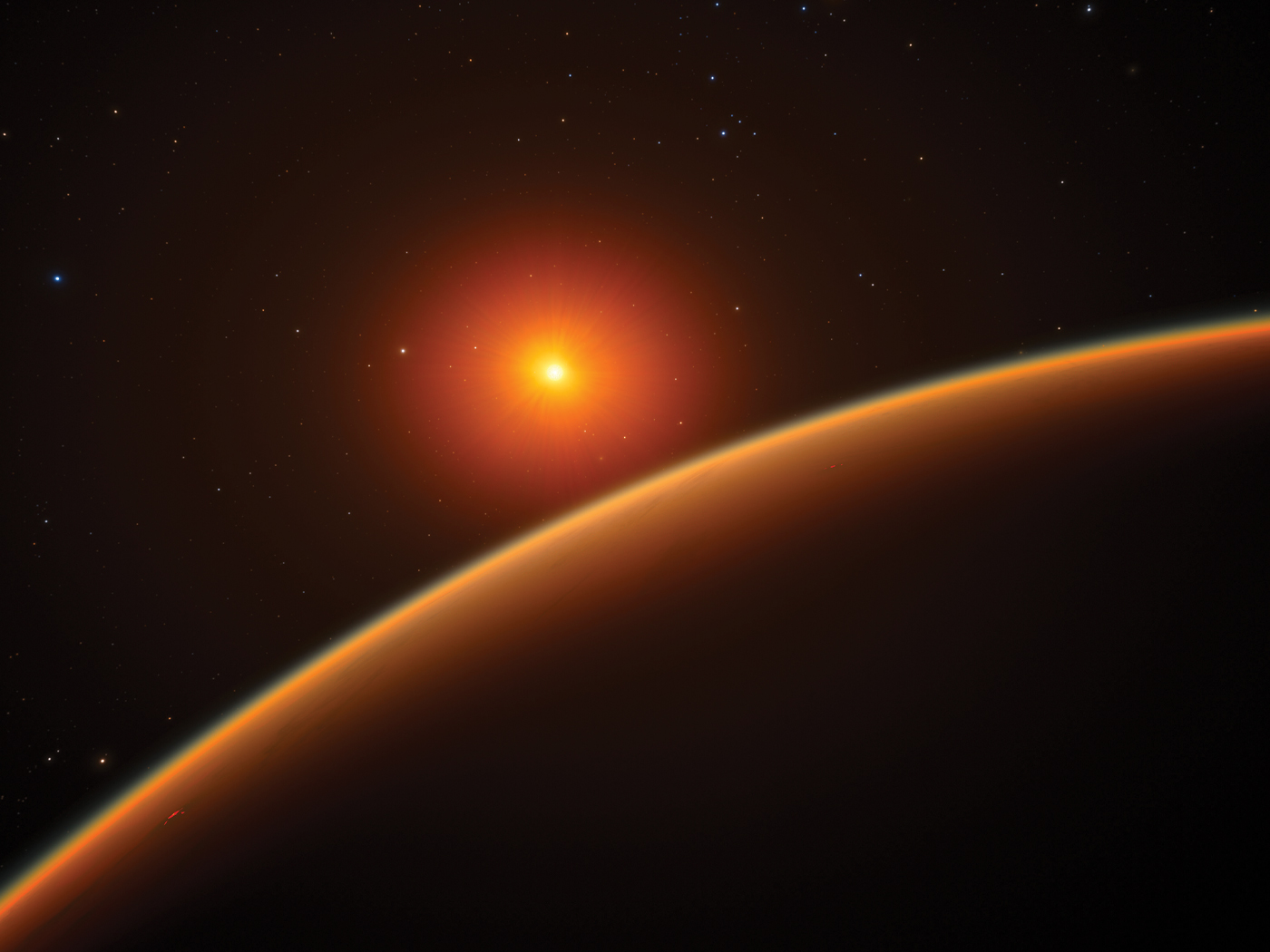
Planets, including the earth, generate magnetic fields that encompass the space around them. Observations have shown that, like earth's, the planet Mercury's magnetic field is rapidly breaking down, and NASA's Messenger spacecraft confirmed that again earlier this year.
If the planets in the solar system are billions of years old, why do these magnetic fields still exist?
In 1974 and 1975, the Mariner 10 spacecraft measured Mercury's magnetic field strength with its onboard magnetometer and sent the data to earth. The astronomers analyzing the data at the time found that the average magnetic moment was 4.8 x 10²² gauss cm3, which yields a field strength "about 1% that of the Earth."1
A decade later, creation physicist D. Russell Humphreys published a magnetic field model based on clues from the Bible. He reasoned that earth and the planets all shared a watery beginning, in accord with Genesis 1 and 2 Peter 3:5.2 He calculated what the magnetic field strength would have been at the creation by using a mass of aligned water molecules equal to the masses of each planet.
Then, he plotted the rate at which the magnetic fields would have diminished over the roughly 6,000 years since. Humphreys wrote, "Electrical resistance in a planet's core will decrease the electrical current causing the magnetic field, just as friction slows down a flywheel."3 The resulting model accurately predicted the magnetic field strengths of Uranus and Neptune, as well as the declining strength of Mercury's field.4
In 2008, Messenger flew past Mercury and captured a magnetic field measurement, and Humphreys compared it with the decaying slope generated by his creation model. Sure enough, Mercury's magnetic field strength had diminished since 1974, right in line with the predicted value of the creation magnetic field model.
If Mercury's magnetic field is supposed to have lasted for many millions of years, then it should be very stable over vast time periods. But as Messenger's data show, researchers can measure its decay within a person's lifetime.
Humphreys wrote, "My predicted 4% decrease in only 33 years would be very hard for evolutionary theories of planetary magnetic fields to explain, but a greater decrease would be even harder on the theories."3 He anticipated more accurate 2011 measurements, which Science published on September 30.
The Science authors wrote that the field strength for Mercury is "~27% lower in magnitude than the centered-dipole estimate implied by the polar Mariner 10 flyby."5 This confirms that Mercury's magnetic field is rapidly diminishing, which in turn confirms that the field must only be thousands of years old—just as the creation model predicts.
References
- Ness, N. F. 1979. The magnetic field of Mercury. Physics of the Earth and Planetary Interiors. 20 (2-4): 209-217.
- Humphreys, D. R. 1984. The Creation of Planetary Magnetic Fields. Creation Research Society Quarterly. 21 (3): 140-149.
- Humphreys, D. R. 2008. Mercury's magnetic field is young! Journal of Creation. 22 (3): 8-9.
- Humphreys, D. R. 1990. Beyond Neptune: Voyager II Supports Creation. Acts & Facts. 19 (5).
- Anderson, B. J. et al. 2011. The Global Magnetic Field of Mercury from MESSENGER Orbital Observations. Science. 333 (6051): 1859-1862.
Image credit: NASA
* Mr. Thomas is Science Writer at the Institute for Creation Research.
Article posted on October 26, 2011. Article updated October 30, 2011.