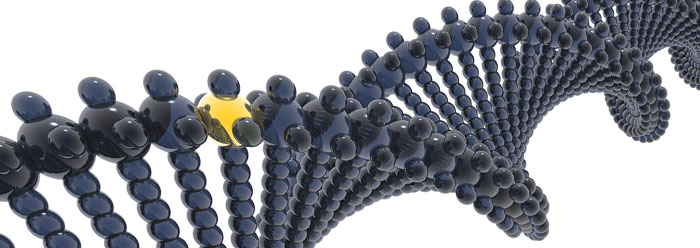
DNA is the famous molecule of heredity that carries the code of life—an altogether remarkable biopolymer (polynucleotide). As expected, the more research that is conducted on the DNA molecule, the more complexity it divulges.1
Decades ago, when less was known about this amazing molecule, the definition of the unit called the gene was fairly cut and dried. For example, in 1980 evolutionist David Kirk stated in his college biology text, “The units of heredity are invisible entities called genes, which specify the observable features of an organism.”2
Today, the gene is given molecular and nonmolecular labels: “In nonmolecular terms, a unit of inheritance that governs the character of a particular trait. In molecular terms, a segment of DNA containing the information for a single polypeptide or RNA molecule, including transcribed but non-coding regions.”3 Gerald Karp also stated, “Our concept of the gene has undergone a remarkable evolution as biologists have learned more and more about the nature of inheritance.”4
In his chapter on “the units of selection,” Mark Ridley wrote:
[American evolutionary biologist George C.] Williams defined the gene to make it almost true by definition that the gene is the unit of selection. He defined the gene as “that which segregates and recombines with appreciable frequency.”5
It’s hardly surprising, then, that someone has said, “What a gene is depends on who you ask.”
In the 21st century, the definition of a gene continues to become more convoluted, with the possibility that the word—like life—will remain a challenge to define (although a good description of “life” can be found on pages 11-15 of ICR’s Origin of Life science curriculum supplement). Confusion over what exactly a gene is has been added to by discoveries made through ongoing investigations into the genome (the total genetic material within a cell or individual).6
Take, for example, an amazing genetic discovery called “the Splicing Code” announced last year by computer scientists and molecular biologists.7 A news release at the time declared:
Researchers at the University of Toronto have discovered a fundamentally new view of how living cells use a limited number of genes to generate enormously complex organs such as the brain.8
This inner code has been painstakingly deciphered to the extent that molecular biologists can actually predict what happens during some phases of genetic regulation. The Human Genome Project revealed that man has but 20,000 genes that directly and indirectly regulate the system of our body,9 and the Splicing Code directs when and how the genes and regulatory elements are to be assembled by a communication network.
So far, scientists have found that 95 percent of our genome has this amazing alternative splicing. The complexity arises when required combinations (who knows how many) must be assembled and then expressed. Is it any wonder that in addition to computer scientists and molecular biologists, cracking this Splicing Code required other researchers proficient in vector calculus, code optimization, geometry, advanced algebra, probability theory, and information theory? This is the antithesis of the time and chance required by evolutionism (which was never mentioned in a related paper in Nature10).
Regardless of how the gene is defined, logic shows it to be a product of planning, purpose, and special creation. With each new discovery, the complicated reality of the genome more clearly reflects the genius of its Maker.
References
- Criswell, D. 2007. The Code of Life: Little Words, Big Message. Acts & Facts. 36 (3).
- Kirk, D. L. 1980. Biology Today. New York: Random House, 446.
- Karp, G. 2010. Cell and Molecular Biology. Hoboken, NJ: John Wiley & Sons, Inc., G-8.
- Ibid, 379.
- Ridley, M. 2004. Evolution. Malden, MA: Blackwell Publishing, 308.
- Thomas, B. Genomes Have Remarkable 3-D Organization. ICR News. Posted on icr.org November 15, 2010.
- Ledford, H. 2010. The code within the code. Nature. 465: 16-17.
- U of T researchers crack “splicing code,” solve a mystery underlying biological complexity. University of Toronto news release, May 5, 2010.
- Kunarso, G. et al. 2010. Transposable elements have rewired the core regulatory network of human embryonic stem cells. Nature Genetics. 42 (7): 631-634.
- Barash, Y. et al. 2010. Deciphering the splicing code. Nature. 465 (7294): 53-59.
* Mr. Sherwin is Research Associate, Senior Lecturer and Science Writer at the Institute for Creation Research.
Cite this article: Sherwin, F. 2011. So, What Is a Gene? Acts & Facts. 40 (10): 16.