In 1999, this author witnessed an unforgettable "air show" in which a dive-bombing maneuver resulted in the gruesome death of an unsuspecting victim who was in the wrong place at the wrong time. It was a bizarre event, yet that air-to-ground fatality, strangely enough, teaches an important lesson in apologetics.
Military Science: Air-to-Ground Offensive Technology
Imagine the military engineering and precision implementation that are required for a dive bomber attack, such as the bombing of German military buildings during World War II. Think about the many moving parts involved, and how easily something could go wrong.1
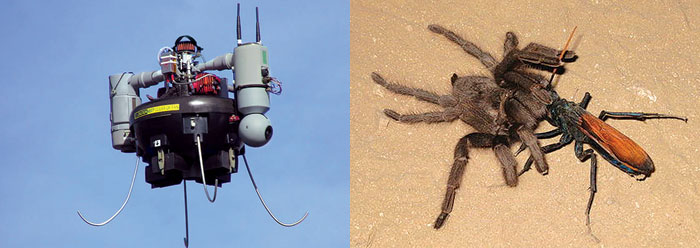
Or imagine the more recent computerized robotic technology used to send unmanned aircraft units into Iraqi combat zones to locate targets for subsequent air-to-ground destruction.2 One such unit is described below:
The UK has ordered Honeywell RQ-16A T-Hawk micro air vehicle (MAV) systems…becoming the first foreign military customer for the backpackable UAV [unmanned aircraft vehicle]. The T-Hawk is the first ducted-fan vertical take-off and landing air vehicle to enter production….After a successful evaluation in Iraq of the MAV in the anti-IED role, the US Navy in November placed a $65 million production contract for 90 Block 2 MAV systems, each comprising two T-Hawk air vehicles and a ruggedized laptop ground control system.3
The intelligence required to plan and implement such a craft staggers the mind.
Arthropod Science: Air-to-Ground Offensive Technology
Equally amazing is the "dive bombing" behavior of the tarantula hawk wasp (Pepsis formosa), an aerial arthropod that dives upon…and stabs…its victim, the tarantula Dugesiella echina. The arachnid’s death is a lingering one, allowing a parasitic consumption of the spider’s flesh for as long it remains alive. This prey-predator relationship illustrates what could be called "arachnid apologetics," displaying a bizarre example of God’s providential balancing of earth’s post-Eden ecology.
Yet even more bizarre are the details of how the venom-stung spider’s flesh is consumed. Two creation scientists reported observations of these tarantulas in their field study in the Chihuahuan Desert of Texas’ Big Bend National Park.
These large, hairy spiders are often employed by Hollywood in scenes to frighten an audience. The creatures do appear fearsome when one observes them. However, their bites are relatively harmless [sic] to man and they are not very aggressive. Often they are kept as pets and books have been written on how to take care of them.4
Although tarantulas are predators by nature, sometimes they themselves become the prey:
Tarantulas are carnivorous, generally preying upon smaller vertebrates and occasionally on small snakes, frogs, and birds. Catching their prey, they inject the victim with venom and suck the liquids from the body. Such an arthropod may appear to be invincible acting only as a predator, but not so. Likely, the Chihuahuan Desert tarantula’s deadliest enemy "…is a large orange and velvet blue wasp (Pepsis formosa) commonly known as the tarantula hawk….The ’hawk,’ using its venomous stinger, paralyzes its tarantula and buries it after laying an egg on the victim. When the wasp egg hatches, the young larvae feed on the paralyzed prey."…Thus the balance in nature, maintained by an all-wise Creator, often is seen in a prey-predator relationship.5
In other words, the tarantula victimized by the attacking wasp serves the larval wasp as "live meat." The doomed spider literally hosts the mother wasp’s "planted" child.
Tarantula "Selected" for Destruction
It was this kind of dive-bombing maneuver that I observed in the summer of 1999 beside my garage door. The tarantula hawk wasp stabbed the back of the tarantula, which struggled and shuddered, and then went limp. The mother wasp dragged the now-groggy tarantula for burial beneath a nearby bush, where the dying arachnid would "host" the implanted wasp larva until it was mature enough to emerge from the remains of the tarantula.
Some might interpret this event as "natural selection" in action, but if that were the case, who actually did the "selecting"? The physical environment "selected" nothing. The concrete pavement near my garage merely served as a color-contrasting background so that an airborne tarantula hawk wasp could easily spy the crawling, dark-colored tarantula. But the decision to dive-bomb and strike the tarantula…i.e., the choice to "select" the spider for destruction…was a decision made by the wasp, not the pavement.
As Dr. Randy Guliuzza has recently clarified, the phrase "natural selection" is a misleading oxymoron, because no one can empirically identify a mythical entity called "Nature" that somehow makes any intelligent choices as a "selector": "To legitimately use the word ’select,’ there must be a real ’selector.’"6
In this case, the death-dealing selector was not "Mother Nature," it was a pregnant wasp that chose to attack the tarantula.
And why? Because she was pre-programmed, as are all other arthropods, to "breed abundantly in the earth, and be fruitful, and multiply upon the earth" (Genesis 8:17).
The mother wasp is genetically and behaviorally programmed to locate and anesthetize a tarantula, and to carefully transfer her larval offspring to the arachnid’s body. Why does all of this work out the way it does in each life cycle of this particular kind of wasp? Because, before Adam’s fall in Eden, God cleverly and carefully planned out (consistent with His infinite foreknowledge) the innumerable details that would be needed, after Eden, to make this air-to-ground system operate successfully enough to propagate tarantula hawk wasp populations from one generation to the next.
The wasp did not invent herself, nor did she invent the "all-or-nothing" knowledge and skills needed to accomplish this life cycle. This wasp was purposefully engineered, as all such wasps are, with the necessary anatomy and instincts to feed her offspring in this manner so that they can survive and thrive in this cursed and "groaning" world (see Romans 8:20-22). Surely, the genius of God is exhibited in this bizarre form of predator-prey dynamics.
A Creationist Insight from the U.S. Army’s "Unmanned" Aircraft
Note the above references to the Army’s unmanned aircraft…specifically, the Honeywell RQ-16A T-Hawk micro air vehicle. The "T-Hawk" portion of that aircraft’s name is an abbreviation for "Tarantula Hawk"; i.e., this particular military surveillance robot was named for the tarantula hawk wasp. Thus, even the dazzlingly clever inventiveness of man (who was created in the Creator’s image and thus can be creative at a finite level) points directly, in this instance, to an insect that God Himself invented…the original female "T-Hawk."
More important, however, is the U.S. Army’s qualification in its official report on "unmanned aircraft systems" clarifying that these complicated and clever inventions are not really "unmanned":
Army UAS [Unmanned Aircraft Systems] are the "Eyes of the Army" and support information dominance by providing the capability to quickly collect, process, and disseminate relevant information to reduce the sensor-to-shooter timeline.…A UAS is comprised of an unmanned aircraft (UA), payload, human operator, control element, display, communication architecture, life cycle logistics, and the supported soldier. The idea that the UAS are "unmanned" is a misnomer because trained and professional Soldiers operate and maintain Army UAS.2
It is the highly intelligent and skilled soldier who ultimately operates and maintains each of the Army’s "unmanned aircraft systems"…including the Honeywell T-Hawk aircraft units named for the tarantula’s enemy, the tarantula hawk wasp.
Even more so, it is the infinitely intelligent and skillful Creator-God, who became mankind’s Redeemer as the Lord Jesus Christ (John 1:1-14), who ultimately operates and maintains each of this world’s tarantula hawk wasps. (Even wasps are not truly "unmanned.")
Amazingly, even arachnids’ air-to-ground attackers…mother tarantula hawk wasps…provide providential proof of the divine pre-programming "selections" that were intelligently planned and, during creation week, skillfully implemented by none other than the Lord of hosts.
References
- Breuer, W. B. 2005. A Horrendous Bombing Error Pays Off. Bizarre Tales from World War II. Hoboken, NJ: John Wiley & Sons, Inc., 90-91.
- U.S. Army Unmanned Aircraft Systems Center of Excellence (ATZQ-CDI-C). "Eyes of the Army": U.S. Army Roadmap for Unmanned Aircraft Systems 2010-2035 (U.S. Army, n.d.; 138 pages), 1. For this official report’s context, see the Roadmap’s Foreword by General Martin E. Dempsey.
- Warwick, G. UK Orders T-Hawk MAVs. Aviation Week. Posted on aviationweek.com January 12, 2009, accessed August 17, 2011.
- Williams, E. L. and R. L. Goette. 1997. Tarantula Goes Accourtin’ and He Does Roam: The Tarantula and the Tarantula Hawk Wasp Show the Creator’s Balance in Nature. Creation Research Society Quarterly. 34 (1): 3-4.
- Ibid, quoting Wauer, R. H. 1980. Naturalist’s Big Bend. College Station, TX: Texas A&M University Press, 106-107; and Davidson, R. H. 1991. Tarantula Hawk. Encyclopedia Americana. Granbury, CT: Grolier, 26: 292.
- Guliuzza, R. 2011. Darwin’s Sacred Imposter: How Natural Selection Is Given Credit for Design in Nature. Acts & Facts. 40 (7): 12-15, especially at 13-14.
* Dr. Johnson is Associate Professor of Apologetics and Chief Academic Officer at the Institute for Creation Research.
Cite this article: Johnson, J. J. S. 2011. Slow Death for a Tarantula: A Lesson in Arachnid Apologetics. Acts & Facts. 40 (10): 10-11.